
Working Backwards Amazon Summary for Real Estate Leaders
What Is the Working Backwards Amazon Summary for Real-Estate Leaders?
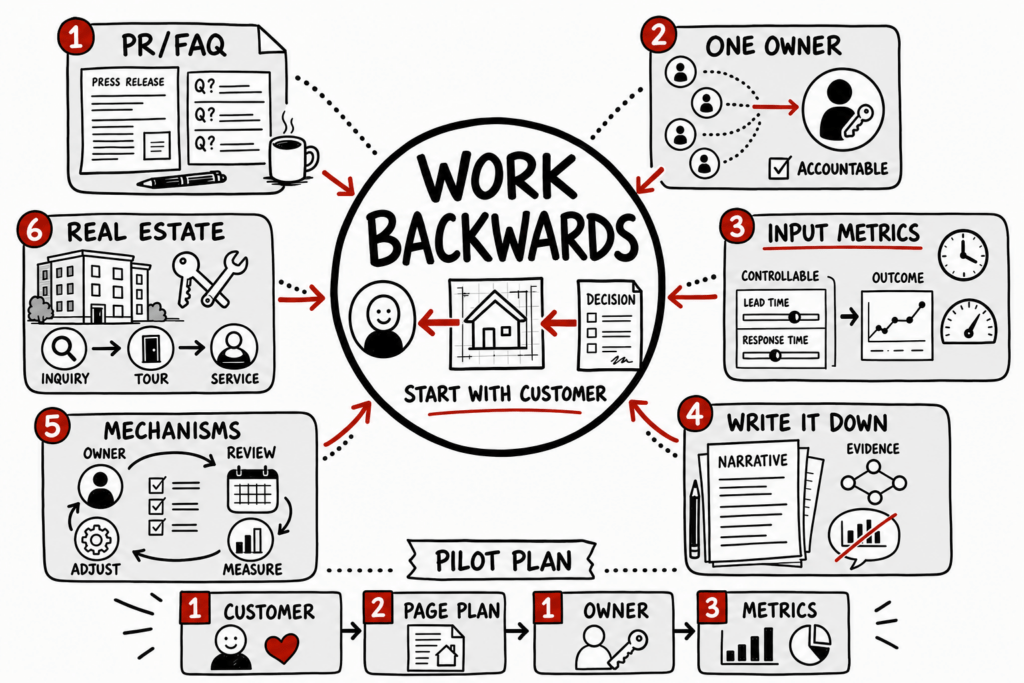
Working Backwards by Colin Bryar and Bill Carr describes an operating system for turning customer needs into clearer products, accountable teams, and repeatable decisions. Its named mechanism begins with a future-facing press release and FAQ, often called a PR/FAQ, that explains the customer, problem, proposed experience, benefits, risks, and unresolved questions before development starts. For real-estate leaders, the value is earning clarity before committing capital, headcount, or technology.
The book connects customer obsession with single-threaded leadership, written narratives, input metrics, structured hiring, and durable operating mechanisms. Smaller teams may need only a focused PR/FAQ pilot; larger teams can use the mechanisms to make fragmented journeys easier to own.
What Working Backwards Actually Is—and Is Not
The core idea is to start with the customer outcome and reverse-engineer the product, process, metrics, and organizational design required to deliver it. A mechanism is not an aspiration or one-time initiative; it has owners, inputs, inspection points, and corrective action.
The book also connects the approach to Amazon’s Leadership Principles, written narratives, hiring controls, and operating reviews. This is a leadership-systems briefing, not a growth-hacking formula or an instruction to copy Amazon vocabulary.
Core Idea
A proposed press release describes the finished customer experience in plain language. The FAQ pressure-tests demand, economics, dependencies, risks, trade-offs, and difficult executive questions. A multifamily operator might describe a resident maintenance experience before buying software: what changes for residents, how requests are acknowledged, who owns resolution, and what service level is credible.
Leaders should separate controllable inputs from outcomes. Response time, listing completeness, qualified-tour conversion, inspection cycle time, and follow-up compliance can be managed directly; revenue, renewals, or occupancy are downstream results that still need context.
Best Takeaways
1. The Amazon PR/FAQ Process Exposes Weak Thinking Early
Slides can conceal missing logic behind design and shorthand. A written PR/FAQ makes ambiguity visible. If a team cannot explain the customer benefit without internal jargon, or cannot address adoption, cost, implementation, and failure scenarios, the initiative needs more work before approval.
2. Single-Threaded Ownership Beats Shared Accountability
Single-threaded leadership gives an important initiative one integrating owner. That person does not complete every task; they coordinate dependencies, resolve trade-offs, and report performance. The approach can reduce product, operations, training, and market teams blaming one another.
3. Written Narratives Improve Decision Quality
A narrative connects context, evidence, assumptions, alternatives, and implications. The lesson is not that every memo must be six pages. Consequential decisions deserve coherent written logic before the meeting begins.
4. Mechanisms Scale Better Than Founder Intervention
Founders can rescue deals and settle disputes for only so long. Review cadences, metric definitions, decision rights, and hiring standards transfer judgment into the organization and make exceptions visible.
Why It Maps to Real Estate and Prop-Tech
Real estate contains fragmented journeys and handoffs. A buyer moves among portals, agents, lenders, inspectors, and closing teams; a resident moves among leasing, payments, maintenance, amenities, and renewal. Each function can hit its local target while the customer experiences a poor journey.
Before launching automated leasing, entering a market, or adding an owner dashboard, define the user, painful moment, promise, adoption barrier, operating owner, and input measure. A useful pilot might test response time and no-show rate together, rather than treating feature count as progress.
Where It Falls Short
Amazon had unusual scale, data access, talent density, and investment horizons. A constrained startup cannot give every priority a dedicated leader or make every experiment document-heavy. The main danger is ceremonial adoption: long memos, banned slides, or copied language without better customer decisions. Keep the mechanism only when it earns its overhead.
How to Apply It
- Choose one consequential customer decision, such as a market launch, resident workflow, agent tool, or operating change.
- Name one customer instead of combining residents, owners, agents, and employees into one imagined user.
- Draft a short PR/FAQ with the problem, benefit, experience, objections, economics, dependencies, and failure cases.
- Assign one accountable owner with authority to coordinate product, operations, finance, and field execution.
- Select two input measures and one output measure and review them weekly for four weeks.
- Record what changed in assumptions, decisions, ownership, and customer evidence.
The Working Backwards site provides additional context. Use the book as a menu of mechanisms, then adapt the pilot to the team’s size, controls, and customer obligations.
Who Should Read It?
Founders moving beyond informal coordination, executives managing multi-market operations, product leaders facing cross-functional friction, and functional heads building repeatable systems should read the full book. Solo operators and very early teams may start with the PR/FAQ, input-metric, and ownership concepts before adopting more process.