
Build Tony Fadell Summary: Product Lessons for Real-estate Tech
What Is the Build Tony Fadell Summary for Product Leaders?
Build by Tony Fadell is a mentorship-style guide to product judgment, hiring, leadership, communication, and the work required to turn a promising idea into a dependable experience. Its practical question for a real-estate technology team is simple: what painful customer problem is being removed, and what evidence will show that the change matters? The book is useful for deciding what to build and how to lead the work; it is not a real-estate forecast or a technical implementation manual.
Core Idea: Make Something Worth Making
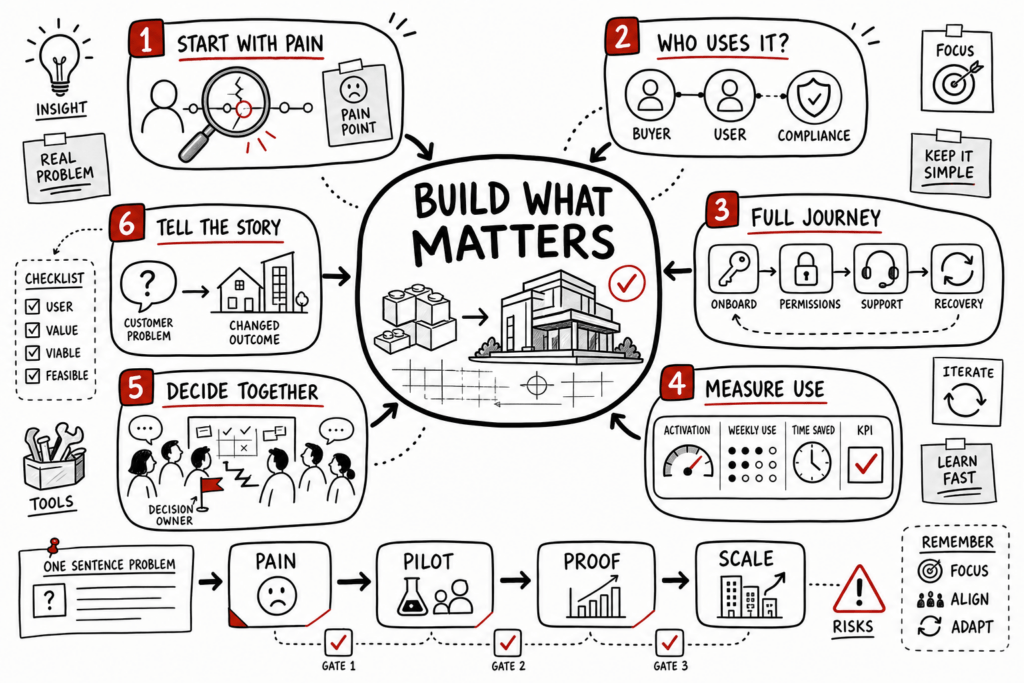
Durable products begin with a problem people genuinely care about. Design, technology, and brand cannot rescue weak demand. In real estate, the economic buyer, daily user, compliance stakeholder, and person carrying implementation work may all be different. Product discovery should name those roles before a team treats enthusiasm for a demo as evidence of need.
Build reads less like a conventional corporate memoir than a set of direct operating conversations. That modular structure makes it useful when a specific product, hiring, or leadership problem appears.
Build Tony Fadell Review: What Works for Operators
The book’s strength is its density of practical judgment. Fadell addresses customer pain, product quality, productive disagreement, standards, and the transition from invention to scale without hiding behind innovation language. Some advice comes from consumer hardware, so its transfer to regulated, relationship-driven real estate requires judgment.
The official Tony Fadell site and HarperCollins provide publisher and author context. The review’s value comes from the questions the book helps a team ask, not from celebrity proximity.
Best Takeaways for Real-Estate Technology
1. Start With Pain, Not Available Technology
A brokerage does not need an AI feature because competitors are announcing one. It may need faster listing preparation, cleaner CRM data, better lead routing, or fewer compliance handoffs. Interview users about the last time the problem occurred and what it cost, rather than asking whether they hypothetically like an idea.
2. Treat the Whole Experience as the Product
A technically sound platform can fail through difficult onboarding, unreliable data, unclear permissions, weak support, or poor exception handling. Product quality includes implementation, migration, training, security review, reporting, and recovery when the normal path breaks.
3. Combine Data With Product Judgment
Define pilot measures before launch: activation, weekly use, cycle time, support requests, data completion, or hours saved. Pair those measures with interviews and observed behavior. A high login rate says little if users return to spreadsheets for the critical task.
4. Use Conflict to Improve the Work
Product, sales, engineering, operations, legal, and compliance see different risks. Make disagreement safe while keeping decisions accountable. The goal is a better decision followed by coordinated execution, not consensus at any cost.
5. Storytelling Is an Operating Tool
A product narrative should explain who has the problem, why current behavior is inadequate, what changes, and how success will be measured. If the value proposition requires a long feature tour, the positioning probably needs more work.
Build Tony Fadell for Leaders and Innovation Leads
Use the book as a decision aid in a product review. Ask what customer pain is being removed, what evidence says it is important, and what must be true for the release to earn repeat use. Before challenging a legacy workflow, identify why it persists; regulation, fragmented data, incentives, risk allocation, or trust may matter more than resistance to change.
Where It Falls Short
Advice developed in prominent consumer-product environments does not map neatly to every brokerage, fund platform, or enterprise workflow. Procurement cycles are slower, local practices vary, and the person benefiting from a product may not control the budget. The book offers heuristics, not a complete governance, pricing, compliance, or adoption system. Readers wanting underwriting, market analysis, or coding instruction should use a different reference.
How to Apply It in the Next Quarter
- Write the problem in one sentence. Name the user, recurring friction, and business consequence.
- Set three pilot gates: one adoption measure, one operating measure, and one customer-quality measure.
- Audit the full journey, including onboarding, permissions, training, support, reporting, and failure recovery.
- Assign a decision owner. Invite cross-functional challenge, then document who decides and why.
- Rewrite the product story around the customer’s changed outcome rather than the technology stack.
Run the selected pilot for a defined quarter and revisit the principles during roadmap reviews. Treat the result as evidence for the next decision, not as a guaranteed conversion, revenue, or adoption outcome.
Who Should Read It?
Build fits product-minded PropTech founders, brokerage innovation leaders, fund-platform executives, and operators correcting a weak pilot or preparing to scale. Read selectively if product work is already familiar. Skip it when the immediate need is code, property-market forecasting, or an enterprise sales playbook.
The Final Briefing
Build connects product taste with operational responsibility. Its recurring message is that ambition needs empathy, craft, honest feedback, and persistence. Extract three to five principles for the next quarter, then test whether they sharpen customer understanding and cross-functional decisions.