
Scaling Up Verne Harnish Summary: Review for Real Estate Leaders
What Is the Scaling Up Verne Harnish Summary for Real-Estate Leaders?
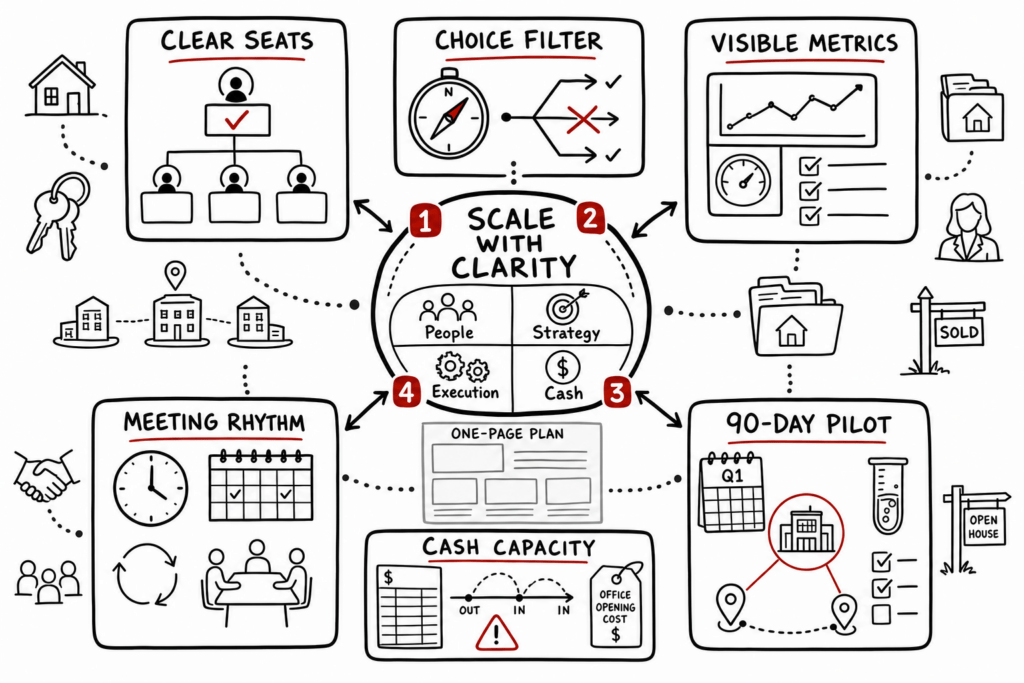
Scaling Up by Verne Harnish is a management manual for organizations whose growth has outpaced informal communication. Its central lens is four connected decisions: People, Strategy, Execution, and Cash. For a brokerage or regional real-estate operator, those decisions translate into accountable seats, a small set of strategic choices, dependable operating rhythms, and enough cash capacity to absorb the next move. The book is a reference for leaders managing complexity, not a promise that every company should expand.
The most useful question is not whether a team can add another office, producer, or service line. It is whether the organization can support that choice without weakening standards, client care, compliance, or financial resilience. Scaling Up earns its place when that question has become operationally urgent.
Quick Verdict: Is Scaling Up Worth Reading?
Yes, when a business has outgrown founder-led decisions, inconsistent meetings, unclear ownership, or reactive cash planning. The book is dense and worksheet-heavy, so it works better as a team reference than as a one-sitting read. Choose one operating problem and test the relevant tool for a defined period; installing every checklist at once can create administrative weight without better decisions.
Publication Context and the Rockefeller Habits Lineage
Scaling Up develops the Rockefeller Habits tradition into a broader operating system for companies moving beyond improvisation. Its enduring value is shared language for priorities, accountability, performance, and cash. The Entrepreneurs’ Organization is useful context for the peer-learning tradition around growth-minded operators, while the book itself remains the source for the framework reviewed here.
Core Idea: The Scaling Up Four Decisions Framework
The four decisions are familiar categories. Their practical value comes from examining them together, because a recruiting decision changes cash, a strategy choice changes execution, and an execution gap can expose a people problem.
People
Growth requires capable people in clearly defined seats. In a brokerage, the question is whether decisions that belong to operations, recruiting, marketing, finance, or office leadership are still trapped with a rainmaker or founder. A role scorecard should describe the work, authority, evidence of progress, and support available. It should also respect employment agreements, licensing rules, and independent-contractor boundaries where those apply.
Strategy
The strategy work asks leaders to identify the core customer, make differentiation concrete, and turn choices into a living one-page plan. A regional brokerage cannot pursue luxury expansion, first-time buyers, agent count, geographic growth, and margin improvement with equal priority unless it states which objective governs the next period and what it will decline.
Execution
Execution is limited priorities, visible measures, meeting discipline, and follow-through. The lesson is not to hold more meetings. It is to create shorter conversations with known metrics, named owners, decisions, and dates. A weekly leadership rhythm can be enough to begin; add other cadences only when a real operating need appears.
Cash
Revenue growth does not automatically create financial resilience. Onboarding, marketing, management hires, office commitments, and technology contracts consume cash before their return is dependable. Model timing, downside cases, and the point at which investment slows. That discipline is especially important when transaction volume is uneven or a new market requires local support.
Best Takeaways from Scaling Up
- Accountability should be singular. Shared support is healthy; shared ownership often leaves a critical outcome unattended.
- Strategy should guide refusal. A credible plan identifies markets, customers, services, and opportunities the firm will not pursue in this period.
- Leading indicators beat delayed explanations. Appointments held, listings taken, agent activation, response time, and conversion can reveal trouble before closings do.
- Meeting rhythm is infrastructure. Predictable communication keeps offices aligned and reduces emergency interruption.
- Growth consumes leadership bandwidth. A financially attractive market can still exceed the organization’s coaching, compliance, recruiting, or management capacity.
- Cash deserves equal status with growth ambition. Include timing assumptions and a downside case before committing resources.
The Scaling Up platform can provide additional framework context, but a brokerage should test each tool against its own economics and responsibilities.
Who Should Read It
Scaling Up fits brokerage owners, regional presidents, operations leaders, and leadership teams managing multiple offices or rapid headcount growth. It is less suited to a solo agent seeking sales tactics, a new team without stable economics, or a leader looking for a lightweight introduction to management habits. This is a book about organizational scaling, not personal productivity.
Where It Falls Short
The main weakness is density. A team can mistake scorecards, plans, and checklists for improvement and create a second layer of administration. The framework is also industry-neutral. Commission-driven cultures, independent-contractor relationships, transaction cycles, local volatility, and rainmaker influence require translation. It helps leaders ask better questions; it does not remove market judgment, financial modeling, or difficult personnel decisions.
How to Apply It in a Real-Estate Brokerage
- Diagnose before installing. Use the available checklist to identify the one or two constraints causing the most friction.
- Clarify seats and processes. Name accountable owners for recruiting, onboarding, lead generation, compliance, marketing, office performance, and reporting.
- Build a one-page plan. Define the core customer, brand promise, annual objective, and next-quarter priorities.
- Choose a small scorecard. Track five to eight useful measures, mixing leading and lagging indicators.
- Install one meeting rhythm. Start with a disciplined weekly leadership meeting and add cadence only when evidence supports it.
- Stress-test cash and capacity. Model onboarding cost, management time, marketing commitments, transaction timing, and the downside case.
A useful pilot may run for 90 days in one office or region. Review whether decisions became faster, ownership clearer, and priority completion more reliable. If the system adds paperwork without clarity, simplify it before expanding the toolkit.
Scaling Up Key Takeaways and Final Recommendation
The durable lessons are disciplined rather than glamorous: put capable people in accountable seats, make strategic choices explicit, execute through visible priorities, and protect cash while growth absorbs resources. The framework works when it sharpens decisions and fails when it becomes paperwork. For an established real-estate operator at an expansion inflection point, use it selectively, review it quarterly, and keep only the habits that improve operating clarity.