
High Growth Handbook Summary and Review: a Practical Scaling Playbook
What Is the High Growth Handbook Summary for Scaling Leaders?
Elad Gil’s High Growth Handbook examines the management stage after early traction, when informal habits stop working but mature-company bureaucracy would slow the organization. For brokerage owners and real-estate team leaders, the useful question is how to clarify roles, build managers, and install repeatable operating systems without copying a technology company’s assumptions.
The book is a reference for organizational decisions, not a promise that a particular structure will produce growth. Read it when a dependable revenue engine is creating headcount, management, or founder-dependency problems.
What High Growth Handbook Is and Who It’s For
High Growth Handbook is not a motivational startup story or a tidy sequence of steps. Gil writes from the perspective of an operator, investor, and adviser who has watched companies hire executives, add management layers, formalize culture, and coordinate larger teams.
The interview-driven structure works better as a reference than as a cover-to-cover narrative. Readers can go directly to the problem in front of them: recruiting, compensation, board management, organization, international expansion, or the founder’s changing role. The Stripe Press catalog and Elad Gil’s writing provide additional context.
Core Idea: Growth Requires a Different Operating System
The practices that create early momentum are rarely the same practices that sustain a larger organization. Founder intuition, broad job descriptions, informal communication, and heroic effort can work when everyone fits around one table. As headcount and market coverage expand, those habits create role confusion, inconsistent decisions, process debt, and dependency on a few people.
Gil’s scaling playbook is therefore about organizational redesign: clarify decision rights, recruit specialists, develop managers, install communication rhythms, and make culture explicit enough to guide behavior when the founder is absent. For a brokerage, service-market fit means lead generation, agent performance, transaction delivery, and client experience can be repeated without constant executive intervention.
Best Takeaways: High Growth Handbook Key Takeaways
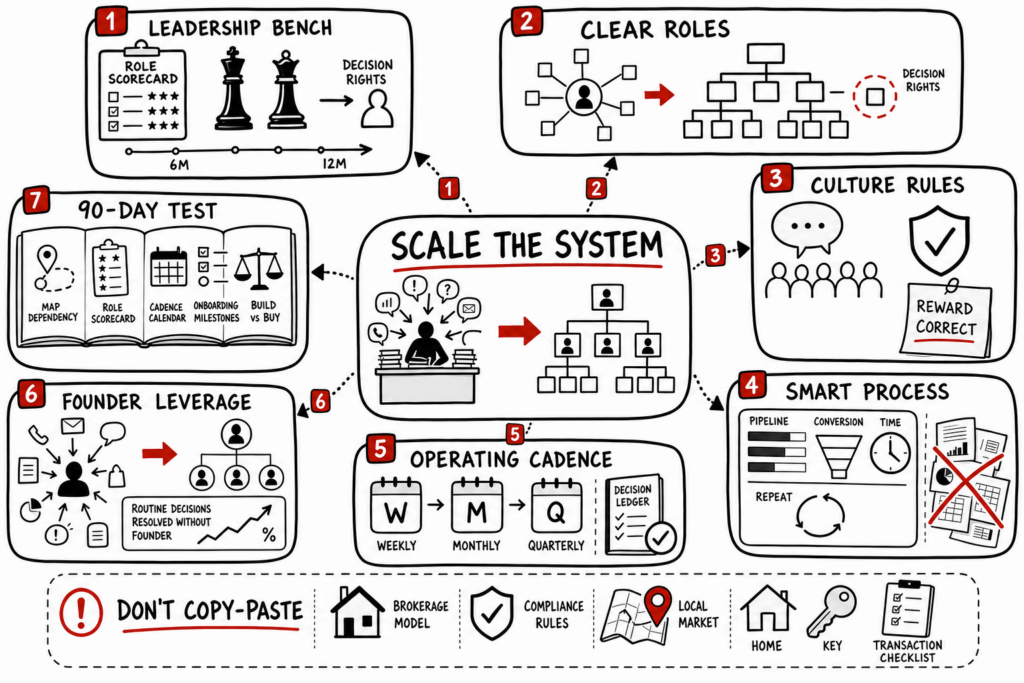
1. Build the leadership bench before the founder becomes the constraint
Define what a leader must own, which decisions move into the role, and what should be visible during the first six to twelve months. “Hire a sales leader” is too vague; a scorecard might assign agent ramp, appointment-to-client conversion, forecast quality, recruiting yield, and producer retention, with definitions that fit the team.
2. Treat culture as operating infrastructure
Culture is the behavior that receives rewards, tolerance, or correction. Translate expectations into hiring criteria, management habits, communication norms, and promotion decisions. A top producer who damages handoffs, morale, or compliance can generate revenue while weakening the system.
3. Add process where failure becomes expensive
The book does not argue for bureaucracy everywhere. It argues for deliberate structure around recurring, consequential work such as recruiting, onboarding, compensation, forecasting, and executive communication. A weekly pipeline review should expose conversion gaps and ownership issues, not become an hour of repeating CRM data.
4. Use external stakeholders strategically
Boards, investors, and advisers can be force multipliers rather than ceremonial overseers. A privately held real-estate organization may use an advisory group to challenge assumptions, identify talent, and bring pattern recognition from adjacent industries. It works only when leaders share useful data and ask specific questions.
Where It Falls Short
The technology-company lens has limits. Venture-backed software businesses can pursue market share, use equity upside, and tolerate operating losses in ways most brokerages cannot. Real-estate organizations face licensing, local-market variation, independent-contractor dynamics, commission pressure, and relationship-driven delivery.
Some advice also assumes access to elite executive candidates, investors, and networks. A regional brokerage may need to develop leaders internally, and compensation must reflect cash flow, classification, local norms, and compliance rather than Silicon Valley precedent. The modular interviews offer decision frameworks, not a turnkey organization chart.
How to Apply It to Real Estate Team Scaling
Start with the bottleneck, not the entire book. Choose one area where growth is producing friction and translate the relevant idea into a time-bounded operating experiment.
- Map founder dependency: track recurring decisions that reach the owner, group them by function, and delegate one category with written boundaries.
- Create role scorecards: define three to five measurable outcomes for team leads and support leaders, with evidence owners.
- Install a management cadence: separate weekly pipeline reviews from monthly business reviews and quarterly talent discussions; give each a purpose and decision record.
- Strengthen onboarding: set 30-, 60-, and 90-day milestones and measure the signals that actually matter to the role.
- Evaluate build versus buy: compare cost, control, speed, quality, and compliance exposure before deciding whether coordination, marketing, or technology belongs inside or outside the firm.
These lessons require current employment guidance, brokerage rules, compensation realities, and local-market knowledge. Translation is required; blind imitation is not.
Who Should Read It?
Read High Growth Handbook if a repeatable revenue engine now faces headcount growth, management gaps, inconsistent execution, or excessive founder dependency. It is less urgent for a solopreneur or a new team still proving demand.
The best reading strategy is modular: use the table of contents as a diagnostic menu, read the section tied to the immediate constraint, and convert one idea into a measurable operating experiment.