
The Fund Rob Copeland Summary: Radical Transparency Reviewed
What Is The Fund by Rob Copeland About?
Rob Copeland’s The Fund examines Bridgewater Associates, radical transparency, ratings, recordings, and the tension between an idea meritocracy and founder authority. Its value for a scaling leader is as a case study in how a management philosophy can become an operating system with real effects on power, safety, feedback, and succession.
This is a review of a reported culture, not a neutral audit of causation or a plug-and-play management manual. Read the book alongside primary material and external reporting, then test the lessons against your own decision rights and appeal paths.
Core Idea: What The Fund Is Really About
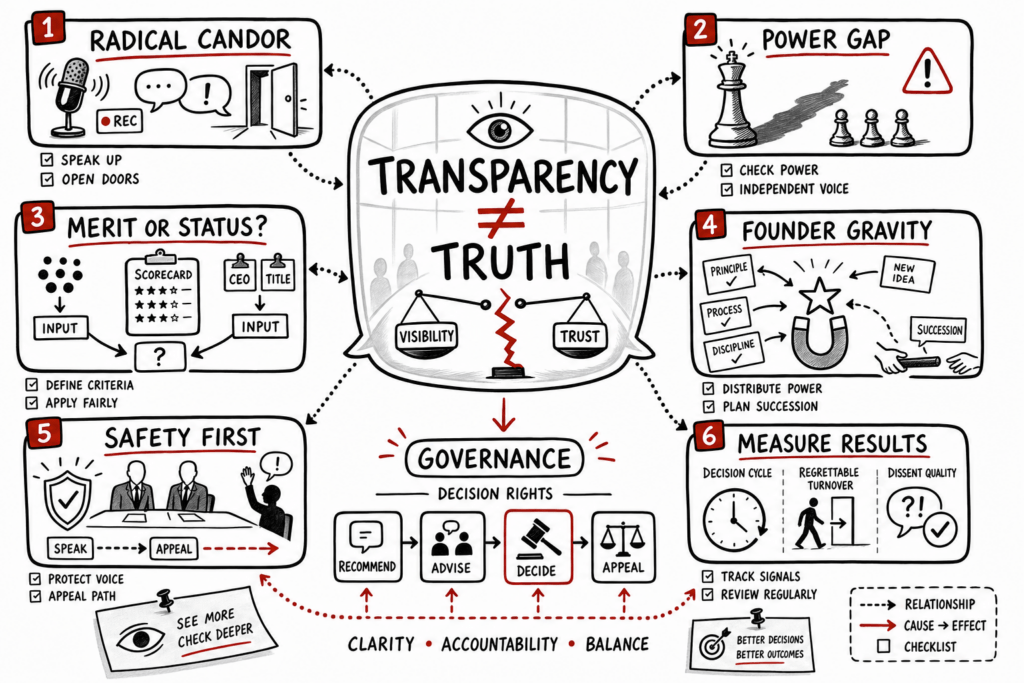
The Fund is less a hedge-fund story than an investigation of an operating system. The central tension is straightforward: a company can declare that the best idea wins while still operating under hierarchy, loyalty, and founder gravity.
Readers can compare the reported account with Bridgewater’s principles. The comparison is useful when it separates stated design from lived experience without pretending either account is complete.
Best Takeaways from The Fund
1. Transparency Is an Amplifier, Not an Automatic Virtue
Recordings, public feedback, and scorecards can expose weak reasoning. They can also magnify status differences and make employees perform agreement. Governance determines whether visibility produces better decisions or more control.
2. Idea Meritocracy Can Quietly Become Credentialed Hierarchy
Giving more weight to demonstrated expertise can be sensible, but the organization may control both the scoring system and the definition of credibility. Review major decisions with names and titles removed when practical; a material difference can reveal status effects.
3. Founder Strength Can Become Succession Risk
Codifying a founder’s instincts helps until every difficult judgment still requires the founder’s approval. A growing firm needs independent authority, clear principles, and an appeal path that can operate without one person interpreting every exception.
What the Bridgewater Culture Teaches Scaling Firms
Process density is not operating discipline. A firm can collect extensive employee data while remaining unclear about decision rights, appeals, and behaviors that remain unacceptable regardless of performance. High candor works best when feedback concerns observable behavior and employees have a credible independent voice.
For a real-estate operator, test whether feedback improves decision quality, cycle time, and psychological safety rather than simply increasing documentation.
Where It Falls Short
Copeland constructs an investigative counter-narrative rather than a controlled assessment of whether Bridgewater’s methods caused specific business outcomes. The book is also not an investment-strategy guide. Its strongest territory is power, culture, succession, and the gap between a system’s claims and its consequences.
The New York Times business section is a broader external reference for readers who want to separate organizational lessons from the mythology surrounding a single firm.
How to Apply It Without Copying Bridgewater
- Audit challenge safety: ask anonymously whether people can disagree with a senior leader without career damage.
- Define decision rights: identify the recommender, final decision-maker, advisers, and appeal path.
- Review feedback tools: determine whether recordings, ratings, or scorecards improve decisions or only increase anxiety.
- Track useful signals: monitor decision cycle time, regrettable turnover, and major decisions reopened after missed dissent.
- Stress-test succession: run one planning cycle without the founder acting as the final interpreter of values.
Who Should Read It?
The Fund fits CEOs, COOs, founders, investment committee members, HR leaders, and operating partners building governance in fast-growing organizations. Its best use is a leadership discussion: compare one official principle with one reported risk, then identify where the firm may have the same gap.