
Broken Money Summary: Review for Wealth Advisors & Real Estate Leaders
What Is the Broken Money Summary for Wealth Advisors and Real Estate Leaders?
Lyn Alden’s Broken Money examines money as a system for storing value, communicating prices, and settling transactions. For a wealth advisor or real-estate leader, the useful question is how monetary structure changes the assumptions underneath leverage, liquidity, custody, and long-duration decisions.
This is a book review, not a rate forecast or investment recommendation. The book is most useful as a framework for asking which parts of a balance sheet depend on stable purchasing power, reliable settlement, or continued access to credit.
Core Idea: Money Is a Technology, Not a Fixed Institution
Alden compares different monetary arrangements by the jobs they perform and the trade-offs they create. Commodity forms may be difficult to move, bank-ledger money depends on intermediaries, and fiat-and-credit systems support flexible economies while creating their own debt and purchasing-power risks.
The systems view is the book’s strongest contribution. It encourages readers to examine fiscal pressure, banking structure, energy, technology, and the distribution of newly created money together rather than treating inflation as one isolated variable.
Author Credibility and Framing
Alden writes as a macroeconomic researcher and investor with an emphasis on liquidity, debt, fiscal conditions, energy, and scarce assets. Readers can review the author’s official Broken Money overview. The book’s value is regime recognition and balance-sheet questioning, not exact timing.
Best Takeaways
1. Separate Nominal Wealth From Purchasing Power
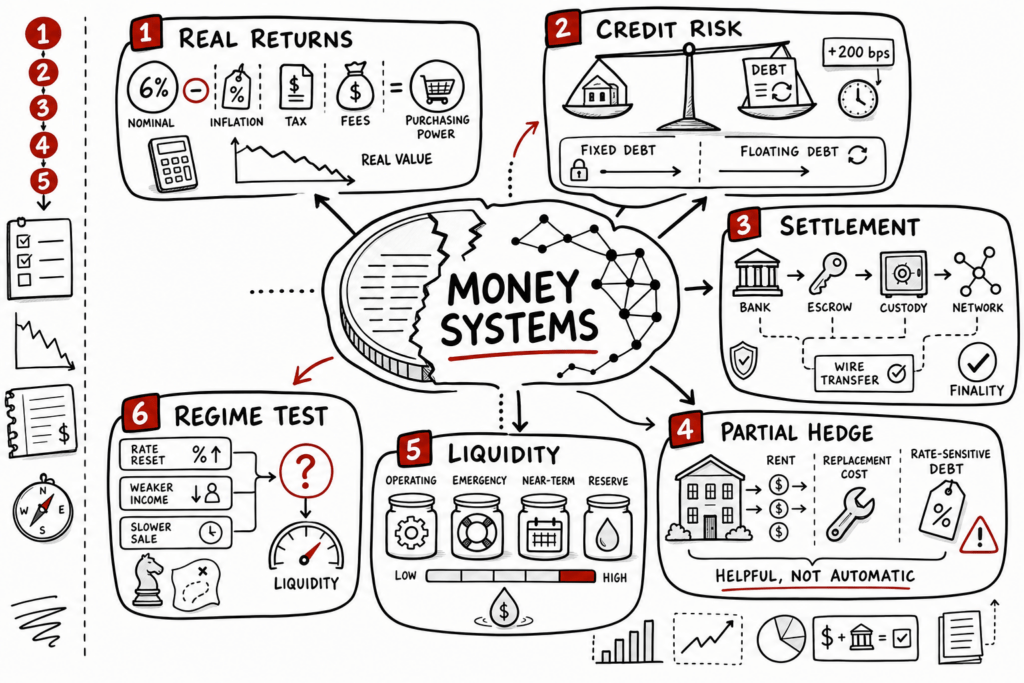
A higher account balance is not automatically greater capacity. Examine what capital can buy after inflation, taxes, financing, maintenance, and fees. For property, look beyond headline appreciation to income, replacement cost, debt service, and exit liquidity.
2. Match Leverage to the Durability of Cash Flow
Debt should be tested against the durability and timing of the cash flow supporting it. Model a rate reset, weaker income, delayed sale, or refinancing constraint rather than assuming a favorable regime persists. The question is whether the borrower has enough time and liquidity for the downside.
3. Treat Settlement and Custody as Strategic Risks
Ask who verifies the transaction, where value is held, how a failure is handled, and which controls protect a high-value transfer. The Bank for International Settlements’ payment-system guidance provides institutional context; each transaction still needs its own bank, escrow, custodian, and wire controls.
4. Real Estate Is a Partial Hedge, Not Automatic Protection
Scarcity, replacement cost, and repricing can help a property preserve value under some conditions. Location, taxes, insurance, regulation, vacancy, financing, and forced-sale risk can overwhelm that benefit. No asset category is an automatic protection.
Broken Money Leadership Lessons
Strong leaders translate monetary complexity without theatrical certainty. Separate what is known, what is probable, and what remains unknowable. A client conversation is more useful when it names exposures, trade-offs, contingency plans, and the professional advice still required.
Where It Falls Short
The historical sweep is valuable, but some readers may find it repetitive or too focused on emerging monetary networks for conventional portfolio work. Understanding currency debasement does not reveal the timing of inflation, rate cuts, recessions, or asset corrections. Diversification, scenario analysis, liquidity reserves, and local conditions still matter.
How to Apply It
- Recalculate real returns: compare expected returns with inflation, taxes, fees, financing, and operating costs.
- Run a debt reset scenario: test higher rates, slower sale, and weaker income.
- Segment cash by purpose: separate operating funds, emergency liquidity, near-term commitments, and longer-term reserves.
- Map settlement dependencies: document banks, custodians, escrow providers, wire procedures, and cross-border constraints.
- Upgrade client messaging: match assets, liabilities, time horizons, and liquidity instead of presenting a perfect hedge.
Who Should Read It?
Broken Money fits readers who allocate capital across cycles, advise affluent families, finance development, or manage long holding periods. It is less useful for anyone seeking next quarter’s rate outlook or a trading signal. Its durable value is better questioning about leverage, liquidity, purchasing power, and institutional risk.