
Loonshots Safi Bahcall Summary for Real-estate Leaders
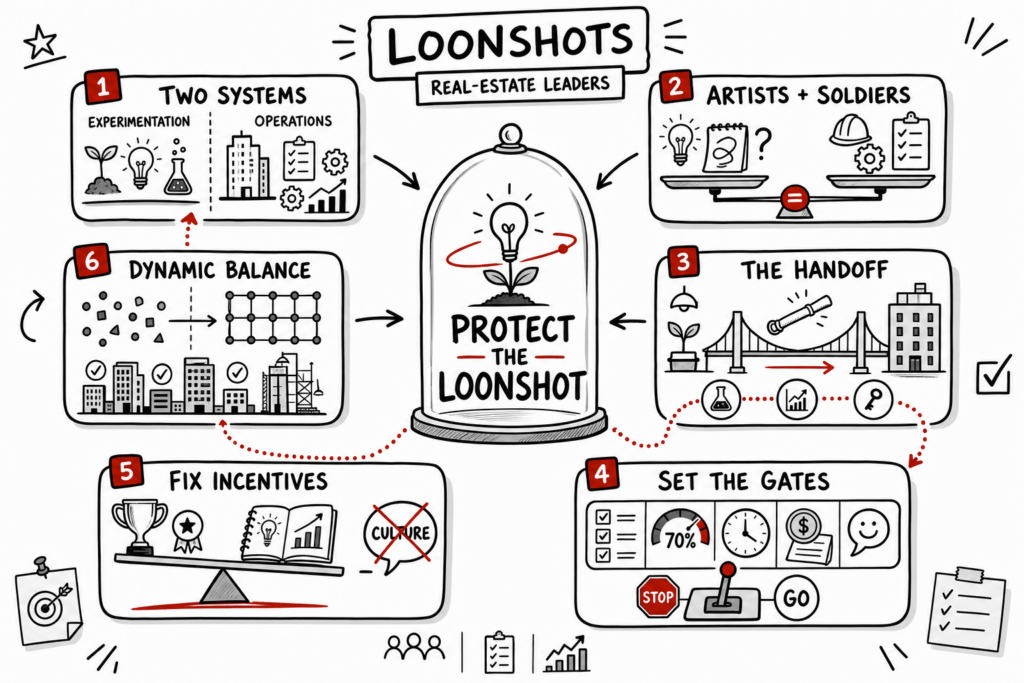
What Is the Loonshots Safi Bahcall Summary for Real-Estate Leaders?
Safi Bahcall’s Loonshots asks leaders to protect fragile ideas while keeping dependable operations reliable. A loonshot is an uncertain idea that needs patient testing; a franchise is a proven product, service, or operating model that needs disciplined execution. The distinction is useful for real-estate leaders because experiments and core controls should not be managed by identical measures.
The book is a leadership review rather than a property implementation manual. Its practical question is how an organization can protect discovery, test evidence, and transfer a validated idea without exposing the operating business to unbounded risk.
Core Idea: Loonshots vs Franchises
Uncertain ideas need room to learn and permission to fail intelligently. Proven operations need reliability, accountability, and scale. Applying franchise standards too early can kill an experiment; applying loonshot freedom to a regulated or high-value transaction can create avoidable risk.
Bahcall also describes how incentives, team structure, hierarchy, and internal politics can change behavior abruptly. The lesson is structural: inspect the conditions that reward or punish experimentation instead of relying on an innovation slogan.
Best Takeaways from Loonshots
1. Protect Artists and Soldiers Without Ranking Them
The book’s Artists and Soldiers distinction describes different work, not different human worth. One group explores fragile possibilities; the other turns validated ideas into dependable systems. A healthy organization respects both and makes room for each group to challenge the other’s assumptions.
2. Manage the Transfer, Not Just the Idea
Many organizations can generate ideas; fewer can transfer them into operations. Name the handoff owner, define the evidence required, involve operators early enough to expose integration and service risks, and keep the experiment separate enough to learn. The transfer decision should follow agreed evidence rather than enthusiasm alone.
3. Change Incentives Before Giving a Culture Speech
If promotion rewards only current revenue, capable leaders may avoid experiments that could fail publicly. If innovation teams have no delivery expectations, activity can be mistaken for progress. Review what the system actually rewards: learning, risk avoidance, handoff quality, or short-term influence.
4. Maintain Dynamic Equilibrium
Senior leaders need not become the chief inventors. They do need to protect fragile work, demand honest evidence, and prevent either experimentation or execution from dominating the other. Bahcall’s Loonshots resources offer the specific author context; Harvard Business Review’s innovation coverage provides a broader comparison point.
Where It Falls Short
The book is stronger on diagnosis and memorable patterns than on a finished implementation. Leaders still need to design governance, investment gates, staffing, and termination criteria. The physics analogy is illuminating, not literal: organizations contain power, emotion, regulation, and uneven information.
Structural patience should not become immunity from evidence. A family office, brokerage, or property company still needs a way to size checks, limit downside, sequence dependencies, and close projects that no longer justify attention.
How to Apply It in Real Estate
Map major initiatives into an experimental or proven operating lane. If the classification is unclear, define the evidence that would resolve it. For an experiment, name a sponsor, budget ceiling, testing period, learning milestones, and transfer owner. Protection means freedom from premature core metrics, not freedom from accountability.
Set transfer criteria before enthusiasm builds. A prop-tech pilot might need a defined adoption measure, a verified workflow improvement, acceptable integration cost, and no material decline in client or tenant experience. The exact thresholds belong to the business and should be recorded before testing.
Who Should Read It?
Loonshots fits CEOs, innovation leaders, operating partners, family-office principals, and board members balancing non-consensus bets against a cash-flow engine that cannot be destabilized. It is less useful for readers seeking property tactics, software comparisons, or a finished underwriting framework.
Leadership Discussion Prompts
- Which projects are being managed as proven operations even though they remain fragile experiments?
- Where are reliable operations receiving too little discipline because leaders still treat them as experiments?
- Who owns the transfer between a pilot and the operating business?
- What incentive makes a manager safer for rejecting an idea than testing it?
- What single structural experiment could receive a fairer test over the next planning cycle?