
Recoding America Summary: Systems Lessons for Operations Leaders
What Is the Recoding America Summary for Operations Leaders?
Recoding America by Jennifer Pahlka examines why promising public services can break down during implementation. Its examples connect policy ambition to the systems that carry it into daily use: procurement, ownership, legacy processes, and the decisions made by people closest to delivery.
For an operations leader, the useful question is not whether a new platform sounds modern. It is whether a person can complete the intended task accurately, with reasonable effort, and with a clear owner when something goes wrong. The book is most useful for leaders confronting execution problems; it is not a software comparison or a finished operating model for a brokerage.
Core Idea: Strategy Is Only as Good as Delivery
The book’s central argument is that plans and technology cannot compensate for a delivery system that loses contact with the outcome people need. A sound objective can be distorted by layers of interpretation, approvals, procurement, and defensive decisions before it reaches the person using the service.
A luxury real estate firm can make a similar mistake when a client repeats information, waits for an unclear handoff, or receives updates from disconnected systems. The intention may be premium while the experience feels fragmented. Technology amplifies the process underneath it, so automating a confused workflow can produce faster confusion.
Best Takeaways from Recoding America
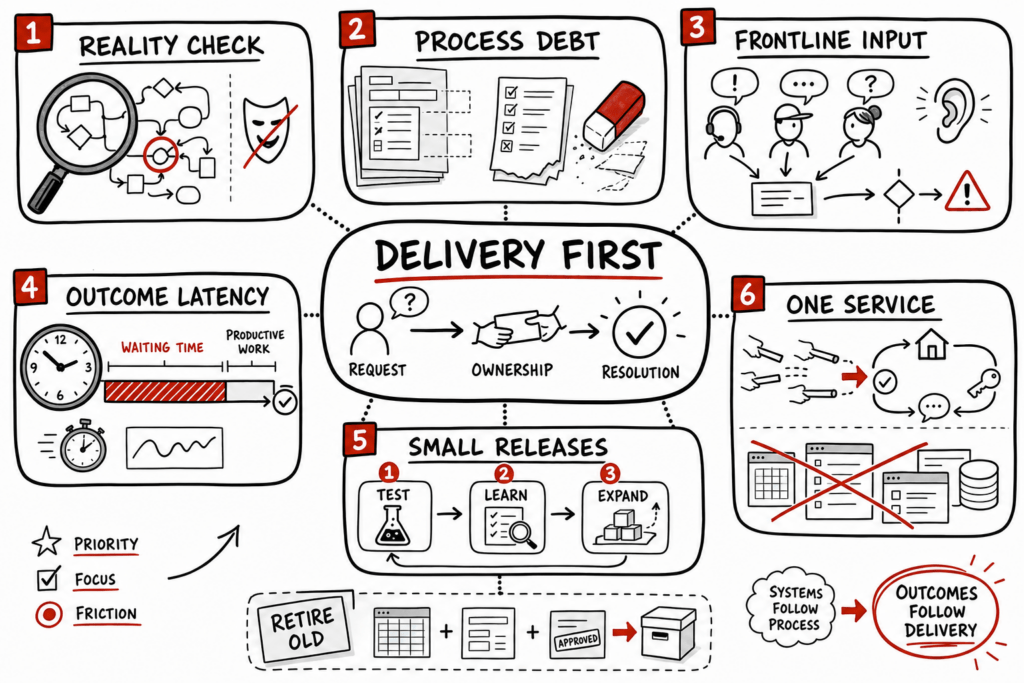
1. Separate Delivery Reality From Leadership Theater
Launch meetings, dashboards, and transformation language can create the appearance of progress. Inspect the complete delivery chain instead: who owns the outcome, where work waits, which approval protects a defined risk, and whether the person receiving the service can finish the task.
Useful measures may include completed outcomes, errors, cycle time, and avoidable follow-up contacts. Choose measures that expose the service problem under review rather than collecting activity for its own sake.
2. Treat Process Debt Like Technical Debt
Duplicate entry, inherited approvals, outdated checklists, and workarounds accumulate just as technical shortcuts do. Make each recurring friction point visible, name an owner, estimate its effect, and decide whether to repair or retire it. A new CRM should not become another layer over an unresolved operating problem.
3. Design With Frontline Evidence
Executives see summaries; frontline employees see where information disappears, exceptions multiply, and clients become anxious. Agents, transaction coordinators, service staff, and compliance professionals should be part of service design alongside legal, financial, product, and technology perspectives.
Frontline observation is evidence, not an instruction to accept every request unchanged. Compare it with outcome data and risk requirements before choosing a response.
4. Prefer Small Releases to Grand Transformations
Complex service environments contain dependencies that are hard to predict. A smaller change makes learning possible: test one intake form, one ownership model, or one communication cadence before replacing an entire technology stack. Measure the result over a defined period, then let evidence earn the next phase.
Systems-Thinking Lessons for Luxury Real Estate
Premium client experience often fails in the space between departments. Intake, advisory, compliance, marketing, transaction management, and post-close follow-up may each be optimized while the overall journey remains fragile.
Map where information is first captured, who may change it, what triggers the next action, and how the client learns that progress is being made. Then identify the point where professional judgment can override a routine path without creating a hidden exception.
Scalable luxury does not mean scripting every interaction. It means codifying routine reliability so professionals can spend judgment on discretion, empathy, and negotiation.
Where It Falls Short
The book’s public-sector depth is a strength, but private-sector readers must translate its lessons across different competition, funding, legal constraints, and definitions of success. It will not hand a brokerage a commercial scorecard or a finished implementation plan.
The analogy also needs care. Not every approval is bureaucracy, and not every legacy process should disappear. In regulated, high-value transactions, a control should be evaluated against the risk it addresses and the burden it creates.
Who Should Read It?
Recoding America is a fit for operations directors, founders, customer-experience leaders, and executives responsible for technology change when capable people are working hard but delivery remains inconsistent. It is also relevant to luxury real estate team leads managing growth across agents, coordinators, vendors, compliance requirements, and high-touch expectations.
The publisher’s book page provides the specific book context, while Code for America gives readers a separate view of the organization referenced in the book. Readers seeking a conventional technology playbook may find less value.
How to Apply It on Monday Morning
Build a Recoding Backlog
List handoffs, duplicate entries, unclear approvals, recurring exceptions, and outdated rules that slow service. Rank them by client impact, frequency, risk, and the time between a request and resolution. Begin with a service problem, not a shopping list of software.
Observe One Journey End to End
Choose a high-value workflow such as new-client onboarding, listing launch, offer management, or post-close follow-up and follow it across every person and platform. Record waiting time separately from productive work, then ask where information changes hands or disappears.
Run Frontline Discovery
Ask employees where they create workarounds, what clients repeatedly misunderstand, and which fields or approvals add no visible value. Compare those answers with leadership assumptions and available outcome data.
Prototype One Improvement
Change one workflow, assign one outcome owner, choose two or three measures, and set a review date. Turnaround time, error rate, complete submissions, and client follow-up requests can be useful if their definitions are written down.
Retire What the New Process Replaces
A redesign is incomplete if the old spreadsheet, form, meeting, or approval remains in parallel. Explicit retirement prevents process debt from surviving beneath the new system.
Final Verdict: Is Recoding America Worth Reading?
Yes, if you lead a system in which intent is strong but delivery is inconsistent. The book’s value is its disciplined attention to why institutional purpose loses contact with real users and outcomes. Use its lessons as a diagnostic, then adapt them to the controls, evidence, and responsibilities of your own service.