
The Expectation Effect Summary: Mindset Lessons for Real Estate Leaders
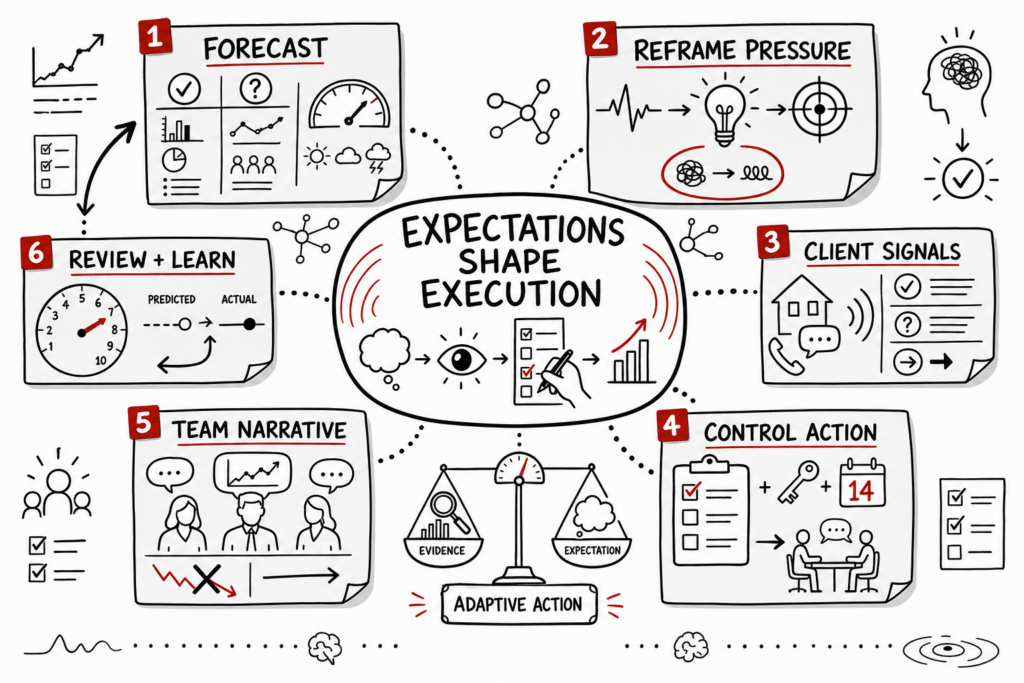
David Robson’s The Expectation Effect is most useful to a real-estate leader as a bounded review of how forecasts can shape attention, stress interpretation and behavior. It does not claim that optimism overrides pricing data, financing conditions or a client’s choices.
What Is The Expectation Effect Summary for Real Estate Leaders?
The book asks how expectations about an experience can influence the way a person interprets and responds to it. For a leader, that makes expectation management a practical question: which part of a forecast is evidence, which part is assumption and which action remains controllable?
Core Idea: What The Expectation Effect Actually Argues
Robson distinguishes an expectation from a guarantee. A belief can affect attention, motivation, communication and the meaning assigned to physical or emotional signals, while external conditions still constrain the result. The useful operating habit is to hold a forecast alongside evidence and a review point.
In a brokerage, “buyers have disappeared” may reduce preparation and outreach if nobody tests the claim. “Our qualified activity has slowed in this segment; we will review the data and change the follow-up plan at the next checkpoint” is a more actionable expectation.
The Expectation Effect Key Takeaways: Best Takeaways for Leaders
1. Reframe pressure without denying reality
A racing heart before a listing presentation can be treated as information that preparation matters, rather than proof that the meeting will go badly. Reframing does not remove pressure; it can prevent a second story from making the pressure harder to manage.
2. Treat market narratives as operational inputs
Market commentary can alter activity, risk tolerance and client language. Replace a broad narrative with a defined observation, a plausible range and the behavior required under current conditions. Keep the underlying inventory, financing and pricing evidence visible.
3. Expectations travel between people
Clients and colleagues read tone, timing and hesitation. That does not justify manufactured confidence. Explain what is known, what remains uncertain and which action can improve the decision without promising an outcome.
4. Environment can cue better expectations
A pre-meeting checklist, current pipeline data and a short debrief can interrupt a distorted forecast. The routine should remind the team what good preparation includes without turning a complex decision into a script.
The Expectation Effect Review: Where It Falls Short
The book is accessible and broad, but it is not a listing manual, compensation plan or leadership operating system. It also risks being overapplied if every setback is assigned to mindset. Interest rates, inventory, competition, skill and client finances remain real constraints.
Who Should Read It?
Read it if you lead people or high-consideration conversations and want a clearer way to notice how forecasts affect execution. It is less useful as a first resource when the bottleneck is basic follow-up, CRM discipline, pricing process or financial control. Robson’s official site provides author context.
How to Apply It: A Real Estate Leadership Mindset Protocol
The protocol is a practical label for a review sequence, not a proprietary framework. Before a high-stakes event, write the forecast, separate verified facts from assumptions and choose one controllable preparation action.
Before a high-stakes event
Name the expected outcome, the evidence supporting it and the two questions most likely to change the plan. Confirm decision criteria, rehearse the explanation and assign the next follow-up owner.
During client expectation design
Describe current reality, a range of plausible outcomes and the date or signal that will trigger review. This gives a client useful uncertainty instead of false certainty or passive ambiguity.
After the event
Compare the forecast with what happened. Note whether the difficulty was overestimated, underprepared or changed by an external condition. Use the record to improve the next decision rather than to punish an imperfect forecast.
Should I Read The Expectation Effect?
Yes, if you want a thoughtful lens on how beliefs shape execution while keeping evidence and external constraints in view. Its best use is selective: improve stress interpretation, challenge automatic narratives and build routines that cue focused action. If you want to examine how those choices fit your team, request a complimentary one-hour conversation with a senior advisor who is an experienced operator. Talk through your next move.