
The Price of Time Summary: a Review for Real Estate Leaders
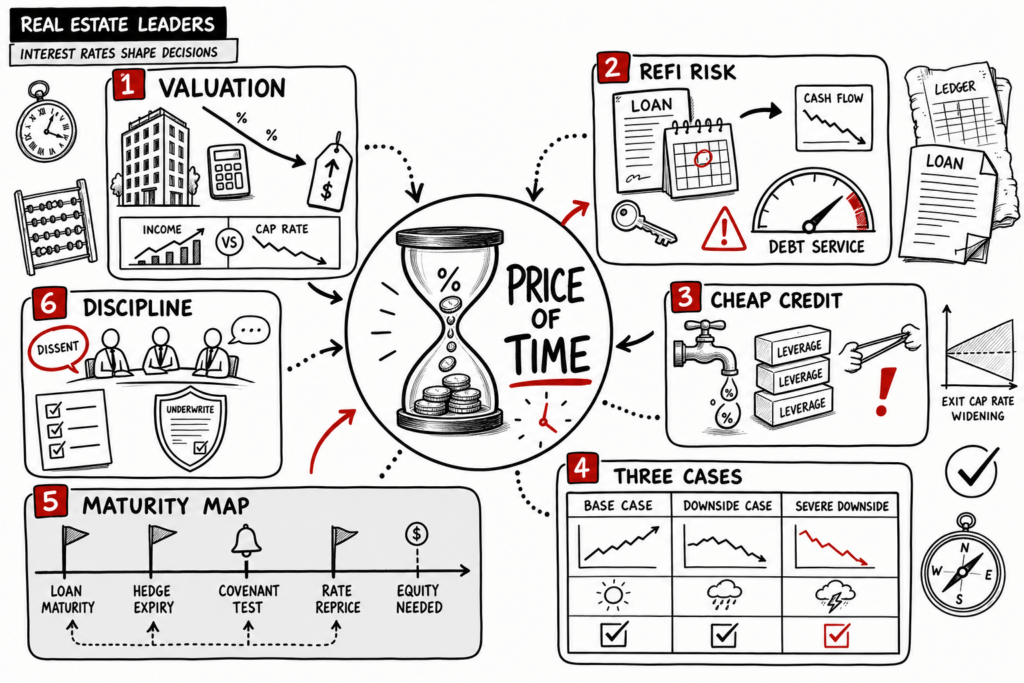
Edward Chancellor’s The Price of Time is a history of interest, credit and the consequences of making money unusually cheap. For a real-estate leader, its value is a way to question valuation and leverage assumptions. It is not a current rate forecast or a substitute for loan advice.
What Is The Price of Time for Real Estate Leaders?
The book’s central idea is that interest is the price of waiting for money. That price influences asset values, capital allocation and the risks hidden in a refinancing plan. A property decision should therefore survive more than one rate and exit assumption.
Quick Orientation for Busy Investors
Chancellor examines the history of interest, credit, monetary policy, speculation and financial repression. The publisher’s page is the source for the book record. The book offers pattern recognition across long periods rather than a short-term prediction.
Core Idea: Interest as the Price of Time
Low funding costs can make weak projects look attractive, expand leverage and encourage investors to treat recent conditions as normal. When funding costs change, the assumptions become visible. That is a warning about trade-offs, not a claim that every low-rate period or credit expansion ends in the same way.
Best Takeaways from The Price of Time
1. Valuation Is Downstream of Financing Conditions
Discount rates, cap rates, terminal values and required returns are connected to the cost and availability of money. Separate property operating performance from the help provided by leverage, cap-rate movement or falling debt costs.
2. Refinancing Risk Can Matter More Than Headline Value
Review debt yield, interest coverage, loan-to-value, maturity date, hedge expiration, covenant triggers and possible equity needs. Stable occupancy does not remove maturity risk.
3. Cheap Credit Changes Behavior Before It Breaks Models
Easy funding can reduce resistance to leverage, thin spreads and optimistic exit assumptions. Add a question to underwriting: which assumption became easier to accept only because financing was inexpensive?
4. Institutional Memory Is an Operating Advantage
Record the assumptions that held during prior cycles and the signals that changed them. Historical memory helps an investment committee challenge recency bias without pretending to predict the next cycle.
Major Themes Without Spoilers
The book explores the tension among savers, borrowers, asset owners and policymakers. Interest rates also distribute opportunity and pain unevenly. That wider lens helps a committee avoid treating a central-bank forecast as a complete property strategy.
Where It Falls Short
The historical range is broad, but the book will not tell a sponsor how to negotiate an extension, price an interest-rate cap or choose fixed versus floating debt. Pair its framework with current lender terms, property data and a reputable current source such as the Federal Reserve Economic Data site.
Who Should Read It?
It suits people who approve acquisitions, set hurdle rates, structure leverage, oversee development, manage dispositions or allocate capital. It is less essential for someone who needs only immediate financing tactics.
How to Apply It
- Model a base case, a higher-for-longer case and a severe refinancing case.
- Show maturity dates, extension options, hedge expirations, covenant triggers and estimated equity needs.
- Separate income growth, operating improvement, leverage and cap-rate movement.
- Ask one committee member to explain how cheap credit may have shaped the price, product or exit assumption.
The book is most useful when it makes a capital allocator less casual about the cost of money. Its contribution is disciplined skepticism, not a promise about the next rate move.