What Are the Elon Musk Key Takeaways for Luxury Real-Estate Leaders?
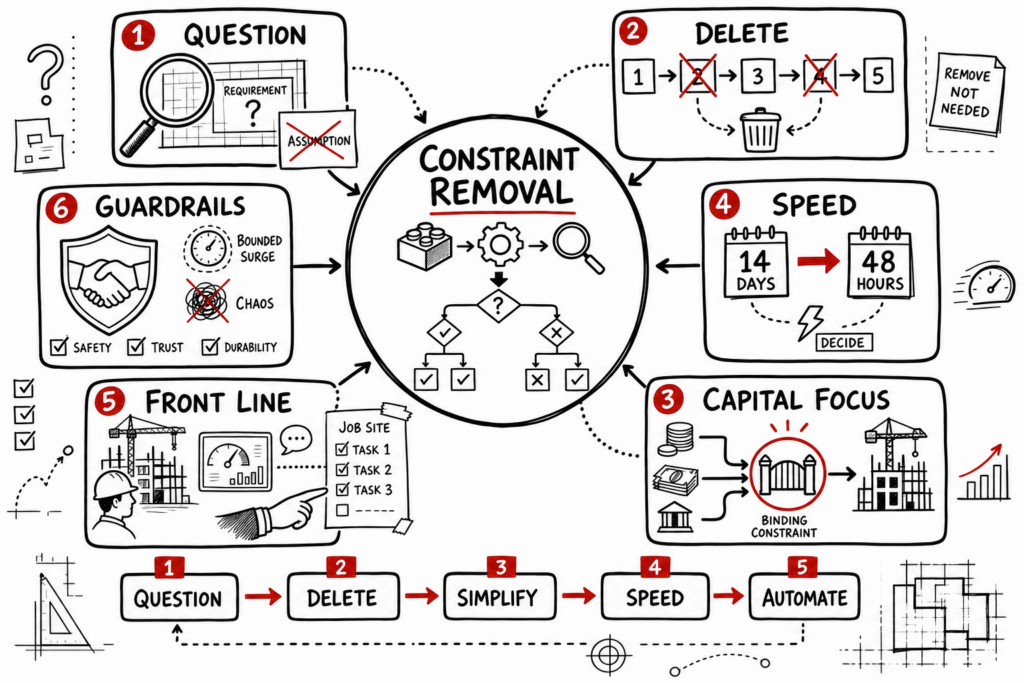
The Elon Musk key takeaways from Walter Isaacson’s Elon Musk are most useful to luxury real-estate founders and operators who must allocate capital, compress timelines, and lead several complex projects at once. The strategic implication is clear: study Musk’s operating system, but do not copy his personality or management extremes. Isaacson shows how first-principles analysis, direct involvement at the operational front line, and rapid feedback loops can expose false constraints and accelerate execution. The most practical framework is Musk’s five-step algorithm: question every requirement, delete unnecessary parts or processes, simplify, shorten cycle time, and automate only after the first four steps. Applied to real estate, that could mean challenging a costly design assumption before value engineering or reducing a 14-day approval cycle to 48 hours. This book is worth reading for leaders scaling capital-intensive ventures, provided they treat it as a case study in trade-offs rather than a universal leadership manual.
Book Snapshot: Why Executives Are Still Talking About It
Walter Isaacson’s biography is an access-driven portrait of an operator moving simultaneously across aerospace, electric vehicles, energy, artificial intelligence, infrastructure, and media. It is not a conventional management book, and that is part of its value. Instead of presenting a polished doctrine, Isaacson documents recurring decisions, operating habits, conflicts, and consequences.
The timing also matters. Published after Musk’s acquisition of Twitter, now X, the book examines leadership under intense public scrutiny and volatile stakeholder expectations. That makes it relevant beyond technology. Luxury developers also manage long-duration projects while lenders, investors, buyers, brokers, municipalities, and the public judge decisions on different timelines.
Readers seeking publication details can consult the publisher’s page for Walter Isaacson’s Elon Musk. Isaacson’s broader work and biography credentials are available through his official website.
Core Idea: An Operating System Built Around Constraint Removal
The central idea in this Elon Musk book summary is that exceptional speed often begins by questioning whether an accepted constraint is real. Musk repeatedly returns to the underlying physics, materials, labor, time, and cost rather than accepting an inherited specification. This is first principles thinking leadership in practical form: reduce a problem to what must be true, then rebuild the solution from those facts.
For a real-estate operator, that means refusing to treat a historical cost per square foot, procurement sequence, approval layer, or sales convention as permanent. A requirement may be necessary, but its source and purpose should be identifiable. “That is how we do it” is not evidence.
The useful discipline is not contrarianism for its own sake. It is separating genuine constraints—building codes, debt covenants, structural loads, contractual obligations—from habits disguised as requirements. That distinction can improve development pro formas and uncover faster, less capital-intensive paths.
Best Takeaways: Elon Musk Key Takeaways That Translate
1. Use the five-step algorithm in the correct order
Musk’s operating algorithm is the book’s cleanest reusable tool: question requirements, delete unnecessary components or processes, simplify what remains, accelerate cycle time, and automate last. The sequence matters. Automating a bad process only makes waste move faster.
Use it in a monthly project review. Ask who owns each requirement and what risk it controls. Identify steps that can be removed without compromising safety, quality, buyer experience, or compliance. Then track one cycle-time KPI, such as days from design revision to final approval.
2. Go where the work is happening
A recurring Elon Musk leadership lesson is the value of direct observation. Musk’s factory-floor involvement has an obvious equivalent in job-site walks, sales war rooms, design meetings, and capital-raise sprints. Dashboards summarize reality; they do not replace it.
Senior leaders should periodically inspect the point where value is created or delayed. A site superintendent, sales director, procurement lead, or lender may see a bottleneck weeks before it reaches an executive report. Front-line contact shortens the distance between signal and decision.
3. Sequence capital instead of spreading it evenly
The strongest capital allocation lessons for founders concern concentration. Capital, talent, and executive attention should surge toward the constraint that determines whether the broader system moves. Equal allocation can feel disciplined while quietly starving the highest-leverage priority.
In a development portfolio, one delayed entitlement or financing milestone may govern several downstream commitments. A practical rule is to identify the project’s current binding constraint and assign disproportionate resources until it clears. This is not permission to gamble blindly. Liquidity reserves, downside scenarios, and covenant headroom still matter.
4. Design teams for learning speed
The book favors ownership, technical fluency, mission alignment, and fast learning over credentials alone. For multi-venture leadership, this suggests hiring people who can make sound decisions with incomplete information and communicate problems without institutional theater.
Real-estate leaders can translate this into shorter reporting lines, named decision owners, and explicit escalation thresholds. For example, a project leader might have authority over changes below a defined cost and schedule threshold, while larger deviations receive a same-day executive decision.
5. Treat urgency as a tool, not a permanent climate
Compressed deadlines can expose hidden slack and create extraordinary focus. Permanent emergency mode, however, weakens judgment, retention, and trust. The deeper lesson is to use short, clearly bounded execution surges around critical windows rather than turning every week into a crisis.
Where It Falls Short
This Elon Musk book review is not an endorsement of every behavior it documents. Isaacson provides substantial detail, but the narrative’s personality-driven intensity can make destructive habits appear inseparable from ambitious execution. Readers should resist that conclusion.
Luxury real estate is unusually relationship-dependent. Entitlements, joint ventures, brokerage networks, repeat buyers, family offices, and lender relationships compound over years. A leadership style that creates rapid internal movement but leaves unnecessary relational damage may destroy more value than it produces.
The book also offers observation more often than clean instruction. Readers looking for a step-by-step management system will need to extract their own operating rules. That makes the biography richer than a typical business manual, but less efficient for anyone seeking a short implementation guide.
How to Apply It Without Importing the Damage
- Run a requirement audit. Select one delayed project and list every approval, report, meeting, and handoff. Record who created each requirement and which risk it controls.
- Measure decision latency. Track the median hours from a material issue being raised to an accountable decision. Reduce delay without weakening diligence.
- Name the binding constraint. For each active development, identify the single issue most likely to control schedule, liquidity, or revenue during the next 30 days.
- Create bounded surge periods. Concentrate senior attention around closings, launches, approvals, or construction milestones, then restore a sustainable cadence.
- Install behavioral guardrails. Preserve direct debate while prohibiting humiliation, impulsive role changes, and manufactured emergencies. High standards do not require avoidable instability.
These Elon Musk strategy lessons work best as decision filters. They should strengthen judgment, not become excuses for recklessness. The relevant test is whether a practice improves speed, quality, capital efficiency, and organizational durability together.
Who Should Read It?
Elon Musk is best suited to founders, developers, investors, and operating executives overseeing several high-complexity initiatives. It is especially valuable if you are scaling a team, entering a new market, managing a capital-intensive pipeline, or trying to shorten decision cycles without losing control.
Is Elon Musk by Walter Isaacson worth reading? Yes, if you want a detailed case study of first-principles problem solving, concentrated capital deployment, and extreme operating cadence. Skip the full biography if you only want a tidy checklist or an uncomplicated leadership hero.
The most credible luxury real estate leadership lessons are selective: challenge inherited assumptions, stay close to operational reality, concentrate resources at decisive moments, and protect the relationships that make long-term execution possible. For the next step, explore a related RE Luxe Leaders leadership briefing on building faster decision systems without turning urgency into organizational chaos.