
Breakneck Dan Wang Summary: Review and Takeaways for Leaders
What is the Breakneck Dan Wang summary for business leaders?
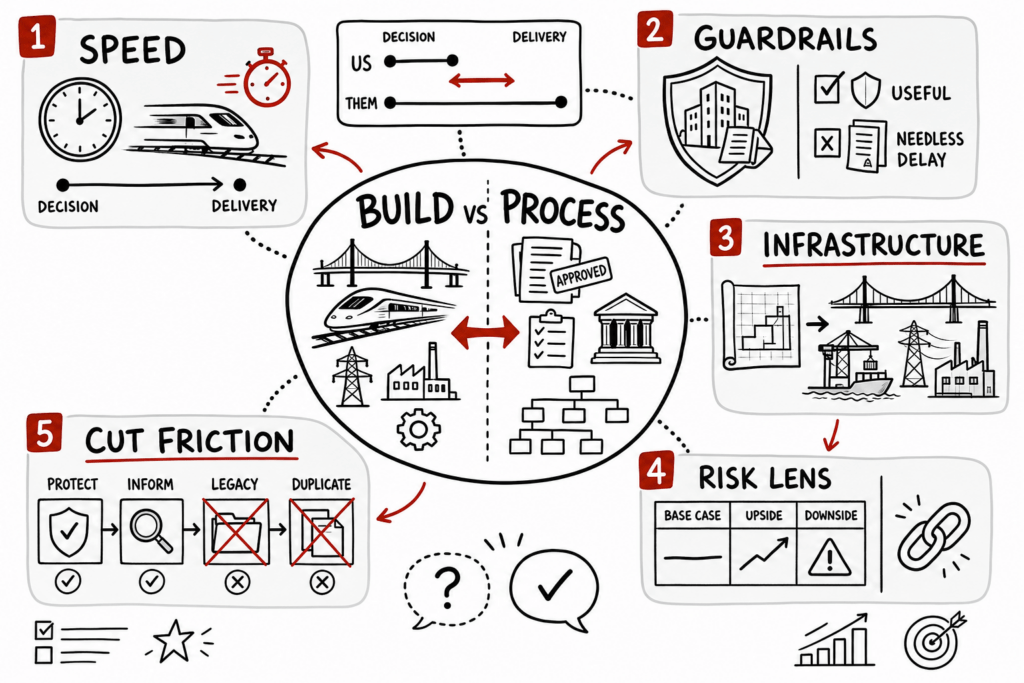
The Breakneck Dan Wang summary for established real estate leaders, investors, and operators is straightforward: Breakneck argues that China behaves like an engineering state, prioritizing physical construction, technical capacity, rapid iteration, and deployment at scale, while the United States relies more heavily on legal process, procedural review, and distributed veto points. The strategic implication is not that speed always wins. It is that leaders must distinguish safeguards that protect value from process friction that merely increases cost and delay. A useful business KPI is decision-to-delivery time: the number of days between approving an initiative and putting it into operation. Readers advising cross-border wealth, evaluating infrastructure exposure, or competing across jurisdictions will find the comparison especially useful. Those seeking stock picks, market timing, or a simple prediction about China’s future should look elsewhere; Wang offers a framework for institutional pattern recognition, not an investment playbook.
This spoiler-safe Breakneck Dan Wang review focuses on the operating argument rather than reproducing the book’s narrative. For publication details and the publisher’s description, see W. W. Norton’s official page for Breakneck.
Who Should Read It
Breakneck is most useful for leaders whose decisions are affected by infrastructure, industrial policy, supply chains, development timelines, or international capital. That includes brokerage owners advising globally mobile clients, real estate leaders working near logistics and manufacturing hubs, and operators evaluating markets where public capacity materially changes private opportunity.
It also serves economically literate readers who want a better vocabulary for comparing national operating models. This is not a motivational business story or a conventional China investing manual. It is a systems book. Its value comes from showing how institutional design influences what gets built, how quickly it gets built, and what risks accumulate along the way.
Core Idea: The Breakneck Dan Wang Summary in Operating Language
Wang’s central contrast is between an engineering-state posture and a lawyerly or procedural state. An engineering state treats physical and technical capacity as a primary expression of power. It builds rail, factories, power systems, housing, ports, and technology infrastructure, then learns through deployment and iteration. A more procedural system places greater weight on legal review, consultation, jurisdictional boundaries, and opportunities to challenge decisions.
Neither model is automatically superior. Engineering speed can produce extraordinary capacity, but it can also amplify poor decisions, oversupply, concentration, or human cost. Procedural checks can protect property rights, communities, safety, and legitimacy, but too many veto points can make even broadly supported projects expensive or impossible.
The real China engineering state book question is therefore practical: which constraints preserve value, and which have become habits that protect no meaningful outcome?
Recurring Themes Worth Watching
Infrastructure is not background scenery in Breakneck. It is strategic language. Rail networks, power generation, factories, ports, and dense supplier ecosystems reveal what a system is designed to accomplish.
Scale matters as much as speed. Large deployment capacity can lower costs, establish standards, deepen technical talent, and reshape market access. It can also create second-order concentration risk. If one geography becomes exceptionally efficient at producing a critical input, buyers elsewhere may gain short-term savings while becoming more exposed to political, logistical, or regulatory disruption.
That makes the connection between China infrastructure and capital flows especially relevant. Capital does not move only toward attractive assets. It also moves toward places where approvals, utilities, transport, labor, financing, and execution can align.
Best Takeaways
1. Measure the cost of institutional delay
One of the strongest Breakneck key takeaways is that delay is not neutral. It raises carrying costs, postpones revenue, increases exposure to changing rates, and gives faster competitors room to establish position. Leaders should track approval cycle time, handoffs, rework, and the percentage of decisions requiring senior escalation.
2. Treat infrastructure as part of the investment thesis
Population growth and headline demand are insufficient. A market’s ability to add power, transport, housing, water, and commercial capacity affects whether projected growth can actually be absorbed. For investor conversations, infrastructure should be treated as an operating dependency rather than a flattering paragraph in a market overview.
3. Policy-shaped markets require a different risk lens
Manufacturing, energy, logistics, housing, and technology deployment are not purely private contests. Subsidies, permitting, procurement, trade policy, and public financing can change the economics quickly. The relevant state capacity and business strategy question is not simply whether government is involved, but whether its involvement produces dependable execution or unstable distortion.
4. Process can become an unexamined competitive disadvantage
The best Breakneck leadership lessons apply inside companies as well as countries. Established firms often accumulate approvals after isolated mistakes. Each requirement appears reasonable on its own; together, they slow decisions without materially reducing risk. These are useful process friction leadership lessons: preserve controls tied to legal, financial, ethical, or reputational exposure, and challenge the rest.
Where It Falls Short
The engineering-state contrast is memorable, which creates its main risk: readers may turn a comparative framework into a slogan. Countries are not single operating systems, and outcomes vary across regions, sectors, political periods, and project types. Fast construction does not prove sound capital allocation. Slow approval does not automatically indicate incompetence.
The book is also more useful for framing than forecasting. Readers should resist converting institutional observations into confident geopolitical predictions or immediate trades. Current data, sector expertise, tax advice, and qualified local counsel remain necessary. A thoughtful Breakneck book review should preserve the distinction between a strong explanatory lens and a complete decision model.
How to Apply It
Start with one delayed initiative in your business. Map the time from decision to delivery, including every approval, meeting, handoff, revision, and idle period. Then classify each point of friction:
- Protective: reduces meaningful legal, financial, ethical, or client risk.
- Informational: improves the decision with evidence that changes the likely outcome.
- Legacy: exists because of history, hierarchy, or habit.
- Duplicative: repeats review already completed elsewhere.
Remove or redesign the legacy and duplicative steps first. Do not confuse simplification with recklessness.
For capital conversations, build three scenarios rather than one forecast. In the base case, infrastructure and approvals continue at their present pace. In the upside case, capacity arrives faster and supports demand. In the downside case, power, transport, financing, or permitting becomes the binding constraint. This converts the book’s broad systems argument into a disciplined discussion about timing, exposure, and resilience.
For leadership teams, compare your decision-to-delivery time with the fastest credible competitor, not only with last year’s internal performance. That is the most practical of the book’s Breakneck strategy lessons: internal improvement can still leave you structurally slow.
Is Dan Wang’s Breakneck Worth Reading?
The answer to Dan Wang Breakneck worth reading is yes if your work requires translating macro conditions into decisions about competition, infrastructure, development, supply chains, or cross-border capital. Read it fully if institutional capacity is central to your strategy. Skim selectively if you mainly need the engineering-state framework and its implications for execution.
Pass if you want short-cycle trade ideas, stock recommendations, or a clean winner-and-loser forecast. The book earns attention as a lens for judgment, not as a substitute for due diligence.
If the comparison exposes a meaningful gap between your firm’s ambition and its operating speed, the next move is to decide which friction deserves removal and which protection must remain.