
Source Code Summary and Review: Bill Gates’s Learning Velocity
What is the Source Code summary, and is it useful for business leaders?
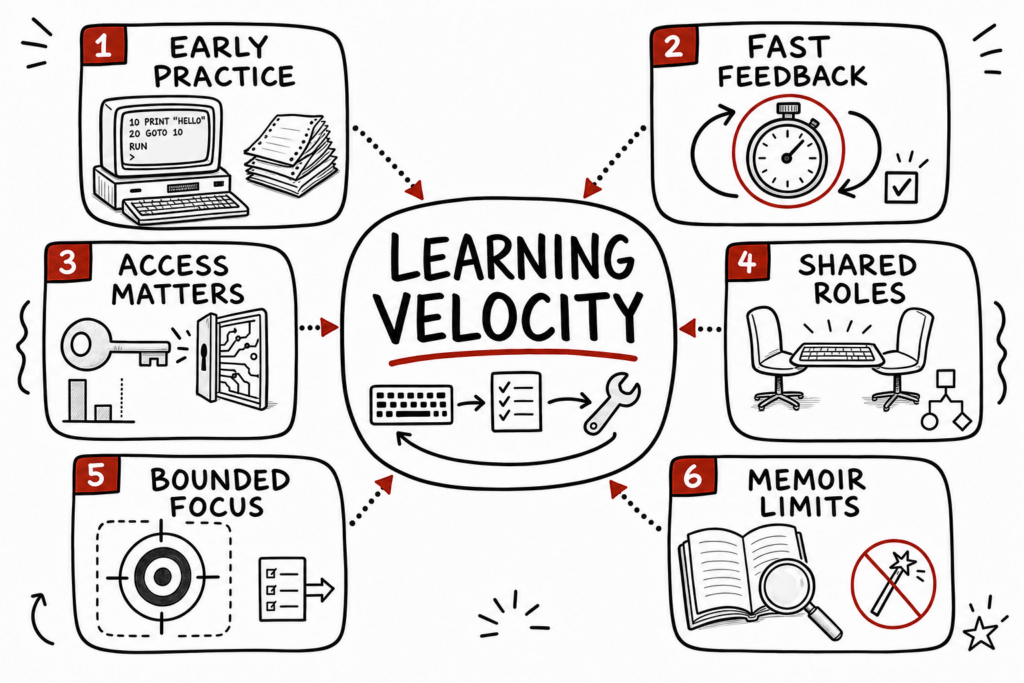
For established founders, team leaders, and brokerage owners, Source Code by Bill Gates is an early-life memoir whose practical value is examining how learning conditions shape judgment—not copying a billionaire’s habits. This Source Code summary covers the book’s public scope: childhood, unusual access to computing, intensive practice, partnership with Paul Allen, and the beginnings of software as a business. The strongest operating idea is learning velocity: how quickly repeated work produces feedback that improves the next attempt. A useful business measure is the time between an employee’s decision and a substantive review of its outcome; reducing that interval can make practice more productive. That framework is an application of the story, not a method Gates formally prescribes. Read the book for a portrait of skill and commercial instinct forming before scale. Look elsewhere for organizational design, a modern leadership system, or a Microsoft-at-scale case study.
Who Should Read It
Source Code: My Beginnings, Gates’s 2025 memoir, suits readers who already run something and want to examine how capability develops. Its value is less “how did he succeed?” than “which conditions made that development possible, and which conditions can I build?”
It is a good fit for an operator reconsidering how people learn, how partners divide responsibility, or how much room to give a technically exceptional colleague. It is less useful if you need an immediate answer about compensation, delegation, recruiting, or managing a mature organization.
As a gift, it works best for someone who enjoys biography and can resist turning one person’s history into universal advice. Give it as an interesting life to examine, not a prescription for working harder.
Core Idea: Learning Velocity, Not the Genius Shortcut
The strongest reading angle is practice design. Early computing offered hard problems and unusually direct feedback: code ran, failed, or produced something that required correction. Scarce machine access made preparation consequential. Repetition mattered, but so did the quality of information each attempt returned.
This is a more useful lens than innate brilliance. Ability, access, temperament, and opportunity all belong in the explanation. Leaving any of them out makes the story cleaner and the lesson weaker.
For an established business, the comparison is straightforward. A team can repeat a process for years without improving if nobody sees the consequences clearly. A weekly meeting is not automatically a feedback loop. It becomes one when evidence changes the next decision.
Best Takeaways: Source Code Leadership Lessons
Shorten the distance between work and evidence
The portable lesson is not to imitate coding marathons. It is to identify where useful feedback arrives too late. In a brokerage, an agent might learn that a listing presentation missed the seller’s real concern only after the instruction goes elsewhere. Reviewing the conversation sooner gives the next appointment a better chance of benefiting from that experience.
Treat obsession as a staffing decision
Deep focus can produce rare expertise. It can also narrow attention and create friction for everyone nearby. The leadership question is not whether intensity is admirable. It is which intensity deserves support, what it costs, and who carries that cost.
A specialist’s concentration may be worth protecting. That does not require accepting poor handoffs or making colleagues permanently available. Protect the work without exempting the person from agreed responsibilities.
Negotiate complementary strengths
The publicly known Gates–Allen partnership offers a useful lens on shared ambition and different contributions. Technical depth, identifying an opportunity, and turning work into a commercial proposition are distinct jobs. Early experiments such as Traf-O-Data also belong to that broader history; they are not a ready-made template for a modern company.
For current partners, “we complement each other” is only a starting point. Specify who decides, who delivers, and how disagreements get resolved.
Where It Falls Short
The main limitation is fit. This is a memoir of beginnings, not a management manual. Readers looking for Microsoft’s later organizational choices will be asking this volume to answer questions outside its scope.
Access also matters. Gates’s Lakeside-era exposure to computing was unusual. His use of that opportunity deserves attention, but unusual access cannot honestly be repackaged as an ordinary starting position. The practical response is to examine your own advantages: relationships, financial runway, early responsibilities, and access to strong colleagues.
Memoir adds another limitation: retrospective selection. A life narrated later can appear more coherent than it felt while being lived. Treat the account as one person’s perspective, not controlled evidence that a particular habit causes success.
The title invites an early-life-as-source-code interpretation: formative conditions later expressed in judgment. That is a reading angle, not a verified map of the book’s symbolism. Likewise, competitiveness is worth examining without assuming every cost was necessary. A trait can build skill and still leave others managing the friction.
How to Apply It
Take one operating decision back to the business, rather than launching a broad initiative around the book.
- Choose work that builds advantage. Select a recurring activity where better judgment matters: pricing recommendations, listing presentations, or hiring decisions. Avoid measuring something merely because the data is easy to collect.
- Measure feedback delay. Record how long it takes to get useful evidence after the decision. As an illustrative test, move a presentation review from the monthly meeting to within 48 hours. Separate immediate process feedback from outcomes that genuinely take longer.
- Make the review specific. Compare the intended result, observed evidence, and one adjustment for next time. Keep it about the work, not a public ranking of people.
- Name the access advantage. Ask what resources made the strongest performer’s development possible. Decide which resources can be shared instead of mistaking unequal opportunity for unequal potential.
- Set boundaries around intensity. Agree on protected focus time, handoff standards, and response expectations. Review whether exceptional work is creating hidden work elsewhere.
Source Code Book Review: The Verdict
Is Source Code worth reading? Yes, if you want a specific portrait of capability developing before institutional scale. Its strongest strategy lesson is to examine the conditions behind performance, not admire the outcome and reverse-engineer a slogan.
The limit is equally important: one remarkable beginning cannot settle how you should run an established business. Keep the questions about feedback, access, focus, and partnership. Leave the mythology.
If those questions expose a decision your business has been postponing, that decision is worth a direct conversation.