
$100m Leads Summary: a Clear-eyed Review for Leaders
What is the $100M Leads summary for real estate leaders?
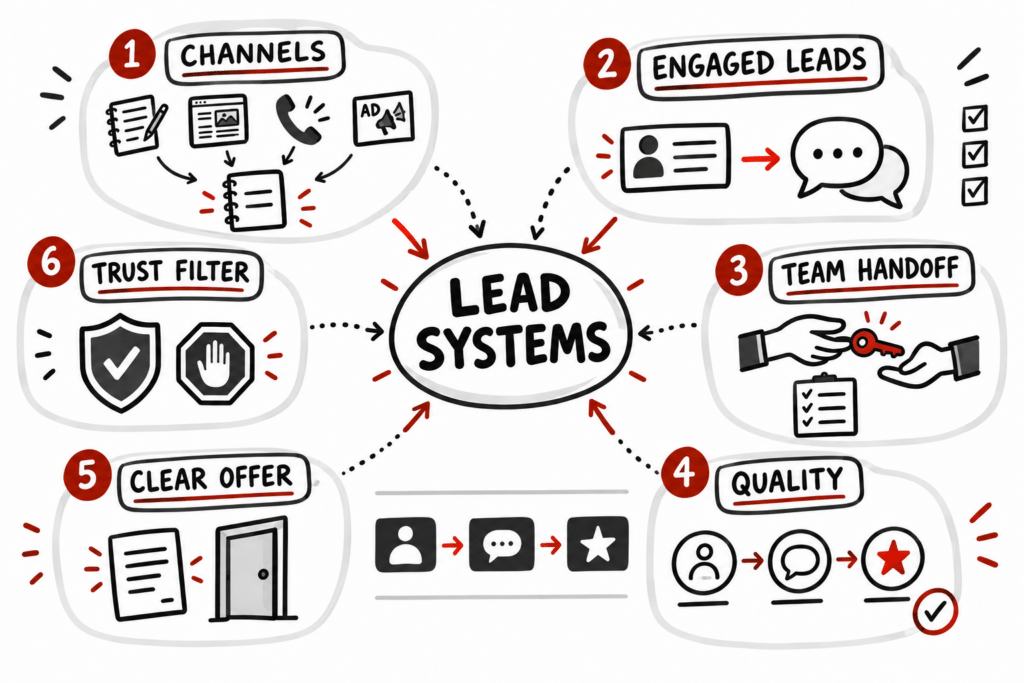
$100M Leads summary: For established real estate agents, team leaders, and brokerage owners, Alex Hormozi’s $100M Leads argues that lead generation needs a repeatable system, not just a strong reputation or offer. The book is a guide to getting potential customers to express interest; it is neither a memoir nor a real estate manual. Hormozi distinguishes a lead, someone you can contact, from an engaged lead, someone who has shown interest. His Core Four framework groups lead generation into warm outreach, content, cold outreach, and paid advertising. For a listing-focused practice, the implication is to assess those channels by the quality of conversations and eventual opportunities, not simply by the number of names collected. Read it if you want a direct map of how businesses create demand and are prepared to adapt its tactics to a high-trust market. Skim it if you want luxury brand theory, negotiation advice, or a ready-made real estate plan.
Core Idea: A reputation is not a lead system
Hormozi is addressing a problem many successful operators recognize: business comes in, but its arrival is hard to explain, assign, or predict. There may be too few new conversations, or plenty of conversations with people who are not a fit. Both problems can keep a team busy without building a useful pipeline.
That distinction matters in real estate, where a large contact list can look reassuring. A person whose details are in your database is not necessarily considering a move, seeking advice, or willing to make an introduction. An engaged conversation is a more meaningful signal, although it is still not the same as a qualified listing opportunity.
The $100M Leads vs $100M Offers distinction is straightforward. $100M Offers concerns making an offer compelling; $100M Leads concerns getting people to engage with it. A strong offer does not create conversations by itself. More conversations will not rescue a vague offer.
This review covers the ideas needed to decide whether to read the book. It does not reproduce the scripts, advertising formulas, daily checklists, or full implementation manual. The publisher’s Acquisition.com books page provides book information for readers who want to explore further.
Who Should Read It
Read this book if you already sell well but cannot clearly describe how someone outside your existing sphere becomes a conversation, or how that conversation is handled when you are not the person initiating it. It is useful for principals considering whether their team can generate opportunities rather than simply service the ones they bring in.
It is less useful if your immediate need is pricing a complex property, improving negotiations, or developing a luxury positioning strategy. Hormozi writes for a broad business audience. The translation to a listing practice is your responsibility, not a service the book provides.
Best Takeaways: $100M Leads key takeaways for listing leaders
Name the channels before adding another one
The Core Four are warm outreach, content, cold outreach, and paid ads. Their value as a framework is not that every business must use all four. It is that each is a distinct way of creating conversations, with different costs, reputational risks, and ownership requirements.
For example, a principal may believe the team has a content strategy because property posts appear regularly. The more useful question is whether that content gives the right people a reason to engage—and whether anyone is responsible for responding when they do.
Separate personal rainmaking from a system
Hormozi also discusses customers, employees, agencies, and affiliates as potential lead getters. For a team builder, the question is whether someone besides the principal can consistently help create appropriate introductions or conversations.
Past clients and professional partners can be part of that picture, but their trust is not a resource to pressure. Design a referral path that makes it easy for someone to introduce you when there is a genuine reason. Then make sure the person introduced receives a thoughtful response.
Measure the outcome, not the noise
One of the most useful $100M Leads strategy lessons is to judge a channel by what happens after contact. Impressions and a full calendar are not proof of a healthy pipeline. Track engaged conversations alongside qualified listing opportunities and the quality of referrals they produce. A channel that generates fewer conversations may be more valuable if those conversations lead to stronger opportunities.
That also puts Hormozi’s sequence of more, better, new in context: increase consistent activity, improve it, and only then look for a new approach. In a high-trust practice, “more” should mean more relevant conversations—not indiscriminate stranger volume borrowed from a different business model.
Make the offer clear before promoting it
A lead magnet is a useful solution to a narrow problem that can expose a broader problem the core service addresses. A market report or free comparative market analysis is not automatically valuable simply because it is free. Ask who it is for, what question it answers, and what a useful next conversation would look like. If those answers are unclear, another distribution channel will not fix the underlying problem.
Where It Falls Short for a luxury practice
This $100M Leads book review comes with a significant qualification: the book’s direct-response mindset does not account for every cost of a poor first impression. Cold volume, aggressive hooks, and giveaways may suit some businesses; imported uncritically into a listing practice, they can weaken the discretion and judgment a luxury client expects.
That does not make outreach or advertising inherently unsuitable. It means the brand filter comes first. Consider whether the approach would still feel appropriate if the recipient were a past client, a respected local attorney, or the owner of a property you hope to represent. If not, the tactic deserves revision, even if it produces responses.
The broader $100M Leads leadership lessons are strongest when treated as operating questions, not instructions to imitate Hormozi’s style. Who owns the work? What counts as a promising conversation? Can the team respond well without the principal stepping in every time?
How to Apply It: $100M Leads for real estate leaders
Start with the channels already in use. Name the Core Four activities your business actually runs, rather than those it occasionally discusses. For each, identify the person responsible and the kind of conversation it is intended to create.
Then follow a recent opportunity backward: how did the person first engage, who responded, and what happened next? If the answer is “the principal remembered,” you have identified a dependency worth addressing. Choose one channel that a competent person can own next, with a clear understanding of when the principal should be involved.
Finally, name one tactic you will explicitly avoid because it conflicts with the way your practice earns trust. That boundary is as useful as choosing a channel: it prevents a growth target from quietly changing the experience clients associate with your name.
Is $100M Leads worth reading?
Yes, if you want a blunt, structured map of how leads can be created and are willing to translate rather than copy. This Alex Hormozi $100M Leads review is more reserved for readers seeking a luxury-specific operating plan: skim it for the channel framework, then look elsewhere for brand and negotiation depth.
If the distinction between personal rainmaking and a durable lead system raises a decision for your business, it is worth talking through.