
Stuck Summary and Review: Housing, Mobility, and Property Rules
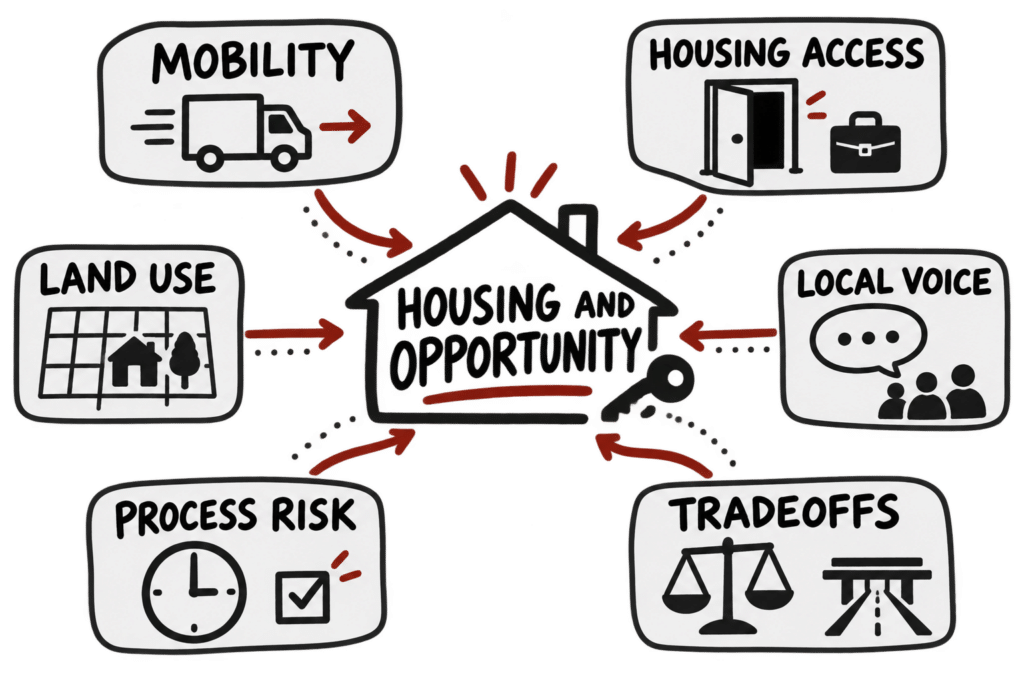
What is the Stuck summary for real estate leaders?
For development executives, brokerage leaders, and policy-facing principals, this Stuck summary explains Yoni Appelbaum’s argument that restrictions on mobility and housing have weakened American opportunity—and why those leaders should account for access as well as asset values. In Stuck: How the Privileged and the Propertied Broke the Engine of American Opportunity, Appelbaum presents geographic mobility as an important part of how people pursue better work and living conditions. Geographic mobility means the practical ability to move from one place to another; an available job matters less if a household cannot find housing it can afford nearby. The book connects that broader opportunity problem to the power of established interests, including property owners, over who can enter a community. It is worth reading if you need historical and political context for the housing debate. It is not a site underwriting guide, a substitute for local counsel, or proof that every proposed development deserves approval.
Who Should Read It
Read Stuck if your decisions depend on understanding why housing supply encounters resistance before a project reaches the market. That includes developers weighing entitlement risk, brokerage owners tracking the effects of limited inventory, and principals whose firms are expected to speak credibly about growth.
This Stuck book review is less relevant if you want a prospecting script or a step-by-step development checklist. Appelbaum offers a way to think about a system, not a set of tactics for winning the next hearing. The useful question for an experienced operator is whether that perspective changes how you assess risk, access, and the politics around a deal.
Core Idea: Stuck Housing and Mobility
The book’s central claim is that the ability to move has been an engine of American opportunity, and that privileged and propertied interests have helped impede it. That is a larger argument than “build more housing.” It asks who gets to reach opportunity, who can afford to arrive, and who has the power to limit entry.
For real estate leaders, one useful reading angle is the connection between land-use restrictions and the cost of arrival. Zoning can limit what may be built, where, and at what density. Other approval requirements and local opposition can add time or uncertainty. When housing is hard to add in places people want to reach, the consequences extend beyond a single project: employers, households, and local markets all face different choices.
That mechanism should not be mistaken for a verified list of every piece of evidence in the book. It is an operating lens for the housing debate, not a substitute for checking Appelbaum’s historical examples and sourcing in the text.
How Housing Markets Seize Up
Operators will recognize three related pressures. First, rules can restrict the amount or type of housing allowed. Second, local politics can give existing owners a strong voice in decisions about change. Third, arguments about neighborhood character can treat newcomers as a risk to existing residents or property values.
These pressures overlap, but they are not interchangeable. A density limit is a rule; a contested hearing is a political process; a claim about character is an argument that may influence both. The book’s broad thesis makes those distinctions worth examining without assuming it ranks the three in this order.
There is also a history of racial and class exclusion in American housing that should not be reduced to a neutral disagreement about building design. Leaders assessing a present-day proposal need to understand both the legitimate local concerns and the possibility that apparently neutral barriers can carry exclusionary effects. The specific history of any community still requires local research.
Where Stuck Sits in the Supply Debate
Stuck belongs in the wider conversation about housing abundance and supply, with a particular focus on mobility, property, and political power. Its value is the connection between today’s land-use disputes and a longer account of American opportunity. It should not be read as a zoning code or treated as a blanket pro-development manifesto.
The surrounding debate is contested. Some participants put more weight on restrictive rules and veto points; others emphasize financing costs, interest rates, investor ownership, or the distribution of new housing. These explanations can coexist. A project can be permissible under zoning and still fail financially; a financially attractive project can face an approval process that makes it too uncertain to pursue.
That distinction matters because a broad diagnosis cannot tell you which constraint is decisive on a particular site. The book can sharpen the questions. The market and the facts of the transaction must answer them.
Best Takeaways: Stuck Key Takeaways for Real Estate Leaders
Housing access is part of the opportunity story
A labor market is not truly accessible to every qualified household merely because jobs exist. Housing availability, price, and commuting options affect whether people can take those jobs. For brokerage and development leaders, that means housing conversations are also conversations about the reach of a local economy.
Process belongs in the financial picture
Treat zoning, hearings, and potential opposition as underwriting inputs rather than background noise. Map the approvals required, the likely sequence, and the carrying costs associated with a longer timeline. Separate known requirements from assumptions about public response. A delay scenario is not a forecast; it is a way to see how much uncertainty the deal can bear.
Existing owners and prospective entrants have different stakes
Current residents may worry about traffic, infrastructure, disruption, or property values. Prospective residents may have no seat in the room when decisions are made. Neither observation settles a proposal, but both should inform how leaders interpret the discussion. Listen for who bears costs, who receives benefits, and whose preferences are absent.
Where It Falls Short
The risk in a compelling structural argument is using it as an answer to every local question. Housing scarcity can have multiple causes, and the appropriate response depends on location, project economics, infrastructure, law, and community conditions. A reader looking for a single culprit or a universal fix will leave with more confidence than the situation warrants.
Nor does a case for mobility establish that any one upzoning is wise, that every objection is bad faith, or that added supply will solve every affordability problem on its own. Those are separate judgments. Stuck is most useful as context for making them, not permission to skip them.
How to Apply It: Stuck Strategy Lessons for Real Estate Leaders
Start with one decision your firm already faces. For a development team, it might be whether to pursue a parcel with an uncertain entitlement path. For a brokerage owner, it might be how to discuss limited inventory and local growth with clients. Identify the decision first; then use the book’s mobility lens to examine who can enter the market and what stands in their way.
Next, put the constraints in separate columns: legal requirements, political risks, physical limitations, and financial assumptions. Ask counsel and relevant local professionals to verify the requirements. Build timeline and cost scenarios around uncertainties rather than presenting them as settled facts.
Finally, decide what your firm can responsibly say about supply and access before a hearing or headline forces the issue. A credible position can support more housing while acknowledging infrastructure, design, and community concerns. The aim is not to have a slogan ready. It is to know which tradeoffs you are prepared to defend.
Should I Read Stuck by Yoni Appelbaum?
Yes, if you want a serious account of how mobility, property interests, and opportunity fit together—and you are willing to do the local work afterward. Among Stuck for leaders, the strongest use case is not finding a new deal tactic; it is recognizing that the rules around a market can shape who participates in it.
If you need immediate underwriting guidance, start with your site data and advisers instead. Read Appelbaum for the wider frame, then keep your judgment where it belongs: with the facts and tradeoffs in front of you.
If those tradeoffs are already shaping your firm’s decisions, a candid conversation can help clarify what comes next.