
1929 Summary and Review: Leverage, Narrative, and Blind Spots
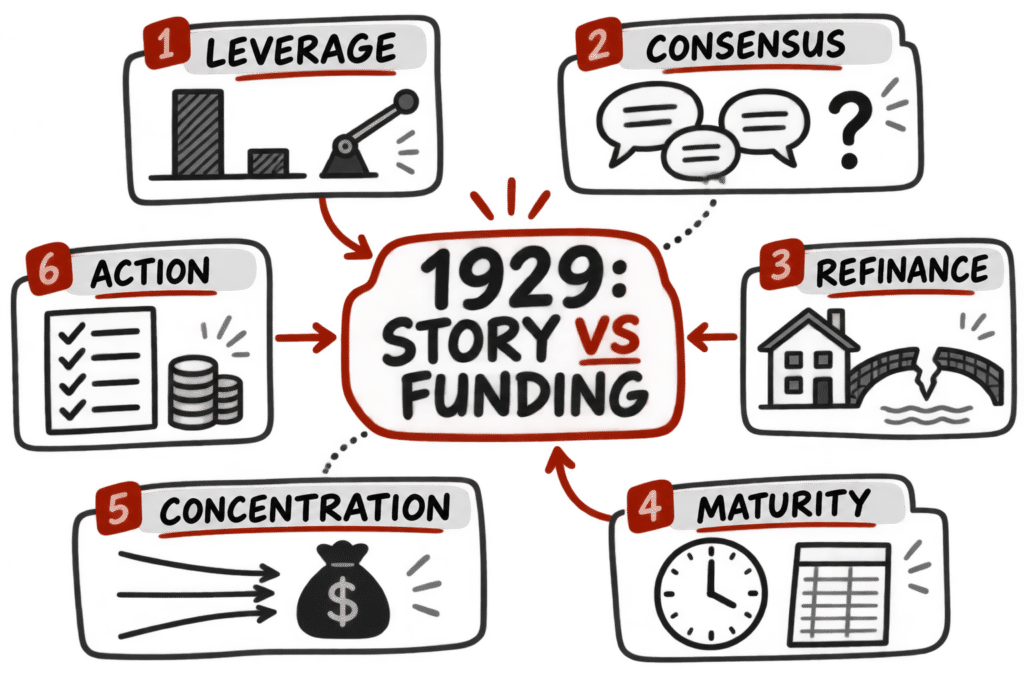
What does a 1929 summary mean for real estate leaders?
For real estate owners, investors, and operators, this 1929 summary of Andrew Ross Sorkin’s book highlights a strategic implication: a persuasive market story cannot protect a leveraged position when financing disappears. The book is positioned around the speculative boom and crash of 1929, a Wall Street episode that offers a useful lens on borrowed money, shared confidence, and institutional blind spots. This is not a commercial-property underwriting manual; real estate applications are translations from the historical context, not claims about Sorkin’s intended audience.
Leverage is the use of borrowed money to increase exposure to an asset. It can amplify gains, but it can also force a sale if a lender demands more collateral or debt comes due without replacement financing. The book may suit leaders who want historical context for examining those risks. Readers seeking a verified assessment of its specific scenes, reporting, or conclusions should consult the book itself; this review is based on its premise and the public historical record, not a confirmed close reading.
Core Idea: A strong story is not a funding plan
The historical premise is straightforward. During the 1920s, speculation expanded alongside credit and optimism about a new era of prosperity. When confidence broke and stock prices fell, leveraged investors faced pressure to find cash or sell. The crash fed a wider national collapse, though it was not the sole cause of the Great Depression.
Margin lending allowed investors to buy securities partly with borrowed money. Investment trusts also promoted exposure to rising markets, sometimes using leverage themselves. These are features of the historical setting, not claims about particular scenes in the book.
The useful distinction for an operator is between a thesis and the financing that carries it. A thesis can be plausible: demand may be durable, an asset may be well located, and a business may have capable leadership. None of those facts guarantees a lender will extend a loan on acceptable terms when it matures.
This Andrew Ross Sorkin summary therefore treats the crash as a lens, not a forecast. A shared narrative can support sound investment. It becomes dangerous when its popularity substitutes for evidence about what happens if liquidity tightens.
Best Takeaways: Three distinctions that matter
1. Leverage versus story
Borrowing changes the consequences of being early, wrong, or simply short of cash. If collateral falls in value, a lender may require additional equity or enforce other loan terms. Selling to meet those demands can add pressure to a falling market. The original investment story may still sound reasonable while the investor loses control of the timing.
For property owners, the relevant questions sit in the loan documents: How much cash equity is committed? Is the debt recourse or nonrecourse? What covenants apply? When does an interest-only period end? When must the principal be repaid or refinanced?
Those facts deserve equal billing with projected appreciation. A rising valuation is useful, but it is not itself a repayment plan.
2. Consensus versus evidence
“Everyone sees it this way” can be reassuring, especially when everyone includes experienced lenders and sponsors. It can also mean the same assumption has traveled through the same network without enough independent challenge.
In 1929, public enthusiasm for a new era of prosperity formed part of the backdrop to speculation. The modern parallel is not that a crash is imminent. It is the familiar habit of treating a favorable assumption as settled because it is widely repeated.
Consider a cap-rate forecast, a demand projection, or the belief that rates will be lower by maturity. Each may prove correct. Ask what evidence would make it wrong, and whether the investment remains workable if the market for buyers becomes thinner.
3. Price versus the ability to refinance
A property can retain substantial value and still face a financing gap. Suppose a loan has an $8 million balance at maturity. A replacement lender values the property at $10 million but will lend only 65% of that value. The new loan would be $6.5 million, leaving a $1.5 million gap before fees and other costs. Income, debt-service coverage, and lender policy could constrain proceeds further.
That is a liquidity problem, not necessarily proof that the asset was a bad purchase. The decision is whether the owner has cash, partners, or other credible options to bridge the gap without a distressed sale. These 1929 book key takeaways are editorial applications of crash history, not quotations or verified conclusions from Sorkin’s text.
Who Should Read It
The book’s premise may appeal to owners, investors, and business leaders who want to think about how financial confidence takes hold among sophisticated people. Sorkin’s public background adds a reason to consider it: he built DealBook, works in financial journalism and television, and reconstructed the 2008 crisis in Too Big to Fail.
That background may lead readers to expect a close view of decision-makers. Whether 1929 delivers that kind of scene-by-scene narrative, and how effectively it does so, remains a question to verify in the book itself. This is a premise-based 1929 Andrew Ross Sorkin book review, not a firsthand assessment of its reporting or prose.
For brokerage owners and team leaders, the transfer may be less about owning leveraged property than about business concentration: exposure to transaction volume, dependence on a few producers, and fixed expenses built for a market that stays liquid.
Where It Falls Short
There are limits to what this review can establish. Without a confirmed close reading, it cannot judge the book’s sourcing, pacing, treatment of individual figures, or contribution beyond existing histories. Those are material questions for anyone deciding whether to spend time with it.
There is also a limit to the analogy. The 1929 stock market and today’s commercial-property market have different financing structures, institutions, and rules. Similar incentives do not produce identical outcomes. Treating history as a direct rate forecast or a verdict on a particular market would overstate its value.
If you need loan-specific advice, market data, or an underwriting procedure, the historical premise is a starting point for better questions—not a substitute for those tools.
How to Apply It
Use these 1929 book strategy lessons as a short capital review, not as a prediction exercise:
- List the maturities. Record each debt balance, maturity date, recourse obligation, and material covenant. Identify who is responsible for arranging replacement financing.
- Separate value from proceeds. Estimate refinancing capacity using both a defensible valuation and a lender’s likely constraints. Show any cash gap separately from the property’s estimated value.
- Challenge the common assumption. Write down the one market condition the plan relies on most, such as lower rates or an active buyer pool. Test what changes if it does not arrive on time.
- Check concentration. Look at how many loans depend on the same lender, maturity window, or source of cash. A solution that works for one asset may not scale across the portfolio.
- Choose a response before the deadline. Depending on the facts, that might mean retaining cash, discussing extensions early, reducing debt, or evaluating a sale. Costs and tradeoffs belong in the decision.
The 1929 book leadership lessons are equally practical: invite a credible dissenting view, ask for the evidence behind a consensus, and make sure someone owns the financing decision. For readers seeking 1929 book lessons for real estate investors, the key question is not whether a property story sounds convincing. It is whether the capital structure can survive a less accommodating market.
Is 1929 by Andrew Ross Sorkin Worth Reading?
Possibly, if you want a historical prompt for examining speculation and leverage and are willing to translate the lessons yourself. If you need a proven guide to commercial-property underwriting—or a confident judgment about this book’s execution—look elsewhere until you can assess the text and its sources. The strongest next step is to bring the question back to your own debt maturities and financing options.
When the capital decision needs a clearer view, a candid conversation can help you weigh the tradeoffs.