
Apple in China Summary & Review: Supply-chain Lessons for Leaders
What is the Apple in China summary for business leaders?
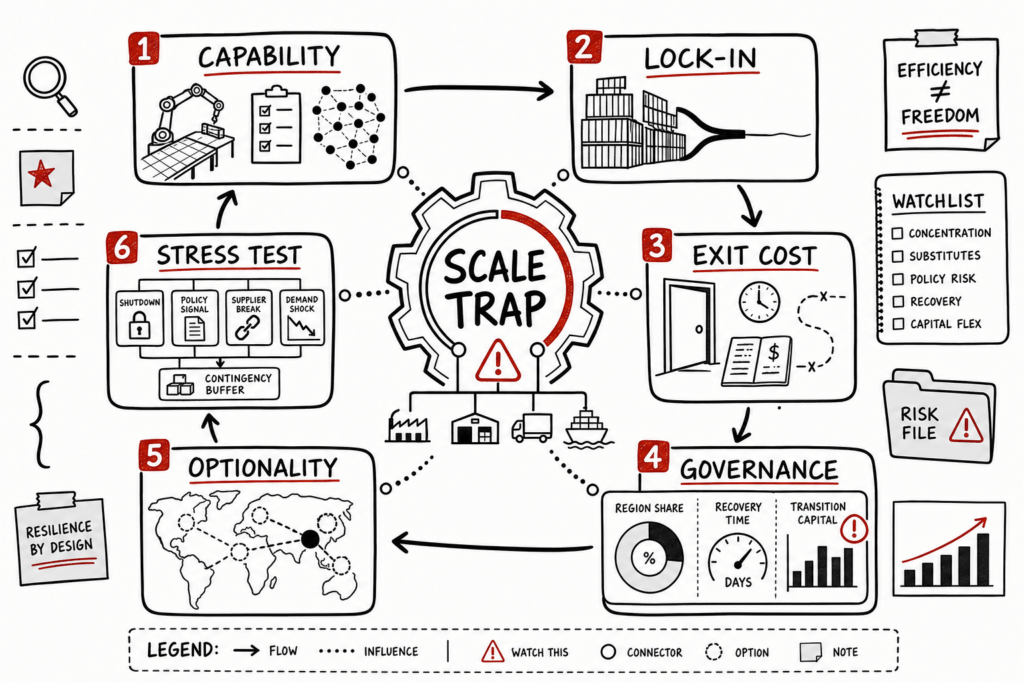
This Apple in China summary explains why Patrick McGee’s reporting matters to founder-operators, executives, investors, and advisors: Apple’s manufacturing success in China created exceptional capability and scale while increasing strategic dependence on an operating ecosystem that became difficult to replace. The core implication is that operational excellence and geopolitical vulnerability can rise together. McGee’s book is most useful for leaders responsible for supply chains, capital allocation, M&A, or concentrated client wealth—not readers seeking a product history. A practical definition of concentration risk is dependence on one geography, partner group, platform, or process whose disruption would materially impair revenue, delivery, or enterprise value. Leaders should therefore track more than unit cost. Relevant KPIs include the percentage of production tied to one region, estimated months to qualify an alternative supplier, transition capital required, and revenue exposed during a forced move. Read the book if those numbers could change your strategy.
Who Should Read It
Apple in China by Patrick McGee is a reporting-driven account of how Apple’s pursuit of manufacturing precision, speed, and scale became intertwined with China’s industrial development. McGee brings a Financial Times reporter’s interest in factory systems, supplier relationships, capital deployment, policy, and institutional power. This is not primarily a story about devices or launch events.
The strongest reader fit is an executive who owns a P&L, supply chain, investment portfolio, acquisition thesis, or client briefing where geographic concentration can reprice the business. Brokerage owners and established team leaders may not operate factories, but they will recognize the underlying problem: a firm can become dependent on one lead source, portal, market, rainmaker, referral partner, or service provider while the relationship still appears highly productive.
If you are asking, “Should I read Apple in China?” the answer is yes when you need a serious case study in China dependency risk and corporate supply chain strategy. Skim selectively if you only need language for a board or client discussion. The publisher’s official overview of Apple in China provides the basic publication context without replacing McGee’s full argument.
Core Idea
The central idea is uncomfortable but useful: the system that creates superior economics can also narrow strategic freedom. Apple did not simply purchase inexpensive manufacturing capacity. Its requirements for quality, tooling, training, volume, and process discipline helped deepen an industrial ecosystem capable of meeting extraordinary demands. That ecosystem, in turn, became central to Apple’s ability to execute.
This is the scale paradox. The more efficiently a company operates within one mature network, the more expensive it can become to leave. Facilities matter, but so do engineering knowledge, worker coordination, supplier density, logistics, management routines, and the accumulated learning that sits between formal contracts. A second factory in another country does not automatically reproduce that system.
That distinction sharpens the usual conversation about supply chain concentration risk. Exposure is not merely the percentage of units made in one place. It also includes switching time, qualification bottlenecks, knowledge transfer, policy constraints, supplier solvency, and the amount of executive attention required to manage a transition. Apple’s own supplier responsibility information is useful primary material for understanding how broadly the company frames standards and supplier oversight.
Apple in China Key Takeaways for Business Leaders
1. Treat dependency as a balance-sheet-class risk
Procurement teams often record supplier performance while boards focus on margins and launch timing. Neither view fully captures exit cost. A dependency capable of interrupting revenue, requiring major capital, or damaging customer trust deserves the same executive attention as leverage, liquidity, or customer concentration.
2. Map capability transfer, not just cash flow
In an important vendor relationship, ask who is learning what. Training, tooling, quality systems, workflow design, and demand visibility are strategic assets. A counterpart may become more capable while serving you, even if no formal intellectual property changes hands. That is not automatically harmful, but leadership should understand the trade.
3. Brand power is not operational sovereignty
Customer loyalty can support pricing, but it cannot instantly recreate specialized capacity. Strong demand does not guarantee manufacturing freedom. One of the clearest Apple in China business lessons is that market power and operating optionality are separate assets.
4. “Diversify later” becomes expensive quietly
Optionality usually erodes before a crisis makes the erosion visible. Each product cycle, supplier investment, and process refinement may strengthen the incumbent network. By the time geopolitical pressure rises, diversification can require years rather than quarters.
5. Governance metrics shape what management notices
If a board reviews unit cost but not time to recovery, it will favor efficiency over resilience without explicitly making that choice. Useful measures include single-region production share, alternative capacity already qualified, days of critical inventory, relocation capital, and projected gross-margin pressure during transition.
Where It Falls Short
This Apple in China review should not turn one deeply reported corporate case into a universal instruction to exit China. Apple operates at unusual scale, with product tolerances, launch cycles, bargaining power, and political visibility that many companies do not share. The facts may illuminate your problem without matching it.
The framing can also tempt readers toward hindsight. A dependency that looks dangerous now may have supported rational decisions at earlier stages. Leaders should distinguish between a poor decision and a successful decision whose risk profile changed over time. Otherwise, the lesson becomes “management should have known everything,” which is emotionally satisfying but operationally weak.
Finally, the book is more effective as a diagnosis than as a ready-made diversification manual. It can sharpen your questions, but it cannot calculate your firm’s transition costs, contractual constraints, customer tolerance, or viable alternatives. Pair its reporting with primary filings, vendor data, scenario analysis, and direct operating knowledge.
How to Apply It
Start with one operating decision, not a broad debate about globalization. Name the dependency: country, supplier, platform, channel, market, individual, or process. Then estimate what a forced unwind would cost in time, cash, service quality, customer confidence, and management attention.
Use a four-part dependency brief:
- Exposure: What percentage of revenue, production, leads, or service capacity relies on the dependency?
- Switching cost: How much capital and time would a credible alternative require?
- Early-warning indicators: Which policy, logistics, pricing, staffing, or service changes would signal deterioration?
- Accountability: Who owns mitigation, and when will leadership review it again?
Then stress-test specific events: export controls, capacity rationing, a plant shutdown, abrupt contract changes, loss of a lead platform, or departure of a key producer. Avoid “decoupling theater”—announcing diversification while leaving the core dependency untouched. Staged dual sourcing, inventory buffers, contractual rights, tested data portability, and gradual capability building are less dramatic and often more credible.
For advisors to principals and UHNW clients, keep the sequence disciplined. Establish verifiable exposure first. Quantify enterprise and liquidity consequences second. Discuss geopolitical narratives only after the operating facts are clear. These are the most transferable Apple in China strategy lessons and geopolitical risk leadership lessons: know what must keep working, what cannot be replaced quickly, and how much contingency capital buys genuine choice.
The broader value of Apple in China Patrick McGee is not a simplistic warning about one country. It is a reminder that exceptional performance can conceal declining optionality. Use the book to identify where your firm is dependent by design—and whether that design still serves the strategy.
If the exercise exposes a consequential dependency without a credible owner or transition path, the next move deserves a focused leadership conversation.