
Chip War Summary and Review: Capital Risk and Strategy
What Is the Chip War Summary for Business Leaders?
Chris Miller’s Chip War is a history of semiconductor power, specialization, industrial policy, and strategic dependency. For a business leader or long-duration real-estate adviser, its practical value is a way to ask which capabilities are difficult to replace and how a disruption could travel through a region.
The book is a scenario-planning lens, not a near-term market forecast. A current decision still needs current evidence about suppliers, power, policy, labor, infrastructure, and local demand. Read it to improve the questions behind a five- to ten-year decision, not to predict the next headline.
Core Idea
Chip War is not primarily a book about electronics. It explains how semiconductors became consequential infrastructure and how specialization created both productivity and vulnerability. Design expertise, fabrication knowledge, advanced equipment, materials, capital, energy, talent, and trusted relationships all matter; strength in one layer does not automatically create strength across the chain.
That distinction replaces the vague idea of technological dominance with a more useful question: who controls the capability that is hardest to replace? A chokepoint can become a source of commercial leverage, national power, or operational fragility. The publisher’s overview of Chip War provides additional context on the book’s historical scope.
Why Executives Trust Chris Miller’s Lens
Miller approaches the subject as a historian of technology, economics, and state power rather than as a chip engineer selling a short-term thesis. His strength is connecting decisions made by governments, researchers, manufacturers, and executives across decades.
The book gives leaders a vocabulary for discussing semiconductor supply-chain risk without requiring every reader to understand circuit design. Its history is substantial, but its limits matter: it does not replace current export rules, subsidy details, project plans, or local infrastructure evidence.
Best Takeaways
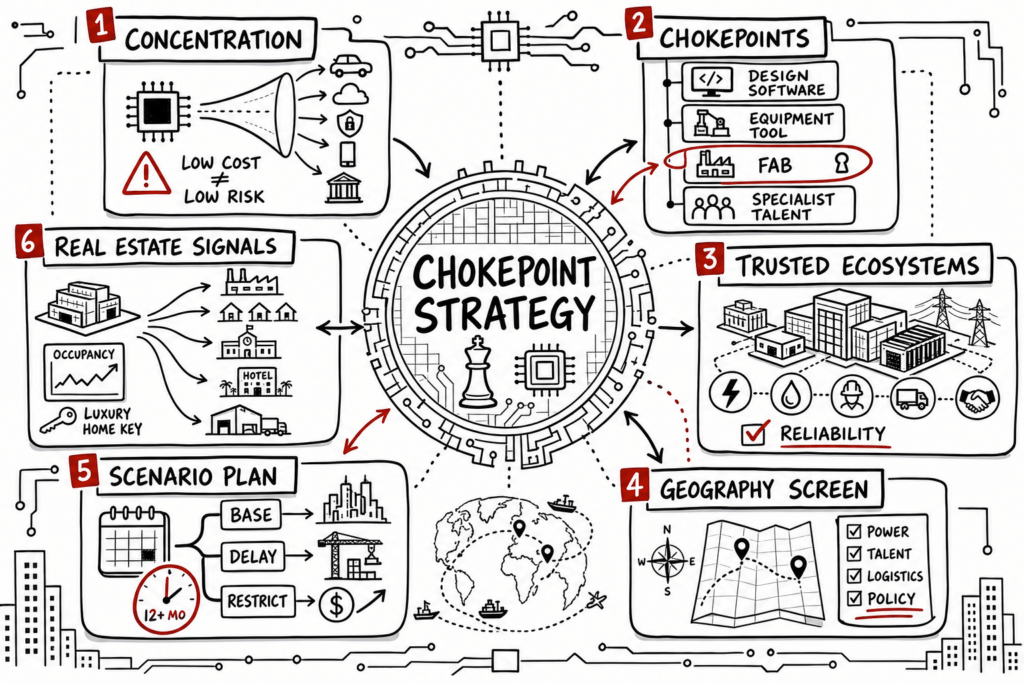
1. Concentration creates leverage and fragility
Extreme specialization can make an industry efficient while allowing a disruption at one critical layer to travel across autos, cloud infrastructure, defense, communications, and construction. Low-cost concentration can hide high-cost dependency.
2. Strategic advantage compounds slowly
Advanced manufacturing ecosystems are not created by one announcement. They require technical learning, suppliers, reliable power, skilled labor, infrastructure, and customer trust. Short-term political commentary rarely captures that long cycle.
3. Industrial policy has commercial consequences
Subsidies, export controls, security reviews, and domestic-manufacturing incentives can influence where facilities are built, where talent relocates, and which regions attract supporting investment. Treat policy as an input to a scenario, not as proof that a project will succeed.
4. Chokepoints matter more than broad market share
A company or country may participate heavily in an industry while remaining dependent on a narrow tool, supplier, or manufacturing capability. Map replaceability and switching time instead of relying on revenue exposure alone.
5. Trusted ecosystems attract durable capital
Capital-intensive industries favor jurisdictions with policy clarity, infrastructure reliability, specialized talent, and secure commercial relationships. The same lens can help a leader assess data centers, advanced manufacturing, logistics, and high-value residential demand without assuming that one investment determines a whole market.
Chip War Business Implications for Real Estate
The connection between semiconductor competition and real estate is indirect but material. A fabrication or advanced-manufacturing investment may create demand for industrial land, supplier facilities, logistics, housing, schools, hospitality, and executive services. It may also expose constraints in power, water, transport, and skilled labor.
The useful signal is not simply that a factory was announced. Ask whether the surrounding ecosystem can retain senior talent, whether infrastructure can support expansion, and whether policy commitments are durable across the investment cycle. Technical executives and family offices may evaluate a jurisdiction through business access, stability, education, connectivity, and security together.
Monitor fab-related capital expenditure, grid capacity, supplier announcements, technical hiring, infrastructure approvals, and premium-housing absorption as a group of signals. No single metric is decisive, and a public announcement is not evidence of sustained demand.
Where It Falls Short
The book’s narrative power can make semiconductor competition feel more determinative than it is. Regional outcomes also depend on demographics, fiscal capacity, energy policy, education, regulation, and execution. Leaders should resist turning one strategic lens into a complete investment thesis.
It offers more historical explanation than operating playbook. Readers seeking a portfolio allocation, property forecast, or company-specific risk score must build that work from current evidence. Geopolitics also changes faster than publishing cycles, so current rules and project timelines require independent review.
How to Apply It
Run a four-part chokepoint audit
Map exposure across suppliers, geography, infrastructure, and policy. For each dependency, record the replacement time, switching cost, jurisdiction, evidence date, and operational consequence. Put dependencies that would take a long time to replace on the executive risk register, using a threshold that fits the business.
Build three scenarios
Create a base case, a delayed-shock case, and a prolonged-restriction case. Test how each could affect construction costs, data-center demand, industrial occupancy, capital flows, and client relocation. Give assumptions a review date instead of treating them as permanent.
Use a geography screen
Compare target markets on power availability, policy durability, technical talent, logistics resilience, manufacturing adjacency, and quality of life. The screen helps distinguish places receiving investment from places capable of converting it into sustained private demand.
Translate the issue for clients
A useful briefing identifies the dependency, the evidence that would confirm a shift, the time horizon, and the decisions that remain reversible. The leadership lesson is to turn complexity into measured choices without manufacturing certainty.
Who Should Read It?
Read Chip War if you allocate capital, lead a technology-dependent company, advise a family office, evaluate infrastructure markets, or underwrite long-duration real estate. It is especially useful for connecting US–China competition, AI-compute demand, industrial policy, and regional development.
Skip it when the immediate need is a technical chip-design manual or a short-term investment forecast. Its value lies in strategic pattern recognition: understanding why trusted capacity, concentrated expertise, and difficult-to-replace tools shape economic power.