
Experience Economy Pine Gilmore Summary for Luxury Real Estate
What is the best Experience Economy Pine Gilmore summary for business leaders?
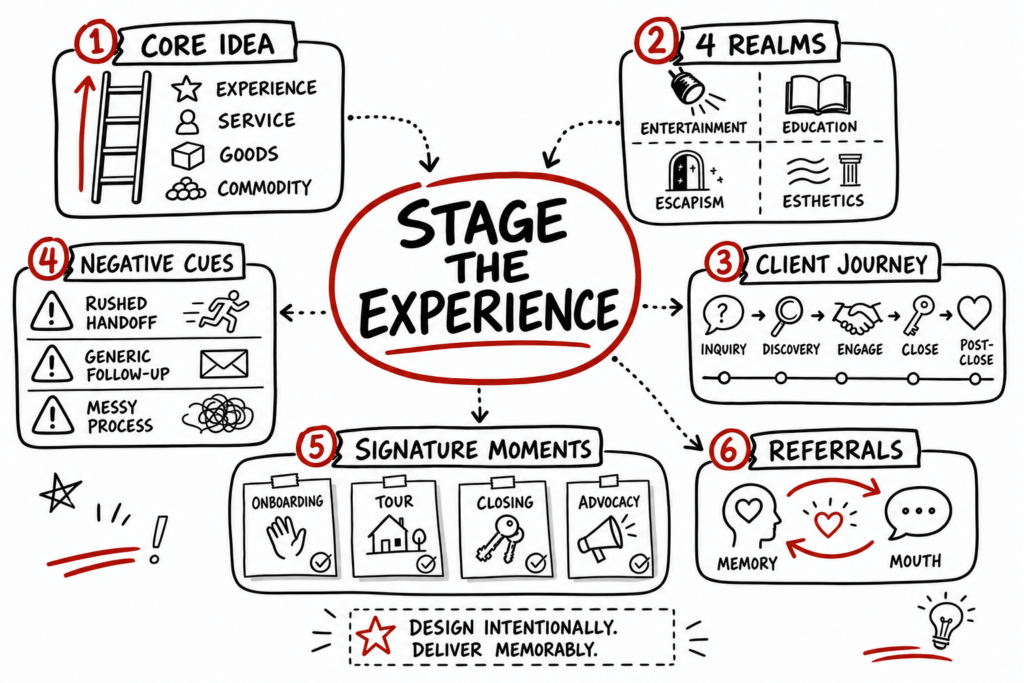
The Experience Economy, Updated Edition by B. Joseph Pine II and James H. Gilmore argues that businesses create value by staging experiences rather than treating service as the final offer. Its useful tool for luxury real estate is the four realms of entertainment, education, escapism and esthetics. Read it as a lens for designing a client journey, not as a script for theatrical gestures or a promise of premium pricing.
Who Should Read It
The book fits luxury advisors, brokerage founders, private-client teams, developers, architects and service leaders whose clients can choose among many competent providers. It is especially useful when “client experience” has become a list of polite replies, polished marketing and closing gifts without a clear memory or purpose.
Pine and Gilmore offer a way to ask what the client actually remembers and whether the firm designed that memory deliberately. The book will not supply a listing presentation or buyer-consultation template; it gives a vocabulary for translating competence into a more intentional relationship.
Core Idea
The authors describe an upward movement from commodities to goods, services and experiences. In a premium market, the distinction is useful because great service can still feel interchangeable. An experience engages a customer personally and makes the journey itself part of the value.
For luxury real estate, that does not require spectacle. It can mean context before surprise, personalization before performance and emotional clarity before a client has to ask. A tour, consultation or closing should feel coherent with the client’s stated goal.
Experience Economy Pine Gilmore Summary: Best Takeaways
1. The offering is not the property. It is the transformation around the property.
The property is the obvious product, but the client may be buying privacy, belonging, mobility, safety, legacy or a new chapter. A buyer relocating for a role may need to imagine daily competence in an unfamiliar place. A seller leaving a long-held estate may need a process that respects memory as well as price. The advisor’s work is to understand that emotional job without inventing a diagnosis.
2. The four realms clarify what your client journey is missing.
Entertainment asks what captures attention. Education asks what makes the client more capable. Escapism asks where the client participates and becomes immersed. Esthetics asks what environment supports attention and trust. A buyer tour may combine them through a clear neighborhood story, useful context, a lived route and a calm arrival sequence.
3. Themeing is not decoration. It is strategic coherence.
Strong themeing makes each cue reinforce the client’s stated future. If the goal is a quieter life with better access, the journey should not feel rushed or crowded. If the goal is legacy, the process should feel curated and dignified. Harvard Business Review’s book page and Strategic Horizons provide additional context for the authors’ work.
4. Negative cues are expensive.
Rushed handoffs, generic follow-up, weak preparation, messy vendor introductions and inconsistent documents can weaken trust even when no single error ends the relationship. Before adding premium touches, remove cues that signal disorganization. Consistency often feels more luxurious than surprise.
Where It Falls Short
Experience design is constrained by regulation, market volatility, family dynamics, financing, inventory and emotion. Clients also notice manipulation. A branded gift is not a strategy if the underlying process is confusing, and a staged moment backfires when it is disconnected from the client’s actual priority.
The book explains how to think about value creation but does not redesign onboarding, compensation, segmentation or referral operations for a brokerage. Translate the ideas into standards with owners and evidence.
How to Apply It
1. Audit the journey by emotional state, not task list.
Map inquiry, discovery, search or listing preparation, negotiation, closing and post-close. Add the likely emotional state at each phase: uncertainty, excitement, fear, fatigue, relief or pride. Ask where the client needs authority, reassurance, privacy or a moment to imagine the future.
2. Design one signature moment per phase.
Do not make every touch unforgettable. Choose one useful moment for onboarding, the search or listing phase, negotiation, closing and the long-term relationship. A private intelligence brief or an annual property conversation can be more meaningful than an expensive flourish.
3. Use the four realms as a team scorecard
Review the journey against entertainment, education, escapism and esthetics. A team may over-index on data or on beautiful collateral. The point is not to maximize each realm. It is to see which kind of value the client can actually use.
4. Remove negative cues before adding premium touches
Standardize calendar language, tighten meeting briefs, improve vendor handoffs and align visual presentation across proposals, buyer packets, listing timelines and post-close materials. Fixing friction should come before adding theatrics.
5. Turn memory into referrals
After a transaction, ask which part of the process gave the client the most confidence. That answer reveals what the market values and gives the firm language for an appropriate referral invitation. Ask only when the relationship supports it.
Final Verdict
The Experience Economy is worth reading for leaders who suspect competence alone is becoming interchangeable. Its strongest application in luxury real estate is restrained: theme the journey around the client’s actual motivation, remove negative cues, design a few signature moments and make the process feel as considered as the result.
You can request a complimentary one-hour conversation with a senior advisor who is an experienced operator. Talk through your next move when your client journey needs clearer intent, fewer friction points and a more coherent experience.