
Filterworld Summary & Review: Lessons for Luxury Real Estate Leaders
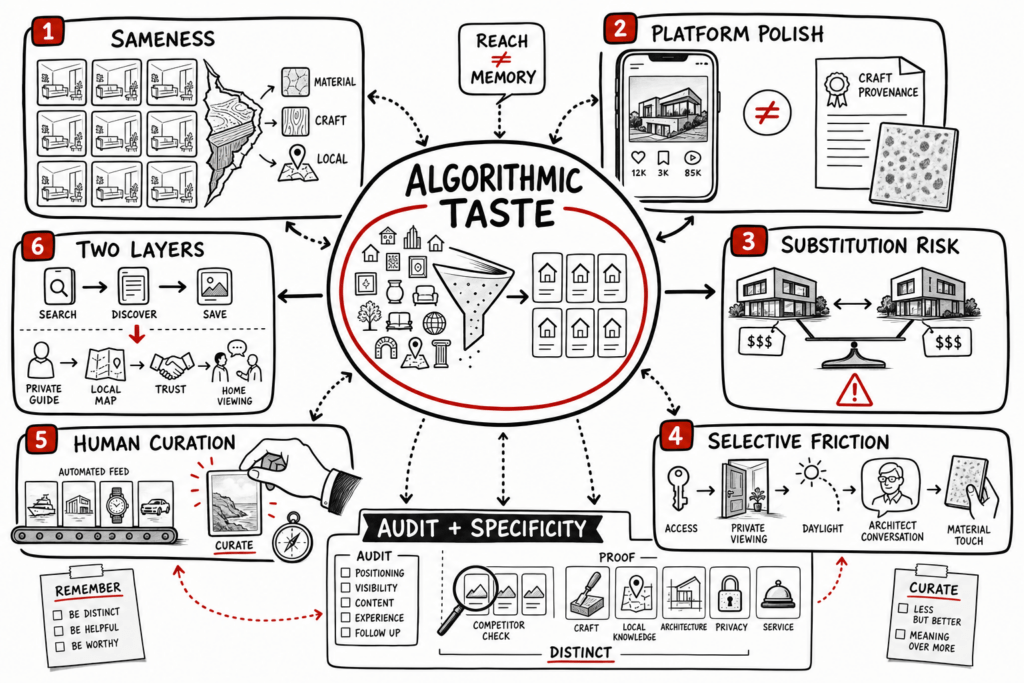
Filterworld asks how recommendation systems influence culture and the choices people encounter. Kyle Chayka’s argument offers a useful starting point for property marketers who find their work becoming difficult to distinguish from everyone else’s.
This is a cultural critique, not evidence that a particular visual style raises property values. The real estate applications below are proposals for examining your own work, separate from the book’s central argument.
What Is the Filterworld Summary for Luxury Real Estate Leaders?
Chayka argues that automated recommendation can influence both what people consume and what creators produce. The publisher’s page for Filterworld identifies the book and its account of machine-guided curation. The original ebook appeared in January 2024; the listed paperback edition followed in January 2025.
For a real estate leader, the useful question is whether distribution choices have begun to dictate the entire presentation. A property can have distinctive qualities that are obscured by familiar images and generic descriptions.
Core Idea: How Algorithmic Taste Produces Sameness
In Chayka’s account, systems that rank and recommend culture can reward recognizable formats, encouraging repetition. His concern extends beyond a person’s feed to the incentives shaping creative work and physical spaces.
A practical application is to inspect the reference material used in a marketing brief. If every example comes from the same popular accounts, a team may reproduce that narrow selection without consciously choosing it. That is a possibility to investigate, not a diagnosis of every campaign.
Filterworld Review: What the Book Does Well
The book’s useful contribution is to make curation visible as a choice. It invites readers to examine who selects the options they encounter and what incentives influence that selection.
For a team discussion, that can be more productive than arguing over whether a photograph looks sufficiently distinctive. Ask how the brief was assembled, what was omitted and whether the final work explains anything specific about the property.
Best Takeaways: Filterworld Key Takeaways for Luxury Brands
The following four takeaways apply the book’s questions to real estate practice. They are working propositions for review, not findings about affluent buyers or a formula for increasing a sale price.
1. Taste is now part of the infrastructure
Look at the sources shaping your team’s references: client requests, architects, local buildings, vendor portfolios, platform feeds and your own experience. Notice when one channel supplies most of the examples. Broaden the inputs before assuming that a repeated style is the only credible choice.
2. Platform polish is not the same as premium value
Separate visual presentation from evidence. A polished image cannot establish the origin of a material, the quality of construction or the condition of a property. Support those details with appropriate records and qualified expertise. Good presentation should help a reader understand the evidence.
3. Sameness increases substitution risk
Interchangeable language may leave readers with fewer details to remember. Treat that as a communication problem to test. Ask someone to explain what differs among several properties after reading their descriptions, without suggesting the answer.
Do not infer a price premium from that exercise. Recall, preference and an eventual purchase are different outcomes with many influences.
4. Selective friction can create meaning
A viewing arranged to understand changing light, a discussion with an available design professional or a material sample may help someone assess a property. Offer these when useful and feasible, with the owner’s permission.
Additional effort is not valuable by itself. Keep information and access usable, accommodate legitimate needs, and avoid manufacturing inconvenience as a signal of exclusivity.
Impact on Buyer Decisions and Luxury Marketing Strategy
Distinguish discovery from evaluation. A search result or short video may introduce the property. Accurate plans, condition information, local knowledge and a useful viewing help a person examine whether it fits their needs.
Review each stage on its own terms. Reach does not establish lasting recall, and a saved post does not establish buying intent. Pair channel measures with the questions people actually ask and the progression of inquiries, while respecting privacy and fair housing. Do not assume every buyer shares the same aesthetic preferences.
Where It Falls Short
A cultural argument does not answer which channel, budget or creative treatment will work for a particular brokerage. Readers still need local research, client feedback and a measured comparison of alternatives.
Recommendation systems can also help people discover unfamiliar work. The useful response is to examine dependence and retain judgment, rather than treat all automated discovery as harmful. Apply the book as a prompt for inquiry and keep its commercial implications open to evidence.
How to Apply It
Start with one property campaign or one service page. Give the review a defined audience and question, then examine the language, images, supporting evidence and next step together. A manageable review is more useful than a broad demand to make the brand unique.
Run a sameness audit
Place the material beside a small, relevant set of other examples and temporarily cover the logos. Identify repeated claims and ask which concrete differences remain. A phrase such as “timeless design” needs explanation; it should not stand in for the actual material, layout or architectural choice.
Build a specificity inventory
List the details you can support: documented design intent, verified material information, usable dimensions, maintenance records, local context and service commitments. Obtain permission before using a person’s contribution or a private account. Remove details that cannot yet be substantiated.
Separate platform content from brand memory
Choose what each channel needs to convey, and keep the underlying facts consistent. A short post may lead to a fuller property guide, but the guide should earn its length with useful information. Ask readers what they understood and what remains unclear rather than treating engagement alone as proof of differentiation.
Protect human curation
Make room for the judgment of agents, designers and other qualified contributors. Explain what their experience adds and where their expertise ends. An informed conversation, a well-chosen detail or a clear explanation of a tradeoff can be more useful than a large volume of similar content.
Who Should Read It?
Filterworld is worth considering for readers responsible for creative direction, property presentation or the way a brokerage uses digital platforms. It offers questions about taste and selection, not a tactical lead-generation manual.
After reading, choose one decision your team can examine with evidence. For the related operating question, see our discussion of technology partnerships for boutique brokerages: a platform should support a defined capability, with its costs and dependencies understood.