
Luxury Property Features 2025: Data-Backed Trends Elite Agents Must Lead
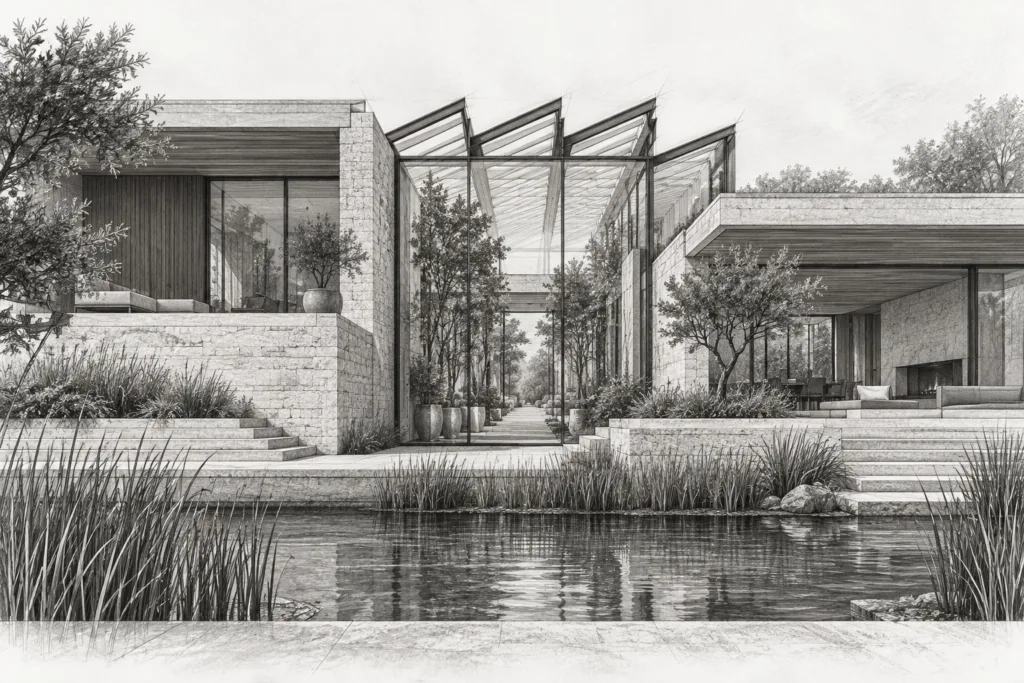
Luxury Property Features: A Listing Evidence Loop
A feature earns space in a luxury listing when the team can explain how it changes the way the home is used, maintained or understood. A beautiful finish may matter, but a feature list by itself does not tell an agent which preparation, proof or buyer conversation deserves attention. Treat the property as a set of signals to investigate rather than a checklist to repeat.
Start with the lived value of each feature
Ask what the feature changes in daily use. Privacy may come from sightline control, planting and entry sequence. Comfort may come from acoustics, ventilation and consistent temperature. Resilience may come from documented systems, accessible maintenance and a clear service history. The same feature can carry different value for different buyers, so the listing narrative should state the observable condition rather than promise a universal result.
Translate the feature into a question
For each material or system, ask who uses it, when it matters, what proof exists and what maintenance it requires. A quiet window package, for example, deserves an acoustic specification and installation record if those documents exist. Without proof, describe the visible design and keep the performance claim conditional.
Build a repeatable feature intelligence loop
Collect observations from comparable listings, showing feedback, buyer questions, inspection notes and service records. Keep the source, date, property context and exact language with each observation. Review the log on a set cadence and retire a conclusion when the underlying evidence no longer matches the market or the property.
Separate observation from interpretation
“Several buyers asked about backup power” is an observation. “Backup power will protect price” is an interpretation that needs stronger evidence. Keeping those statements separate helps the agent decide what to document, what to test and what to leave out of the listing.
Use four signals before prioritizing a feature
- Market behavior: compare relevant listings and transactions, using a consistent feature definition and time period.
- Buyer language: record exact questions and motivations without turning a small sample into a broad preference claim.
- Comparable gaps: identify what differs in the closest competitive set, then explain whether the difference is usable, documented and maintained.
- Operating responsibility: note installation, warranty, service access, replacement cycle and likely ownership work.
The four signals do not produce an automatic ranking. They give the listing team a disciplined conversation about which feature deserves proof, a repair, a better explanation or no emphasis at all.
Describe comfort without promising an outcome
Air quality, daylight, acoustics and sleep-supporting layouts are meaningful design questions, but “wellness” is too broad to stand alone. Describe the actual system, room relationship or documented specification. A filtration unit should be identified by the available records; a quiet bedroom should be described through construction, placement or measured information where available.
Use a feature note that states what is installed, who services it, when it was last maintained and what remains unknown. This makes a buyer conversation more useful than a claim that the feature will improve health, sleep or sale speed.
Map privacy as a sequence of thresholds
Privacy is rarely one gate or one hedge. Map the approach, sightlines, outdoor rooms, bedroom separation, staff routes and technology controls that shape who sees what and when. The map should distinguish design conditions from operating practices such as access rules, lighting schedules and security service.
Show the benefit and the tradeoff
A tall planting screen may soften views while adding irrigation and pruning. A controlled entry may reduce casual access while changing the arrival experience. Giving the seller both sides of the choice supports a more credible listing plan and leaves any emotional or financial effect for the buyer, seller and their professionals to assess.
Document resilience and ownership work
Generators, storage, electrical equipment, HVAC and durable materials can matter because they affect continuity and maintenance. Their value depends on installation quality, service history, capacity, warranties and local conditions. Build a systems dossier with manuals, invoices, inspection records and the name of the servicing party when the owner has those records.
Describe resilience as a documented ownership characteristic. Let the buyer and their professionals determine suitability, operating cost and any pricing implication. A systems dossier supports diligence; continuity still depends on equipment, service and conditions.
Present technology as an understandable service layer
Luxury technology is easier to evaluate when the team can show what controls what, how the systems connect and who supports them. A clear network map, equipment list, access protocol and transfer plan are more useful than a wall of branded features. Avoid calling a home “AI-ready” unless the phrase has a specific, documented meaning for that property.
Keep security and privacy bounded
Do not publish access credentials, camera positions or sensitive household routines. Describe the handoff process and invite the buyer’s professionals to assess the system. Reliability is a maintenance and governance question as much as a hardware question.
Turn feature evidence into a listing plan
The agent’s work is to choose a small set of features that can be explained, supported and connected to the intended buyer conversation. Start with the property’s actual condition, then decide what needs documentation, repair, staging, photography or a carefully worded note.
Use a three-part feature playbook
- Map: connect each feature to a buyer question and the evidence that answers it.
- Prioritize: choose one or two improvements whose scope, cost and timing fit the property and seller’s decision.
- Package: assemble the systems dossier, improvement timeline, service contacts and plain-language explanation.
Review the feature story after showings and inspections. If buyers ask a question the package cannot answer, improve the evidence before adding another marketing claim.
Lead with proof and proportion
The strongest luxury feature narrative makes the home easier to understand. It names the visible design, describes the operating reality, records the proof and leaves decisions to the people qualified to make them. That standard gives the seller a focused preparation plan and gives buyers a clearer basis for diligence.
Request a complimentary one-hour conversation with a senior advisor who is an experienced operator. Talk through your next move.