
Personal Reserves Assessment
Personal Reserves Assessment
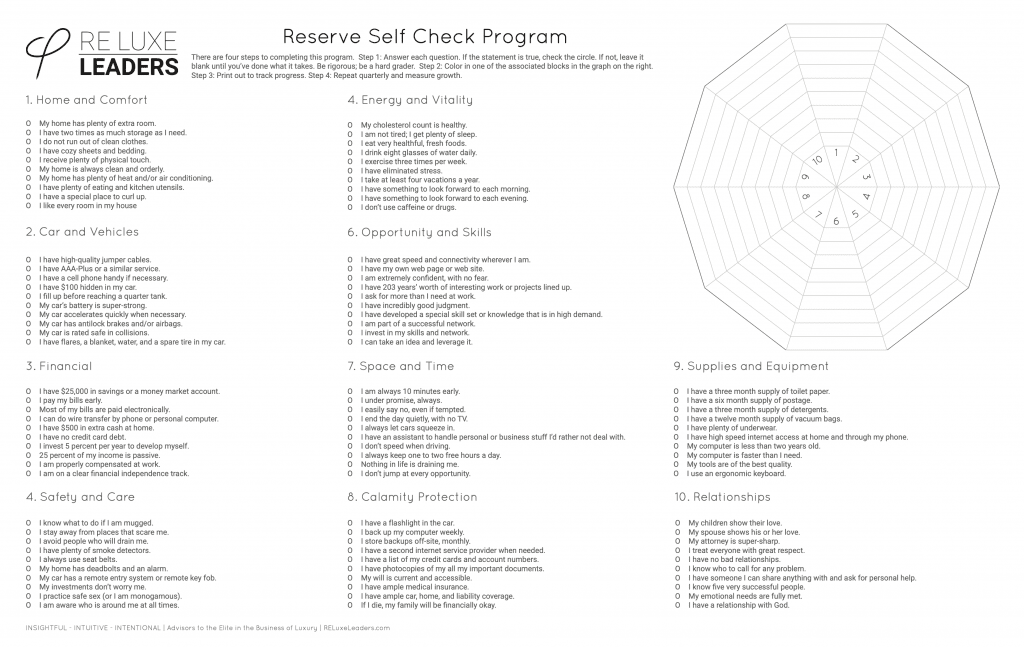
Reserves are the resources and relationships that help a person stay prepared when plans change. The Reserve Self Check Program worksheet offers ten areas for a structured review: Home and Comfort, Car and Vehicles, Financial, Safety and Care, Energy and Vitality, Opportunity and Skills, Space and Time, Calamity Protection, Supplies and Equipment, and Relationships.
Use the ten areas as prompts
Work through one area at a time and describe what is available, what is current and what would be difficult to replace. “Financial” can prompt a review of the records and obligations relevant to your situation. “Energy and Vitality” can prompt an honest look at routines and capacity. “Relationships” can surface the people to call before a difficult decision. The worksheet is a reflection tool; its radial chart should show your answers, not manufacture a level of readiness.
Build a practical next step
- Choose a date and write the evidence behind each section rather than relying on a general impression.
- Circle the area where a small, specific improvement would make the greatest difference to your current plans.
- Define the next action, the resource it needs and a date for checking progress.
- Separate items you can change from items that require advice, a professional service or a conversation with someone you trust.
- Repeat the review when your circumstances change and compare the notes to see what has actually moved.
A reserves assessment is useful when it leads to a grounded decision: replenish one supply, protect one block of time, update one record or reconnect with one person. Keep the review specific enough that the next action can be seen and revisited.
Request a complimentary one-hour conversation with a senior advisor who is an experienced operator. Talk through your next move.