
Reset Dan Heath Summary: Review and Key Takeaways for Leaders
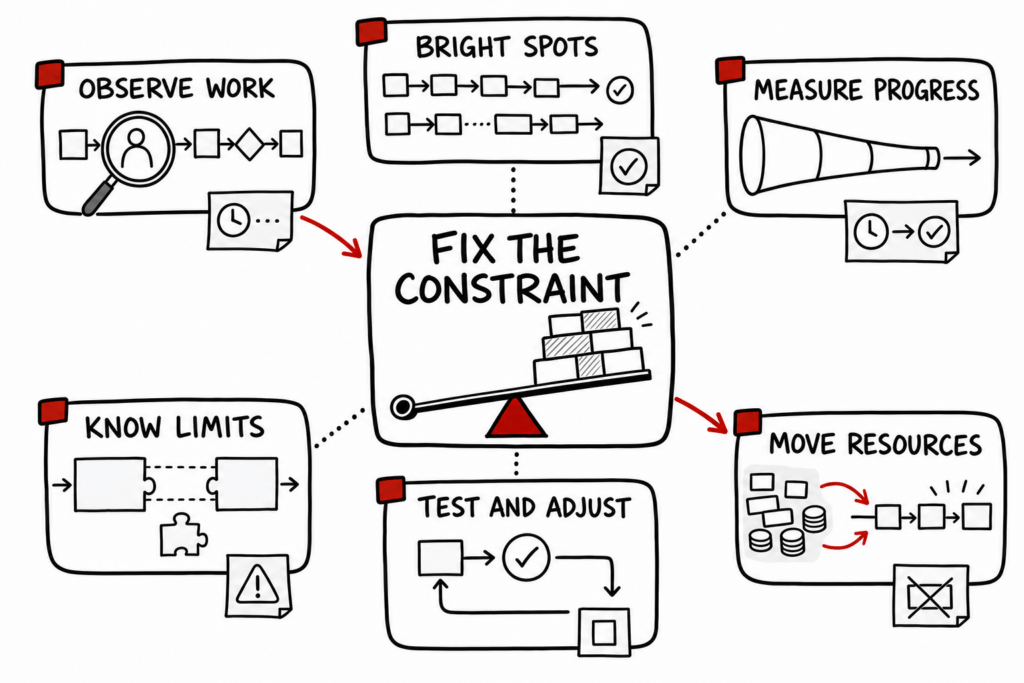
What is the Reset Dan Heath summary for leaders facing stalled change?
For brokerage owners and team leaders, this Reset Dan Heath summary explains how Dan Heath’s Reset: How to Change What’s Not Working frames stalled organizational change as a problem of leverage and resource allocation, not insufficient effort. Its central proposition is to find a leverage point—a place where a focused intervention can influence a larger system—and redirect existing resources toward it. In a brokerage, that could mean examining the delay between a listing consultation and a signed agreement before buying another lead-generation tool. Track elapsed days and conversion at that handoff rather than treating activity volume as proof of progress. The book is a strong fit for operators who can observe work and change how time, money, and talent are used. It is a weaker fit for readers seeking a personal reboot, a culture manifesto, or a step-by-step real estate playbook.
Core Idea: Fix the Constraint, Not Everything Around It
This is Dan Heath’s book, not a Chip-and-Dan coauthored title and not a personal-productivity reset. Its useful territory is work that already exists but no longer produces the result you need: a recruiting process, an operational handoff, or a growth effort that keeps consuming attention.
The familiar response is to add something. Another meeting. Another platform. Another training program. Each addition may be reasonable on its own, while the underlying obstacle remains untouched. That is transformation bloat: more machinery around the same stuck work.
Heath’s leverage-point lens changes the question from “How do we get everyone to try harder?” to “Where would a focused change alter performance?” The distinction matters because a busy system can conceal a narrow constraint. Five visible problems do not necessarily require five initiatives.
The companion idea is resource reallocation: put existing time, attention, money, and talent where they can address that constraint. This is a management decision, not a motivational message. Something else may need to stop.
Who Should Read It
Reset is best suited to owners, operators, and team leaders who have enough visibility to investigate a system and enough authority to move resources within it. You do not need a failing business. You need an identifiable part of the business where effort and results have stopped lining up.
For established real estate leaders, that might be a listing pipeline with inconsistent follow-through, recruiting activity that produces few accepted offers, or recurring service failures between agents and operations. Heath is writing across industries; the brokerage applications here are interpretations, not a real estate manual hidden inside the book.
Readers familiar with Switch and Upstream will recognize related interests: learning from what already works and examining the system behind repeated problems. Here, the useful emphasis is restarting work that has stalled rather than simply launching change or preventing trouble.
Best Takeaways: What Deserves Your Attention
Observe the actual work
A leadership meeting describes the process. Watching a handoff shows what happens. For a brokerage, that means following a real inquiry, recruiting conversation, or listing file through the people and decisions involved. Look for waiting, duplication, missing information, and unclear ownership before deciding the team needs more training.
Study an internal bright spot
If one person or office gets better results under comparable conditions, examine that difference before importing an outside model. The advantage is relevance: the example already operates within some of your constraints. Still, test the explanation. Better territory, experience, or support may account for the result—not a transferable habit.
Check whether the target measures progress
A recruiting team can exceed its conversation target while producing few viable candidates. More conversations may only enlarge the wrong pool. The useful leadership question is whether the metric describes meaningful movement toward the outcome or merely convenient activity.
Make resource allocation explicit
The strongest strategy lesson is uncomfortable but practical: a priority without reassigned capacity is often just an announcement. If a stalled process matters, identify the time or talent it needs and what will receive less. Do not quietly ask people to absorb a new priority alongside everything else.
Where It Falls Short
The leverage-point argument is compelling, but it does not make diagnosis easy. Several constraints may interact. A slow handoff could reflect unclear authority, weak information, or a workload problem. Choosing the most visible explanation can produce a neat intervention that misses the cause.
There is also a boundary between reallocating resources and fixing structural shortages. Focus cannot replace missing expertise, necessary staffing, or adequate capital. A leader should not use the book’s premise to justify asking an already stretched team to do more with less.
As a Reset Dan Heath book review, the candid verdict is that its value lies more in sharpening judgment than supplying a complete implementation system. Do not expect a brokerage script, a culture manifesto, or certainty about results. Small interventions still require measurement and adjustment.
Skip it for now if you cannot name the work that is stuck. Broad dissatisfaction is not yet a useful diagnosis.
How to Apply It Without Launching Another Program
The following is a practical brokerage application of the book’s high-level ideas, not a reproduced worksheet or a promise of improvement.
- Choose one stalled outcome. Replace “recruiting is weak” with a specific observation, such as qualified candidates dropping out between the first meeting and an offer.
- Follow the work. Review recent cases and speak with the people handling each handoff. Distinguish what you know from what you suspect.
- Compare a working example. Find a similar case that moved successfully. Ask what differed and whether that difference is repeatable.
- Name one intervention and its tradeoff. You might reassign administrative support to candidate follow-up. State which lower-value task will lose that capacity.
- Set a bounded test. For example, review handoff time and candidate progression over four weeks. That is an illustrative test window, not Heath’s prescribed threshold. Avoid claiming success from a few favorable cases.
Then decide whether to continue, revise, or stop. The point is not to preserve the experiment. It is to learn whether the intervention addresses the actual constraint.
Is Reset by Dan Heath Worth Reading?
Yes, if you need a sharper intervention in a system you can observe and influence. Its strongest contribution is permission to question the scale of the response: less rollout, better diagnosis, and an explicit choice about resources. Skip it if you want personal reinvention or a ready-made brokerage operating model. Judge the book by whether it helps you choose a smaller, better-aimed change—not by whether it leaves you feeling inspired.
If the next decision is what to stop, shrink, or reallocate, it is worth talking through the tradeoffs before adding another initiative.