
Right Kind of Wrong Summary: Fail Better in Real Estate
What is the Right Kind of Wrong summary for leaders?
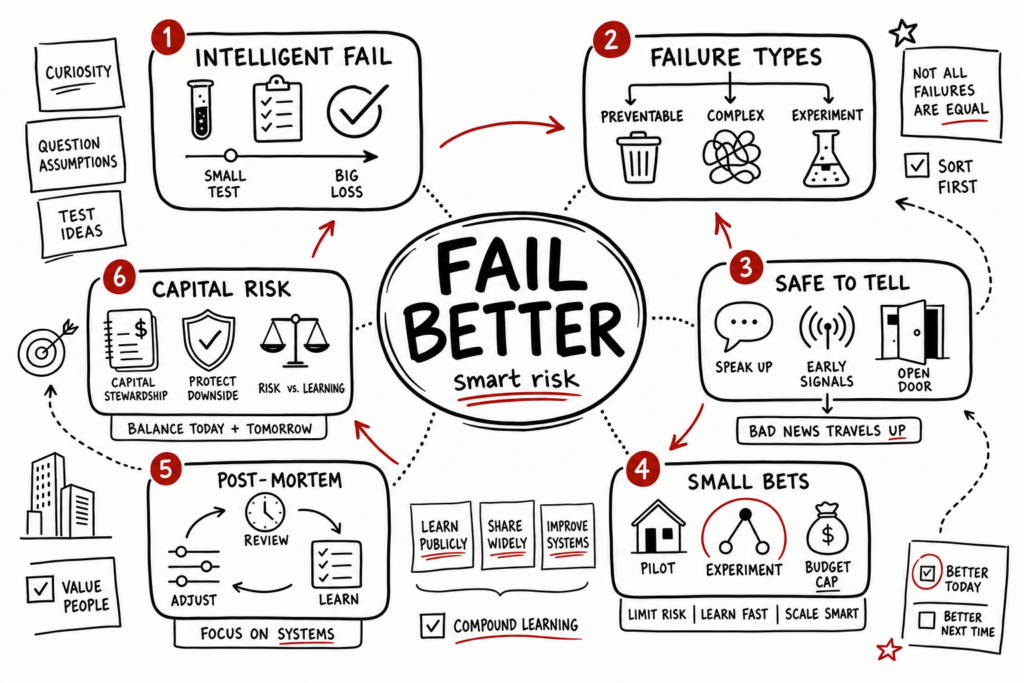
Right Kind of Wrong by Amy C. Edmondson examines how leaders can learn from intelligent failure while still protecting people, capital and standards. For a real-estate team, the useful distinction is between a preventable mistake, a complex outcome and a bounded experiment.
The book is a leadership lens. It does not excuse negligence, remove accountability or guarantee that a post-mortem will prevent the next problem.
Who Should Read It
The book fits leaders who want a more precise vocabulary for risk, learning and psychological safety. It is less useful as a substitute for compliance, safety, financial controls or a direct conversation about responsibility.
Core Idea
Failure should be examined in context. The right response depends on what was known, what was controllable, what was tested, what harm occurred and what the team can change. A learning culture still sets boundaries.
Best Takeaways
1. Intelligent failure needs boundaries
A small experiment needs a defined question, owner, limit and stop condition. The tighter the boundary, the easier it is to learn without turning avoidable harm into a teaching exercise.
2. The language leaders use sets the risk culture
Describe what happened and what was known before assigning a label. Language that is precise about harm and responsibility creates more useful learning than either blame or vague optimism.
3. Psychological safety is not softness
People should be able to raise a concern or admit an error without humiliation. They still need clear standards, direct feedback and a fair response when a decision caused preventable harm.
4. Post-mortems should happen before the corpse is cold
Review while the facts, assumptions and handoffs are available. Separate the immediate response from the later system change, and give the person affected a chance to correct the record.
Where It Falls Short
A failure taxonomy can become another label that avoids a hard decision. Some events require remediation, reporting or discipline. A thoughtful culture makes room for learning while protecting clients, colleagues and the firm.
How to Apply It
Define the bet before funding it
State the assumption, budget, decision owner, evidence and stop condition before work begins. This makes an unexpected outcome easier to understand.
Separate accountability from blame
Ask what the person controlled, what support was missing and what the role required. Correct the record and the system without using humiliation as management.
Create a failure taxonomy for leadership meetings
Use categories such as preventable, complex and experimental only after reviewing the facts. The category should change the action, not end the discussion.
Reward early signal, not heroic recovery
Thank people who surface an issue while options remain. Do not make rescue work the only visible path to recognition.
Install a learning threshold
Choose a point where the team pauses, reviews evidence and decides whether to continue, adjust or stop. The threshold should fit the risk of the work.
Right Kind of Wrong: Key Takeaways for Real Estate Leaders
Edmondson’s framework is most useful when it makes a team more honest about uncertainty and more careful about harm. Publisher context is available from Simon & Schuster and the author’s Harvard Business School profile.
You can request a complimentary one-hour conversation with a senior advisor who is an experienced operator. Talk through your next move when a team needs a safer way to learn without lowering its standard.