
Right Thing Right Now Summary: Stoic Justice for Leaders
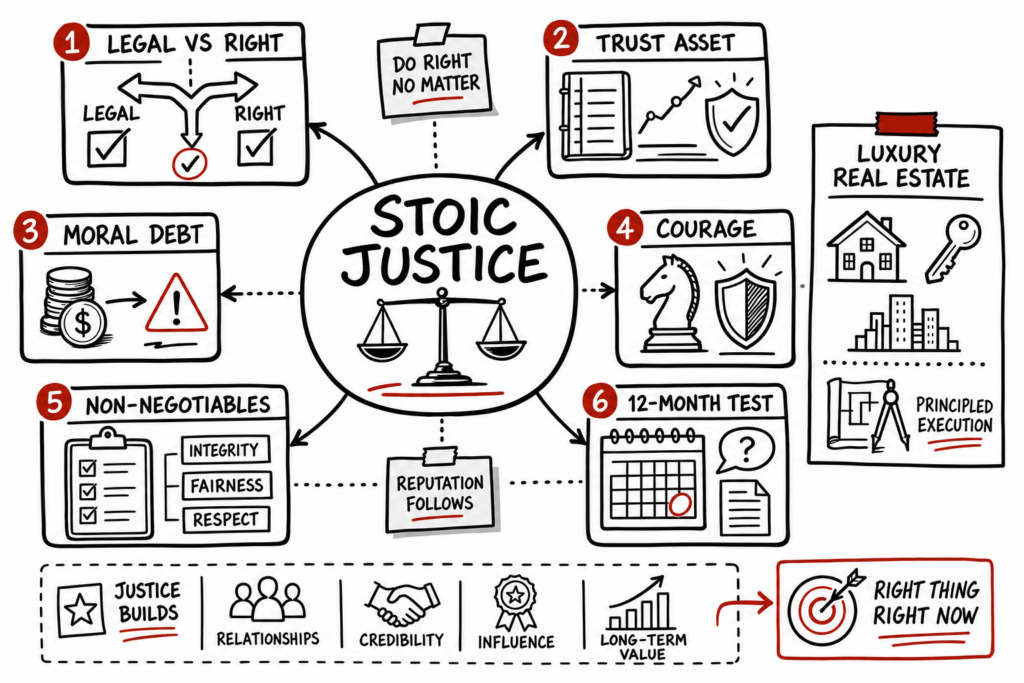
What Is the Right Thing Right Now Summary for Leaders?
Right Thing, Right Now by Ryan Holiday uses Stoic justice to ask how ambition should treat other people. For a real-estate leader, the useful question is not whether a choice is merely permitted. It is whether the client, team, community or partner can understand and fairly bear its consequences.
The book is an ethical lens, not legal advice, a compliance manual or a negotiation playbook.
Book Overview
Holiday presents justice as a discipline of fairness, honesty, duty and proportion. The book’s examples are historical and moral; readers still need current legal, regulatory, fiduciary and privacy guidance for their own decisions.
For broader Stoic context, the Daily Stoic resource is useful. The official publisher page for the book is also retained in the source record.
Who Should Read It
The book fits founders, brokerage leaders, developers, private-client advisors and operators whose decisions affect money, homes, careers, neighborhoods or data. It is useful when a profitable choice feels technically acceptable but strategically corrosive to trust.
Readers seeking a tactical real-estate or legal guide should look elsewhere. This book sits one layer above procedure: it helps define the standards a procedure should protect.
Core Idea
Justice keeps ambition from becoming extraction. A disclosure can be technically adequate and still leave a client surprised. A permitted data tool can still violate the discretion people reasonably expect. Separating legality from rightness makes ethics an operating question.
Best Takeaways
1. Reputation compounds, but so does moral debt
Brand equity is not only photography, events or social proof. It is whether clients believe the firm protects their interests when they are not watching. Review difficult decisions for patterns of speed over clarity, silence over disclosure or margin over fairness.
2. Justice requires courage when the system rewards the opposite
Doing the right thing can cost a deal, relationship or favorable quarter. The test is whether the leader can preserve the standard when the incentive points elsewhere.
3. “Everyone does it” is not a strategy
Common behavior is not automatically trustworthy behavior. Discretion should not become a shield for opacity, and an industry habit should not determine the firm’s ethics.
4. Justice is a leadership system, not a personality trait
Write escalation standards, disclosure protocols, conflict rules and AI-use boundaries so the right choice can survive pressure. Values become durable when they can be repeated by a tired team on a difficult day.
Where It Falls Short
Holiday’s style is principle-forward and may leave readers wanting industry-specific implementation. The book gives an ethical compass; counsel, compliance expertise and internal process still have to translate it for housing, finance, privacy, AI and development decisions.
Its emphasis on individual responsibility also leaves structural incentives for leaders to solve. That limitation is a prompt to design cultures where the right decision is expected rather than heroic.
How to Apply It
1. Create a “legal versus right” review
For a major listing claim, investor deck, AI-generated asset, referral arrangement or data practice, ask whether the stakeholder with the least information would consider the choice fair. Record the answer and the person responsible for the decision.
2. Define your non-negotiables before pressure hits
Write the standards before revenue pressure arrives. Examples include no undisclosed conflict, no manipulated scarcity, no AI impersonation, no selective omission of material facts and no unfunded community promise.
3. Measure trust as an asset
Review repeat relationships, referral context, complaint patterns, disclosure escalations and post-closing feedback alongside volume and price. These measures describe trust; they do not guarantee future business.
4. Use the 12-month headline test
Ask whether the firm would stand behind the decision if the full context became public in a year. The point is continuity, not fear.
5. Build an ethics language your team can repeat
Turn values into plain phrases: do not let a client be surprised by a fact already known; do not confuse urgency with pressure; do not use technology in a way the client would reasonably expect to be hidden.
Final Verdict
Right Thing, Right Now is useful because it sharpens the line between ambition and compromise. Its central value for luxury real-estate leaders is the insistence that justice affects trust, resilience, culture and long-term relationships.
You can request a complimentary one-hour conversation with a senior advisor who is an experienced operator. Talk through your next move when a growth, technology or stakeholder decision needs a standard stronger than instinct.