
Smart Growth Whitney Johnson Summary for Scaling Teams
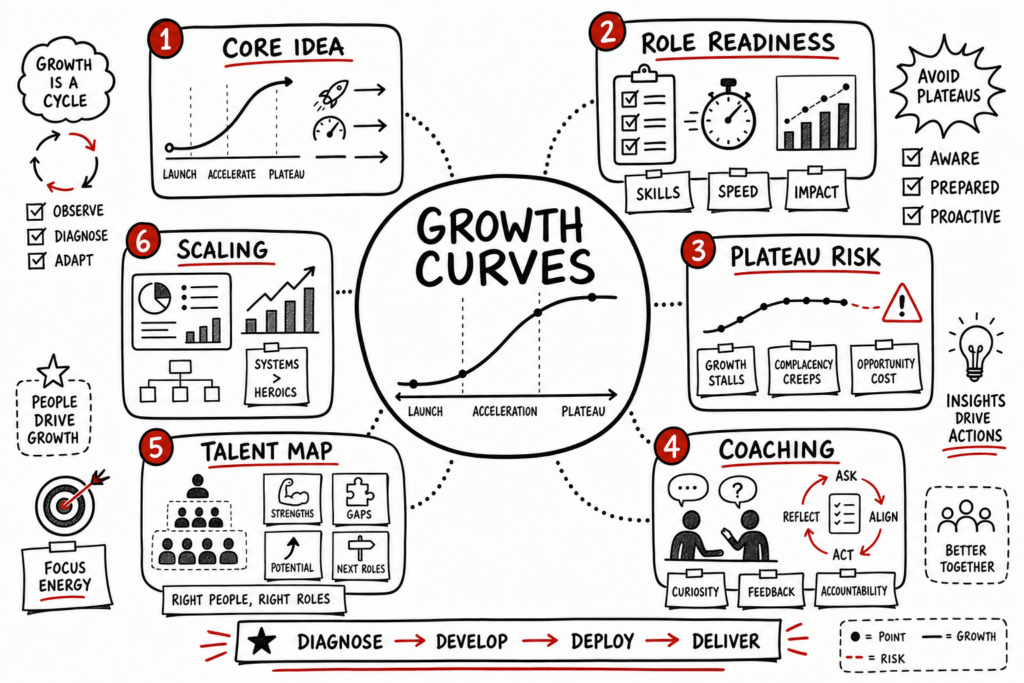
What is the Smart Growth Whitney Johnson summary?
Smart Growth by Whitney Johnson offers leaders a way to think about how people learn, accelerate and eventually plateau. For a growing real-estate team, the useful question is not whether every person should be pushed faster. It is whether the role, support and challenge fit the person’s current stage and the business’s actual needs.
Book Positioning and Audience Fit
This is a leadership and talent-development book, not a real-estate operating manual. The publisher’s book page is the appropriate source for the book’s publication context. Its S-curve lens can be translated into recruiting, onboarding, coaching and succession conversations, but the translation remains a leader’s judgment.
The framework is most useful when a founder is still carrying too many decisions, a new hire needs a clearer ramp, or an experienced producer has stopped learning in the current seat. It does not replace job design, compensation review, employment advice or a candid conversation about performance.
Core Idea
Johnson describes growth as a curve with a slower beginning, a period of acceleration and a later plateau. The same person can be at a different point on that curve in a new role, market or responsibility. A leader who mistakes early learning for low potential may withdraw support too soon; a leader who treats plateau as failure may miss the chance to offer a new challenge.
Use the model as a set of questions. What is this person learning? What evidence shows increasing independence? Which decisions still require support? What work would create a useful stretch without putting a client or the business at unreasonable risk?
Who Should Read It
Smart Growth is a good fit for brokerage owners, team leaders, operations managers and advisors who are building a second layer of leadership. It is also useful for a leader who wants a shared vocabulary for development rather than a yearly review that arrives after the important decisions have already been made.
A solo agent may find the ideas interesting but may not need a team-development system yet. Readers seeking a complete HR manual, compensation plan or legal answer should look elsewhere and involve the appropriate professionals.
Best Takeaways
1. Growth should be managed, not wished for
Define what capable independence looks like in a role, then give the person feedback against that definition. A new listing coordinator may need observed practice and a short review loop. A senior agent may need authority over a larger decision set. The cadence should fit the work and the person, not a universal timetable.
2. Plateaus are retention risks
A plateau is a prompt for inquiry, not a diagnosis. Ask whether the person lacks challenge, has unclear priorities, needs a different kind of support or has decided the role is no longer a fit. Any change in title, compensation or responsibility should follow a real conversation and the firm’s employment and brokerage policies.
3. Talent development is a scaling constraint
Demand can grow faster than a team’s ability to make sound decisions. That is why role scorecards, documented handoffs and coaching capacity matter. Development is not a promise that everyone will progress at the same speed; it is a way to make the organization’s capability more legible.
Where It Falls Short
An S-curve is a useful lens, but it can become reductive when treated as a label. People can learn unevenly, carry responsibilities outside work and respond differently to the same environment. The book does not give a leader local employment rules, a reliable performance diagnosis or a complete plan for a complex brokerage.
The framework also needs a strategy around it. A firm can coach people effectively into a role that no longer serves its clients or economics. Pair development discussions with service standards, financial review and a clear view of the business the team is trying to build.
How to Apply It
Start with one team or role and document the decisions you are trying to improve. Keep the record factual: agreed responsibilities, observed work, feedback, support offered and the next review date.
Step 1: Map your team by growth curve
For each role, note the work the person can do independently, the work that still needs review and the next responsibility that would create useful learning. Treat this as a working conversation, not a permanent ranking.
Step 2: Define role-readiness velocity
Choose a few observable signals such as complete handoffs, accurate client updates, reliable follow-up or sound escalation. Record the baseline and review period. Do not turn an illustrative measure into a universal quota.
Step 3: Separate coaching from rescuing
Coaching clarifies the decision and lets the person practice it. Rescuing silently absorbs the work and leaves the underlying gap in place. When a leader steps in, explain why, capture what was learned and agree who owns the next attempt.
Step 4: Give high performers a new curve before they ask for one
Ask experienced people which decisions, clients or systems they want to own next. A stretch can be a new market, a mentoring role, a process redesign or a larger service responsibility. Confirm the support and boundaries before changing the seat.
Step 5: Use the model in quarterly talent reviews
A quarterly review can connect role needs, observed progress, support and next responsibilities. Keep notes specific and respectful, and include the person’s own view. The model should improve a conversation, not replace one.
Final Verdict
Smart Growth is worth reading when a real-estate leader needs a better way to discuss learning, challenge and role fit. Its value is the question it creates: what does this person need from the role now, and what does the business need them to learn next? Its limits are equally useful. Adapt the lens to the team, verify the facts and keep employment, compensation and brokerage decisions within the right professional process.
You can request a complimentary one-hour conversation with a senior advisor who is an experienced operator. Talk through your next move if your team needs to turn a development conversation into a clear, owned operating decision.