
Supremacy Summary and Review: What the AI Race Clarifies for Leaders
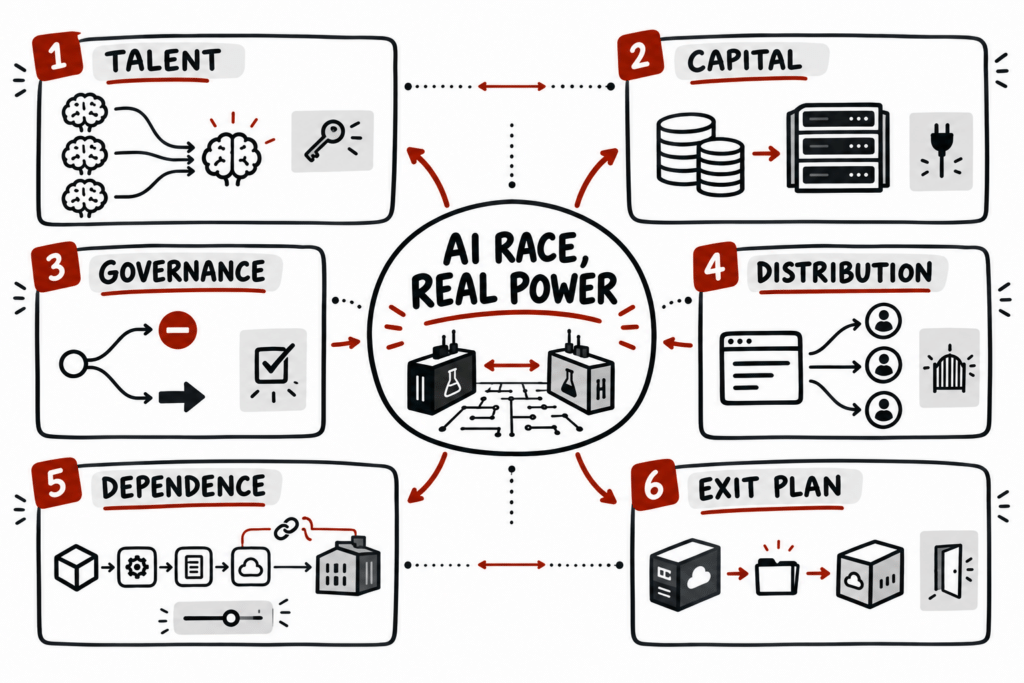
What is the Supremacy summary for executives and founders?
For executives and founders, this Supremacy summary explains how Parmy Olson’s account of the OpenAI–DeepMind rivalry clarifies a strategic risk: adopting AI means depending on institutions whose incentives may differ from yours. Supremacy is reported narrative nonfiction about the people, research ambitions, capital, and corporate power behind the race to build general-purpose artificial intelligence. Its central value is a map of incentives, not a guide to using ChatGPT. Platform dependence means relying on a supplier for capabilities, access, or customer experiences that you cannot readily replace. The practical implication is to examine who controls your technology, who can change its terms, and what switching would require. Read the book if you want a people-and-institutions account of AI competition. Skip it if you need implementation instructions, technical comparisons, or a reliable forecast. Its strongest business use is sharpening questions about talent, governance, distribution, and ownership before committing resources.
Core Idea: The Rivalry Is a Map of Power
Olson follows OpenAI and DeepMind as central institutions in the pursuit of increasingly capable AI. Scientific ambition sits alongside commercial pressure, competition for exceptional researchers, and the need for resources that few organizations can supply. This is an OpenAI vs DeepMind book, but reading it only as a contest between personalities misses its business value.
The more useful contrast concerns how institutions organize research, talent, capital, and the path from laboratory work to public use. Those arrangements shape what gets built and who can influence its direction. That is a reading of the book’s argument, not a universal management rule.
Ownership, partnerships, compute, and distribution matter because a capable system still needs a route to users. An impressive model announcement does not, by itself, establish a durable business advantage. For a founder choosing a platform, the underlying power structure deserves as much attention as the demonstration.
There is also a narrative contest. Read closely for who gets to define progress, openness, and responsible development. Those definitions can serve competitive purposes; they should not substitute for examining actual authority and incentives.
Best Takeaways: Supremacy Leadership Lessons
Talent has a market price and a mission price
Compensation matters, but so do research freedom, organizational purpose, and permission to release work. The book makes talent competition relevant beyond recruiting: the institution that attracts exceptional people must also create conditions in which they can operate.
The application for leaders is straightforward. Before blaming a hiring shortage, examine whether decision rights and working conditions make your organization attractive to the people you need. Do not copy a research lab’s culture into an unrelated business.
Governance matters most when priorities conflict
Safety, speed, and commercial demands are not reconciled by careful language alone. Someone must have authority when those priorities collide. The useful question is not whether an organization expresses responsible intentions, but how its structure handles disagreement and downside.
Applied to your business, that means identifying who can approve a risky use case, stop deployment, or accept a material change in a supplier’s terms. This is an operating lesson drawn from the book, not a governance method Olson claims to have tested.
Distribution changes the value of technical advantage
A strong system becomes commercially consequential when people can access it and build habits around it. Existing customer relationships and established interfaces can matter alongside research quality.
Among the strongest Supremacy strategy lessons is this distinction: choosing a capable supplier is not the same as protecting your position. If a platform controls both the capability and the customer interface, your leverage may be narrower than it appears.
What the Race Clarifies About AI Platform Strategy
The rivalry helps explain how concentrated talent, capital, and distribution can influence which interfaces become defaults—and which organizations set the terms others build on. It does not establish which supplier will remain strongest or which business model will win.
For an established operator, the relevant question is where adoption changes client experience, team capacity, or margin. A polished demonstration is not evidence of any of those outcomes. Neither is broad enthusiasm inside the company.
Consider a hypothetical client-service workflow. If AI reduces drafting time but creates more review work, the apparent productivity gain may disappear. Measure total handling time, correction rates, and client complaints rather than counting generated messages. That example is an application of the review’s reasoning, not a case study from the book.
Where It Falls Short
The narrative’s strength is also a limitation. A contest centered on prominent people and institutions makes complex developments readable, but it can encourage readers to give personalities more explanatory weight than they deserve. Keep the wider market, infrastructure, and institutional context in view.
The focus on leading Western labs also limits the field of vision. This is not a comprehensive technical history of AI or a complete account of global competition. Nor does narrative momentum establish that the next stage will follow the same pattern.
Most importantly, the book does not close the gap between understanding the race and deciding what your organization should do. It offers neither vendor scorecards nor implementation steps. Treating it as a procurement guide would ask it to do a job it was not written to do.
Who Should Read It
Is Supremacy worth reading? Yes, for executives, founders, team leaders, and brokerage owners who want a clearer understanding of the institutions behind technologies they may adopt. It is especially useful when a platform decision could create lasting dependence.
Readers seeking prompt tactics, deployment instructions, or detailed model comparisons should look elsewhere. This Supremacy book review recommends it as strategic context: valuable preparation for a decision, not the decision itself.
How to Apply It
Read for three operating questions: who controls the talent, who owns the customer interface, and who can change the terms after you commit? Then separate what Olson reports from what your own business needs to establish.
- Name the dependency. Identify which workflow would be disrupted if access, pricing, or capabilities changed.
- Define the business result. Choose a relevant measure, such as total handling time or correction rate, before expanding adoption.
- Assign decision authority. Make clear who approves sensitive uses and who can pause them.
- Examine the exit. Understand what data, integrations, and working practices would need to move if you changed suppliers.
The book cannot settle whether you should wait, partner, or build; it can help you make that choice with a clearer view of whose incentives you are accepting.
If that choice now affects your people, margins, or client relationships, it deserves a business conversation before another technology commitment.