
The Coming Storm Summary: Power, Conflict, and Leadership Signals
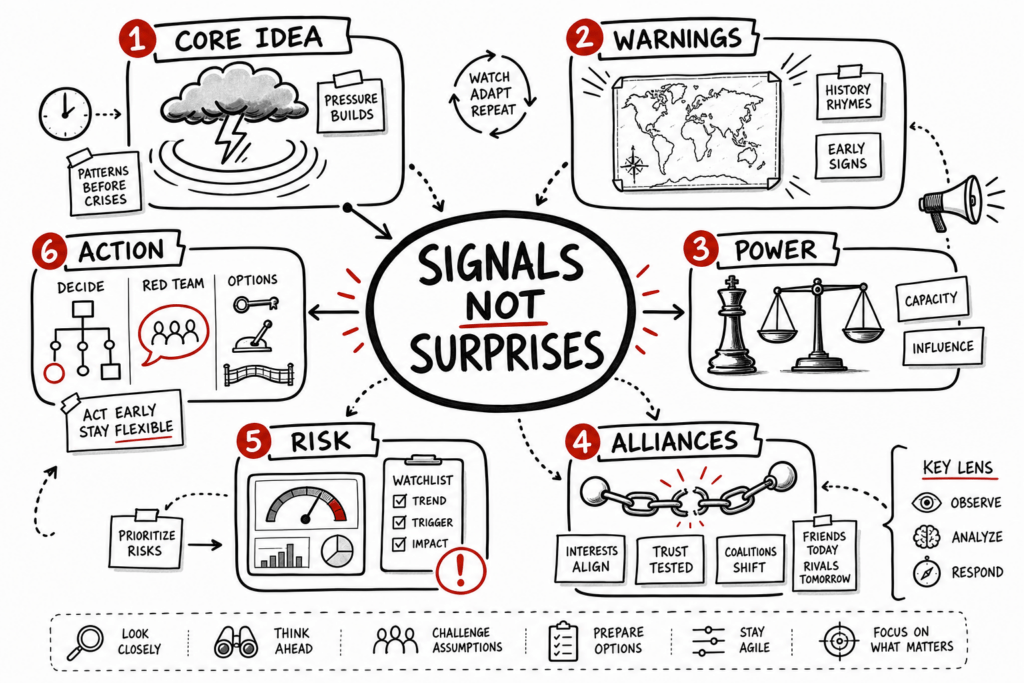
Short answer: The Coming Storm is useful for leaders who want to read pressure before it becomes a crisis. Odd Arne Westad’s history of power and conflict is most valuable as a prompt for examining incentives, miscalculation, alliances and dependence. It is a book for strategic judgment, not a prediction machine.
This review asks what an executive, investor, board member or real-estate principal can carry into a decision room: how to question a comfortable assumption, map exposure and prepare options while the evidence is still incomplete.
The Coming Storm summary: the executive read
Westad’s central argument, as this source presents it, is that major confrontations usually grow through accumulated pressure rather than one isolated surprise. Ambition, fear, status, domestic pressure and bad assumptions can narrow a leader’s choices. Alliances may deter conflict while also creating confidence that has not been tested.
That makes the book relevant to long-horizon decisions. It does not offer a neat formula for what will happen next. It gives a reader a way to ask what each actor wants, what each actor fears and which constraints could make a seemingly stable situation change quickly.
Who Should Read It
The best fit is a reader who makes decisions across time, capital, markets and reputation. Founders, family-office leaders, investors, board members, advisers and real-estate principals can use the historical lens to discuss supply-chain exposure, currency pressure, regulatory dependence, client concentration or the resilience of a key relationship.
It is also a good fit for leaders who want more depth than a daily headline provides. Readers who want a quick forecast or a tactical checklist may find the book too measured. Its value lies in improving the questions behind a plan: which signals matter, which assumption is carrying the most weight and what would change the decision?
Core Idea
The core idea is that history does not repeat mechanically, but incentives and misread signals can create familiar pressure. A rising power may seek recognition. An established power may seek stability on its own terms. Smaller actors may have to navigate both. Trade and interdependence can restrain behavior, but they can also create leverage and vulnerability.
The leadership lesson is disciplined attention. Public rhetoric matters, but so do domestic constraints, alliance commitments, economic dependencies and the room each side has to change course. In a business setting, the parallel is simple: do not assume a competitor, lender, regulator, vendor or buyer sees the situation from your position.
Best Takeaways
1. Watch incentives, not just headlines
Headlines describe what happened. Incentives help explain what may become more likely. Ask whether a government is boxed in domestically, whether a competitor is seeking status, whether a supply chain has become a strategic dependency or whether an alliance rests on an assumption that has never been tested.
2. Alliances are assets, but not guarantees
Relationships can create resilience, but they do not remove the need for contingency planning. Map which partners, lenders, vendors and clients are mission-critical. Then ask what would happen if one relationship became slower, more expensive or less reliable under pressure.
3. Miscalculation is a leadership failure
Leaders often assume that the other side will absorb pressure, accept a loss of status or put economics ahead of principle. A decision process should make those assumptions visible before they harden into a plan. Invite a credible counterview and identify what evidence would prove the preferred interpretation wrong.
4. Interdependence is not immunity
Commercial ties may moderate behavior, but dependence can also transmit fear and disruption. For a company or property business, exposure mapping should include revenue concentration, vendor dependency, capital access, data infrastructure, insurance, logistics and regulatory chokepoints. These are strategic inputs, not only back-office details.
5. Strategic foresight is a habit, not a forecast
The practical value is scenario thinking. Consider a plausible range of changes in capital costs, trade routes, sanctions, regulation, client confidence or buyer demand. The exercise is not to predict one outcome. It is to decide which indicators would change your posture and which options you want ready beforehand.
Where It Falls Short
The historical lens is also the book’s limit for a busy operator. Readers looking for a ready-made board template or a short operating playbook will need to translate the material themselves. Historical parallels can also become misleading when a reader treats similarity as proof that the same outcome is coming.
A careful reading asks what is genuinely comparable, what is different and which current evidence is still missing. The book can sharpen a decision conversation; it cannot replace current intelligence, legal advice, market data or direct knowledge of the people and systems involved.
How to Apply It
Turn the ideas into a quarterly risk conversation. Start with the assumptions behind the most important decisions and sort them into geopolitical, regulatory, financial, operational, reputational and human categories. For each assumption, name an observable signal and the person who will review it.
Next, build a small early-warning dashboard. Five to seven signals are enough if they are specific to the business: policy changes, capital conditions, insurance costs, logistics friction, election calendars, sanctions exposure, energy prices or client confidence in a key market. Record the date, source and interpretation so a later decision can be compared with what was known at the time.
Then stress-test critical relationships. Which contracts are legally sound but commercially fragile? Which partners would still show up under pressure? Which dependency has no practical substitute? A short red-team discussion can expose assumptions that ordinary status meetings leave untouched.
Finally, preserve optionality where uncertainty is high. That may mean liquidity, diversified suppliers, flexible deal structures, stronger local intelligence or a slower commitment. The right choice depends on the decision and the evidence; the discipline is to keep a credible second move available.
Final Verdict
The Coming Storm is a thoughtful addition to an executive reading list when the goal is better judgment under uncertainty. It encourages leaders to look past the dramatic event and examine pressure, incentives, dependence and room to maneuver.
Read it for the quality of the questions it creates. Then test those questions against current evidence, your own exposure and the people responsible for the next decision.
You can request a complimentary one-hour conversation with a senior advisor who is an experienced operator. Talk through your next move when a difficult decision would benefit from an experienced outside conversation.