
The Fourth Turning Is Here Summary for Real Estate Leaders
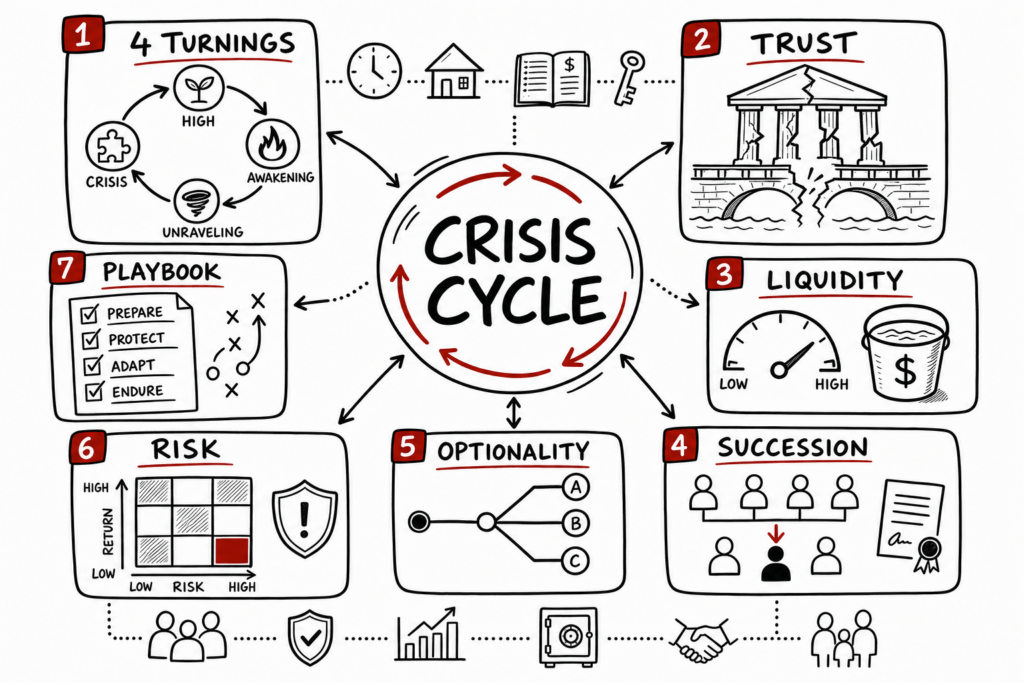
What Is The Fourth Turning Is Here Summary for Real Estate Leaders?
The Fourth Turning Is Here by Neil Howe offers a long-cycle lens on institutional stress, leadership and continuity. For a real estate principal, family-office leader or succession-minded executive, the useful question is not whether the book can predict the next headline. It is whether the framework helps expose fragility in liquidity, debt, governance, leadership depth and concentrated assets. Howe’s model is a lens to interrogate, not a substitute for underwriting or scenario analysis.
The publisher’s book page provides publication context. The book’s arguments should be distinguished from independently verified economic or political forecasts.
Core Idea
Howe and William Strauss developed a generational-cycle theory that describes recurring social eras and four turnings: a high, an awakening, an unraveling and a crisis. Howe’s current book applies that framework to a period he views as institutionally demanding. Readers can review his own work at NeilHowe.com.
The practical translation for an operator is pressure mapping. In a stable period, a firm may optimize for efficiency. In an uncertain period, it may need more optionality, simpler commitments, clearer authority and a stronger ability to explain decisions. The theory does not establish when a particular market will move or what a family should buy or sell.
Best Takeaways
1. Crisis is a leadership environment, not just a market event
A crisis changes expectations as well as prices. Tenants, lenders, insurers, employees, heirs and investors may need clearer decisions when confidence is under pressure. A portfolio can appear sound while the assumptions around financing, coverage, demand or governance change.
2. Succession planning cannot be treated as a private family issue
Leadership transition happens inside the conditions of its time. Clarify who can refinance, sell, approve capital calls, communicate with lenders and speak for the family. If one branch wants liquidity and another wants to hold, the decision rights should be known before a dispute becomes urgent.
3. Long-cycle thinking helps prevent short-cycle panic
A family enterprise cannot be managed only by the next quarter’s cap rate or headline. Keep a record of debt maturities, insurance, taxes, capital needs, demographic exposure and family participation. Long-cycle thinking should broaden the scenarios, not erase the need to test current facts.
4. Institutions get rebuilt by people who are ready before consensus forms
Whether or not a reader accepts Howe’s timetable, the leadership lesson is useful: prepare before clarity is perfect. That may mean cleaning up ownership, documenting reporting, training a successor, renegotiating debt early or selling a non-core asset after a deliberate review.
Where It Falls Short
The framework can make history appear cleaner than it is. Once a cycle becomes the explanation for every event, pattern recognition turns into pattern addiction. Generational labels also flatten people; wealth, place, education, immigration, industry and family culture shape behavior alongside age.
The book is not a property-acquisition, refinancing or portfolio-construction manual. Its strongest use is scenario planning. Its weakest use is deterministic forecasting or a justification for a decision that has not been underwritten.
Who Should Read It
This is a fit for leaders responsible for long-horizon decisions: real estate principals, family-office executives, private-business owners, next-generation successors and board members. Read it if you are asking how much liquidity is appropriate, which authority is unclear or which assumptions from the last cycle no longer deserve trust.
Skip it if you want an exact market call or a neutral academic history. Howe is offering a civilizational framework; it is valuable only when held alongside evidence and dissenting views.
How to Apply It
Run a Fourth Turning portfolio review
Stress-test each major asset and operating company. Ask what changes if rates remain elevated, insurance becomes harder to obtain, a lender narrows terms, taxes or zoning shift, or a key leader becomes unavailable. Rank fragilities before making predictions.
Build a succession map before the crisis chooses one for you
Define authority by role and document the decision owner for capital calls, refinancing, asset sales, family communication and external advisors. If the next generation is not ready, name the gap and train against real decisions instead of ceremonial titles.
Separate core assets from legacy clutter
Identify holdings that consume attention, create conflict or require capital without serving the enterprise’s purpose. A crisis is a poor time to learn that sentimental assets are draining liquidity from essential ones.
Create a liquidity rule
Write a liquidity standard that fits leverage, asset type, obligations and access to credit. A family might choose to cover a defined period of debt service, taxes, payroll, insurance and essential capital expenditure without a forced sale. The period and funding sources must be tested with the firm’s advisors.
Upgrade communication cadence
Uncertainty invites stories when leaders go silent. Choose a rhythm for portfolio briefings, succession review, lender communication and decision logs. Trust is built before the difficult conversation is needed.
Conclusion
The Fourth Turning Is Here is best used as a challenging question: how would the portfolio, leadership bench, family governance and liquidity behave under institutional stress? Hold the cycle theory lightly, test the exposures directly and prepare without treating a historical pattern as destiny.
You can request a complimentary one-hour conversation with a senior advisor who is an experienced operator. Talk through your next move when succession, portfolio concentration or a major transition needs a clearer decision map.