What Is The Fund Rob Copeland Summary for Leaders?
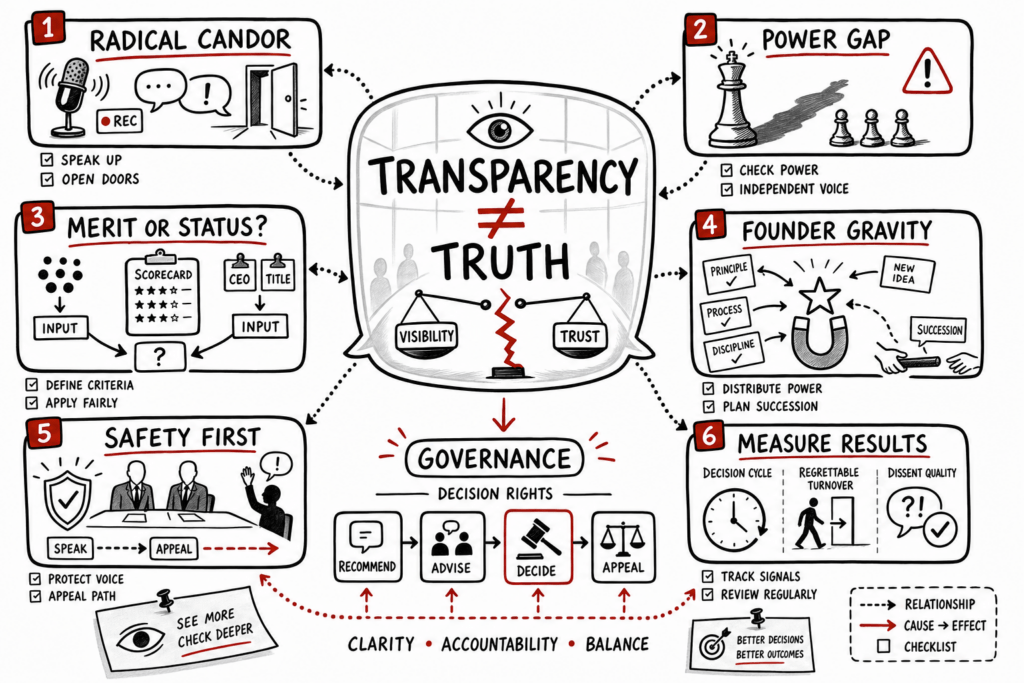
This The Fund Rob Copeland summary gives CEOs, founders, COOs, investment leaders, and people executives a spoiler-free view of The Fund by Rob Copeland and its strategic implication: radical transparency improves decisions only when candor is constrained by psychological safety, due process, and accountable power. Copeland’s reported portrait of Bridgewater Associates examines how an idea meritocracy—a system in which decisions are meant to follow the strongest evidence rather than rank—can collide with founder authority, ratings, recordings, and believability scores. For scaling firms, the practical test is measurable: track decision cycle time, regrettable employee turnover, and the percentage of staff who say they can challenge a senior leader without penalty. If those indicators worsen, more transparency may be increasing control rather than truth. The book is worth reading for leadership teams designing feedback, governance, or succession systems, but it is a cautionary case study, not a plug-and-play management manual.
Core Idea: What The Fund Is Really About
The Fund is less a hedge-fund story than an investigation of an operating system. Copeland looks at Bridgewater Associates as a management laboratory where radical truth, constant feedback, recorded interactions, and structured assessments were intended to make decision-making more rational.
The tension is straightforward: a company can declare that the best idea wins, yet still operate under hierarchy, loyalty, and founder gravity. That gap between stated values and lived experience is the center of the book. If you came looking for a The Fund book summary no spoilers, the safest framing is that Copeland examines what happens when a philosophy becomes both a public brand and an internal mechanism of authority.
This makes the book a useful companion to Bridgewater’s own presentation of Ray Dalio’s Principles. Read together, the two accounts create a productive comparison: one explains how the system is supposed to work; the other investigates how people reportedly experienced it.
Best Takeaways from The Fund
1. Transparency Is an Amplifier, Not an Automatic Virtue
Recordings, public feedback, scorecards, and challenge sessions can expose weak reasoning. They can also magnify status differences and make employees perform agreement. The tool does not determine the outcome; governance does.
The strongest of the book’s radical transparency leadership lessons is to separate visibility from safety. Employees may see more information while feeling less able to question how it is interpreted. For leadership teams, the real test is not whether candid feedback exists. It is whether people can dispute a rating, challenge a powerful executive, and recover from a mistake without political damage.
2. Idea Meritocracy Can Quietly Become Credentialed Hierarchy
Bridgewater’s concept of believability gives more weight to people with demonstrated expertise or a strong record. That sounds sensible. Most investment committees already give experienced performers greater influence.
The risk appears when the organization controls both the scoring system and the definition of credibility. A supposedly objective hierarchy may then reinforce existing power. One practical safeguard is to review major decisions twice: first using weighted expert input, then with names and titles removed. If the conclusions differ materially, status may be driving more of the debate than evidence.
3. Founder Strength Can Become Succession Risk
The Ray Dalio Bridgewater culture book debate is not simply about one leader’s personality. It raises a broader governance question: can a company preserve its operating edge when the founder is no longer the final interpreter of its principles?
Scaling firms often codify a founder’s instincts into values, playbooks, or decision rules. That helps until every difficult judgment still requires the founder’s approval. The Fund book leadership lessons are especially relevant when a business is adding offices, partners, or investment committees faster than it is building independent institutional authority.
What the Bridgewater Culture Teaches Scaling Firms
The Bridgewater Associates management culture offers a warning against confusing process density with operating discipline. A firm can generate extensive data about employees while remaining unclear about who has final authority, how appeals work, or which behaviors are unacceptable regardless of performance.
For real-estate operators, the comparison is practical. Imagine a weekly acquisitions meeting where every participant scores every other participant’s judgment. That may improve preparation, but it may also slow decisions and discourage a junior analyst from challenging the executive who controls promotions. Measure the result through underwriting revision rates, time from first review to investment decision, and anonymous psychological-safety scores—not through the volume of feedback collected.
These leadership lessons from Bridgewater also apply to brokerage teams, development firms, and family offices. High candor works best when decision rights are explicit, feedback concerns observable behavior, and employees have a credible appeal channel outside their direct reporting line.
Where It Falls Short
This The Fund Rob Copeland review should be clear about the book’s limits. Copeland is constructing an investigative counter-narrative, not writing a neutral operating manual. The reporting is vivid and the human dynamics are compelling, but readers should distinguish reported experiences from a controlled assessment of whether Bridgewater’s methods caused particular business outcomes.
The book also offers less value if your main goal is learning investment strategy. It does not function as a detailed guide to macro research, portfolio construction, or risk parity. Its stronger territory is power, culture, succession, and the gap between a management system’s claims and its consequences.
A balanced Ray Dalio Principles critique therefore requires reading primary material and external reporting rather than treating either side as complete. Following broader institutional coverage through sources such as The New York Times business section can also help readers separate the book’s organizational lessons from the mythology surrounding a single firm.
How to Apply It Without Copying Bridgewater
- Audit challenge safety. Ask employees anonymously whether they can disagree with a senior leader without career damage. Segment results by level and tenure.
- Define decision rights. For each recurring investment or operating decision, identify the recommender, final decision-maker, required advisers, and appeal path.
- Review feedback tools quarterly. Determine whether recordings, ratings, or scorecards improve decisions—or merely increase documentation and anxiety.
- Track three KPIs. Monitor decision cycle time, regrettable turnover, and the percentage of major decisions reopened because relevant dissent was missed.
- Stress-test succession. Run one major planning cycle without the founder acting as final interpreter of company values. Record where authority becomes unclear.
The point is not to make candor softer. It is to make candor more useful. Strong systems protect disagreement while preventing transparency from becoming surveillance or ritualized humiliation.
Who Should Read It?
The Fund is high-value reading for CEOs, COOs, founders, investment committee members, HR leaders, and operating partners building governance inside fast-growing organizations. It is particularly useful when a charismatic founder, proprietary culture, and complex evaluation system have become tightly intertwined.
Is The Fund Rob Copeland worth reading? Yes, if you want a sharp case study in organizational power and the human cost of high-control management. No, if you want a clean investment playbook or a simple list of behaviors to copy.
The best use is a leadership-team discussion, not passive reading. Compare one official principle with one reported cultural risk, then identify where your own firm may have the same gap. For the next step, explore a related RE Luxe Leaders leadership briefing on founder-led governance, decision rights, and building accountability without fear.