
The Let Them Theory Summary for Leaders and Managers
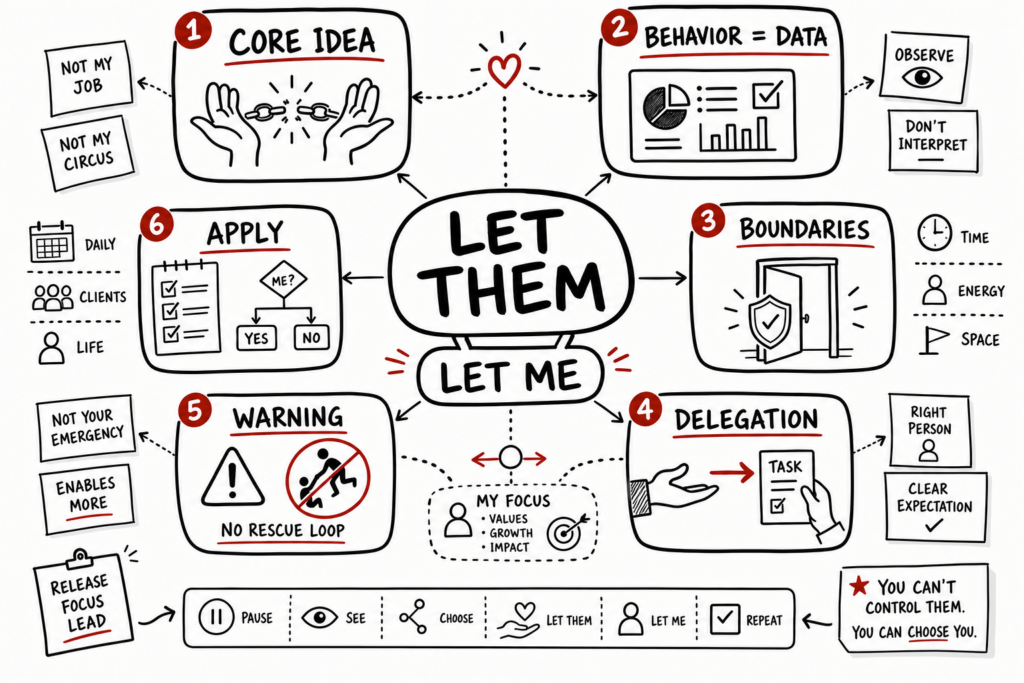
What is The Let Them Theory summary for leaders?
Mel Robbins’s Let Them Theory offers a memorable way to separate another person’s choices from the boundary and decision you own. For a broker, founder or team leader, “let them” is not passive acceptance. It is a pause that lets behavior become information; “let me” is the responsibility to set the standard, choose the next action and decide whether the relationship still fits.
The book is a mindset tool, not a performance-management system. It can reduce emotional over-functioning while leaving hiring, scorecards, feedback and consequences to the appropriate leadership process.
Who Should Read It
The framework is relevant to leaders in relationship-heavy businesses who carry every mood shift and loose end as a personal emergency. It may help a broker stop rescuing a missed handoff, a manager clarify a deadline or an advisor set a client communication boundary. Readers who already have strong boundaries may find the phrase useful as a shorthand rather than a new operating system.
Core Idea
The central move is evidence-based detachment. You cannot control a colleague’s preparation, a client’s reaction or a partner’s timing. You can define expectations, decide what access is appropriate, document patterns and choose whether to continue. The model fails if “let them” becomes an excuse to avoid a direct conversation.
Delegation makes the idea concrete. Define the standard, deadline and decision rights, then give the owner enough room to perform. If the result misses the standard, coach, clarify and document; do not silently do the work forever.
Best Takeaways
1. Stop treating other people’s choices as your emergency
Not every reaction requires an immediate response. Before interrupting strategic work, ask whether the issue belongs to you, whether it is time-sensitive and what standard has already been communicated. A client or colleague may need care without needing you to absorb every consequence.
2. Use behavior as data
Behavior can reveal a process gap, an unclear agreement or a recurring mismatch. Record what happened without assigning motive. Then decide what the pattern requires: a clearer brief, coaching, a role change, a boundary or an exit.
3. Delegation requires letting the outcome breathe
Delegation is incomplete when the leader corrects every step before the owner can learn. Set a reasonable check-in, make escalation conditions explicit and let the person work. If the outcome is below standard, review the evidence and the support rather than rescuing in secret.
4. Calm is a strategic asset
A calm leader can hear the issue, protect trust and make a proportional decision. Robbins’s public podcast resources provide context for her broader ideas; they do not replace a firm’s management standards. Harvard Business Review’s management coverage is complementary reading, not a source for a universal boundary.
Where It Falls Short
“Let them” does not solve underperformance, abuse, legal obligations or a spreading culture problem. Leaders still need expectations, feedback, documentation and consequences. A phrase can help with emotional regulation while the actual management process does the work.
The book also draws heavily from personal relationships, so business readers must translate its examples carefully. Use the mindset to improve judgment, not to label a person or avoid an uncomfortable conversation.
How to Apply It
Step 1: Identify your highest-friction relationship
Choose one recurring issue and describe the observable behavior, timing and impact. Keep motives out of the note. This creates a record you can discuss fairly.
Step 2: Separate control from responsibility
List what belongs to the other person—preparation, mood, urgency or approval—and what belongs to you—standard, communication, consequence, access, fee or decision to continue.
Step 3: Set a measurable boundary
Make the boundary usable: a response window, a complete handoff, a decision date or a documented escalation path. State what happens if the boundary is missed, and apply the standard consistently.
Step 4: Stop rescuing the pattern
Once the expectation is clear, let the person meet it, negotiate it or reject it. Their response becomes information. Use the appropriate process rather than fixing the same issue invisibly.
Step 5: Review the energy return
After an agreed period, ask whether the boundary reduced repeat conversations, protected strategic work and improved the relationship. If it did not, the issue may require a role, process or relationship decision instead of another reminder.
Final Verdict
The Let Them Theory is useful when a leader is over-involved in other people’s choices and needs a short prompt to recover judgment. Its full value appears only when the pause is followed by a clear standard, an owned decision and fair follow-through. Pair the mindset with scorecards, meeting rhythms, hiring discipline and client standards.
You can request a complimentary one-hour conversation with a senior advisor who is an experienced operator. Talk through your next move when a recurring people issue needs a boundary and an accountable decision.