
The Making of a Manager Summary: Practical New Leader Lessons
What Is The Making of a Manager Summary for New Leaders?
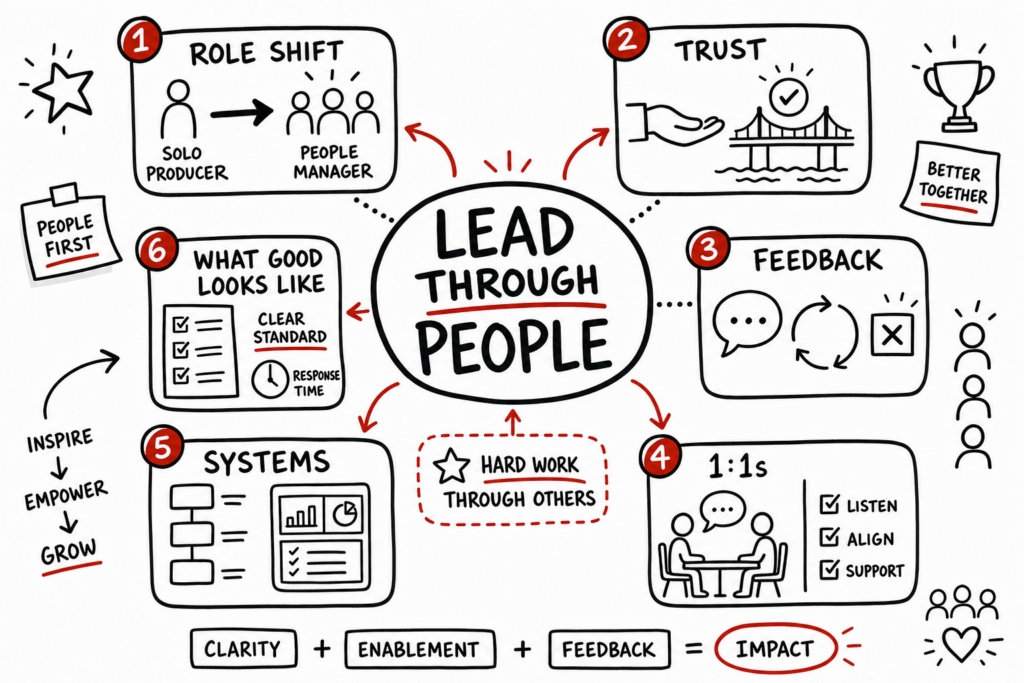
The Making of a Manager by Julie Zhuo is a practical guide to the shift from individual output to team output. Its useful lesson for real-estate leaders is that management is an operating practice: set expectations, build trust, give feedback, run useful meetings, and create conditions where people can do good work without constant rescue.
Who Should Read It
The book fits first-time managers, team leads, operations leaders, and principals whose team has outgrown informal coordination. It is not a substitute for employment, brokerage, licensing, or local policy review.
Core Idea
A manager’s output becomes the team’s output. That requires clarity about the role, authority, priorities, and feedback loop rather than a larger personal task list. The Julie Zhuo site and Harvard Business Review leadership archive provide contextual reading.
Best Takeaways
1. Your Output Is Now the Team’s Output
Define outcomes, decision rights, and support. A team lead should know which work to delegate, which risks to inspect, and what “done” means. Personal heroics can hide weak systems.
2. Trust Is Operational, Not Sentimental
Keep commitments, share context, make decisions consistently, and protect people from avoidable surprises. Trust grows from observed behavior, not a single team event.
3. Feedback Should Be Normal, Not Dramatic
Make feedback specific, timely, and tied to observable work. A short conversation about a missed handoff is more useful than a delayed annual judgment.
4. Meetings Are Not the Enemy. Bad Meetings Are.
Meetings should make a decision, resolve a dependency, or improve shared understanding. Use an agenda, a clear owner, and a written next step; move status updates to a brief or dashboard.
Where It Falls Short
The book’s approachable examples can make management look more universal than it is. Real-estate teams also face independent-contractor, licensing, privacy, compensation, and client-service constraints. Translate principles to the role and policy rather than copying a script.
How to Apply It
Start With the Role Shift
Write what the manager owns, what remains with the principal, and what the team can decide. Reserve leadership attention for exceptions and high-consequence choices.
Install a 1:1 Rhythm
Use regular one-to-ones for priorities, obstacles, feedback, and development. Fit the cadence to the work; consistency matters more than a universal schedule.
Define What Good Looks Like
Describe quality, response, handoff, and client-service standards in observable terms. A team can improve what it can see.
Make Feedback Faster and Smaller
Address one behavior or decision at a time. Record agreed support and a follow-up date when the work is consequential.
Measure Team Health With Visible Signals
Review completion, handoff quality, response patterns, retention signals, and escalation load. Use the measures to ask better questions, not to reduce people to a score.
Final Verdict
The Making of a Manager is worth reading when a new leader needs a practical language for managing through people. Use it as a starting point, adapt it to the team’s obligations, and keep the focus on clear work, trust, feedback, and useful systems.