
The Nvidia Way Summary: Jensen Huang’s Practices Worth Adapting
What does The Nvidia Way summary reveal about leadership?
For established founders, CEOs, team leaders, and brokerage owners, this The Nvidia Way summary points to one strategic implication: copy Nvidia’s approach to information and decision speed, not Jensen Huang’s entire management style. In The Nvidia Way, business journalist Tae Kim examines how Huang built a company around technical conviction, direct communication, and demanding standards. The useful operating idea is organizational latency: the time between discovering a problem and getting a decision from someone able to resolve it. A brokerage, for example, could measure how many business days a pricing exception waits for approval before changing its escalation process. The book is most useful as a reported company-building account, not an implementation manual. Its leadership practices deserve scrutiny because Nvidia’s founder authority, technical depth, and accumulated ecosystem advantages are not conditions most firms can reproduce. Read it to improve how work reaches decisions, not to justify longer hours or harsher feedback.
Core Idea: Reduce Delay Without Abandoning Long-Term Conviction
Kim’s subject is not simply a successful chip company. It is an operating system: how information moves, how standards get enforced, and how a business holds a long-term technical position while responding to immediate problems. This is reported company history, not a chip explainer or a motivational argument.
The book’s authority comes from Kim’s reporting. That gives readers a view of management practices, but not proof that those practices independently caused Nvidia’s results. This review stays with the management argument rather than retelling corporate crises or later strategic developments.
The central tension is useful: long-cycle conviction coexists with short-cycle execution. A strategy can remain consistent while priorities change as customer needs and technical evidence change. That differs from both annual-planning rigidity and constant strategic reinvention.
Best Takeaways: The Nvidia Way Key Takeaways for Operators
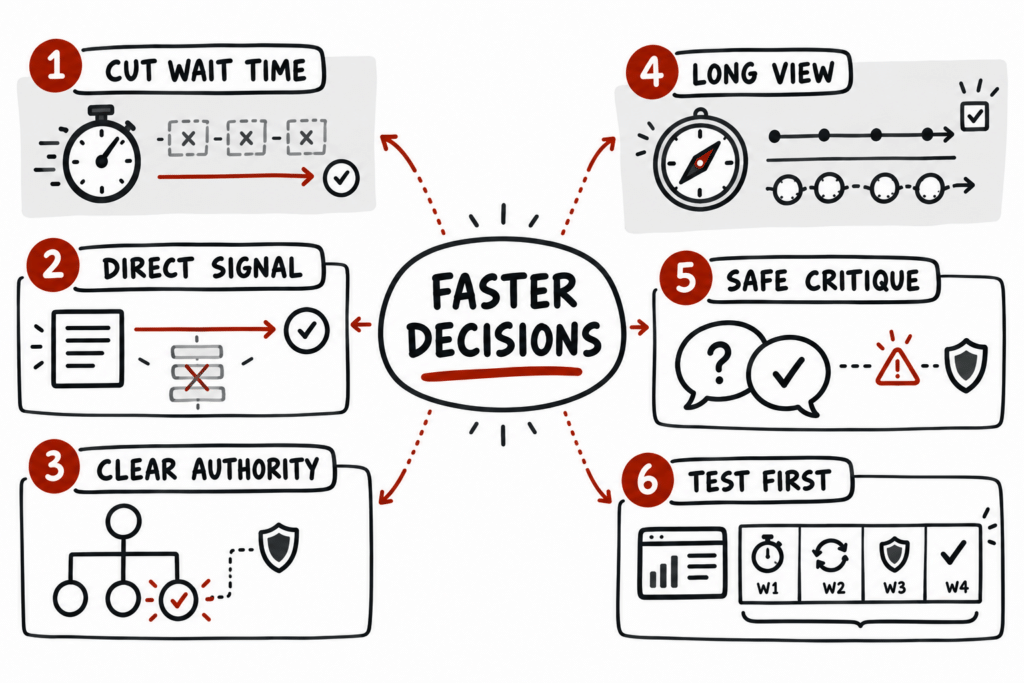
1. Treat speed as a process question
Huang’s “speed of light” language is useful when it challenges unnecessary delay. It becomes unhelpful when leaders translate it into “everyone should work harder.” Those are different instructions.
Ask what the task would require without waiting, repeated approvals, or unclear ownership. The gap between necessary work and elapsed time is where management should look first. Faster execution may require a clearer decision right, not a more exhausted employee.
2. Let the leader see the work
Kim describes unusually direct information flow, including written updates often discussed as “top-five” emails. The important principle is not the number five. It is reducing the distance between people doing consequential work and the leader making consequential decisions.
A summary of a summary can erase uncertainty, soften bad news, and reward presentation over accuracy. Direct written priorities can expose those distortions. But collecting more updates is not inherently better: someone must read them, distinguish signal from noise, and respond without becoming the bottleneck.
3. Make standards visible without making people unsafe
Public critique is among the more demanding aspects of Jensen Huang management style. Shared discussion can teach an entire team what strong reasoning looks like. Titles should not exempt anyone from defending an argument.
That does not make humiliation a management tool. The test is whether people surface mistakes earlier and challenge assumptions more honestly. If critique produces silence, rehearsed agreement, or concealed problems, the information system is getting worse, however forceful the leader sounds.
Which Jensen Huang Leadership Practices Travel?
The most portable practices are direct written priorities, explicit decision standards, and fewer handoffs between customer evidence and someone authorized to act. A professional firm can test these without pretending to operate like a semiconductor company.
Less portable are Huang’s breadth of technical authority, unusually wide span of attention, and the credibility accumulated through decades of company building. Nvidia’s platform position, ecosystem switching costs, and attraction for talent during the AI buildout also change what its management system can sustain.
This is the central filter for The Nvidia Way lessons for business owners: adopt the information system and the speed standard. Do not copy the reporting structure, tone of critique, or working hours unless your business can support them. Copying visible habits after extraordinary success invites survivor bias.
Where It Falls Short
The strength of this company-building account is also its limitation: it concerns an exceptional company under exceptional conditions. One case cannot establish which practices will work in a brokerage, advisory firm, or smaller operating business.
The Nvidia Way strategy lessons are therefore prompts for judgment, not causal formulas. Long-term conviction can support a valuable platform; elsewhere, the same language can protect a failing investment from scrutiny. Readers need evidence that could change their minds, not merely a compelling founder example.
Intensity also has costs. High standards may attract strong people while exhausting others. A leader’s willingness to meet the same standard matters, but does not eliminate burnout or make every demand reasonable. A candid The Nvidia Way book review should keep those costs inside the assessment, not treat them as evidence of insufficient ambition.
How to Apply It
Choose one recurring delay rather than announcing a cultural overhaul. In a brokerage, that might be an exception request passing through three people before reaching someone authorized to approve it.
- Establish the baseline. Record elapsed business days from a complete request to a decision. Separate actual review time from waiting time.
- Expose the relevant facts. Use a short written update covering the decision needed, customer impact, evidence, and accountable owner. Avoid another presentation layer.
- Clarify authority. Name who can decide, what requires escalation, and which safeguards cannot be bypassed.
- Review after four weeks. Compare decision time, rework, and exceptions. Faster approvals are not an improvement if errors or compliance risks rise.
This is an application drawn from the book’s operating themes, not a process Kim prescribes. It tests whether less organizational latency improves your business without importing Nvidia’s whole culture.
Who Should Read It?
Is The Nvidia Way worth reading? Yes, if you already run a substantial operation and want to examine urgency, information flow, and demanding leadership without confusing them with chaos. It offers a stronger reading lens than founder worship or stock-market commentary.
Skim or skip it if you need a portable implementation manual for a nontechnical firm. Who should read The Nvidia Way is ultimately a question of purpose: readers seeking a company-building portrait will get more from it than readers seeking ready-made procedures.
Before changing your management style, decide which single delay your business should no longer accept—and what information must reach you unfiltered to remove it.