What Is The Price of Time Summary for Real Estate Leaders?
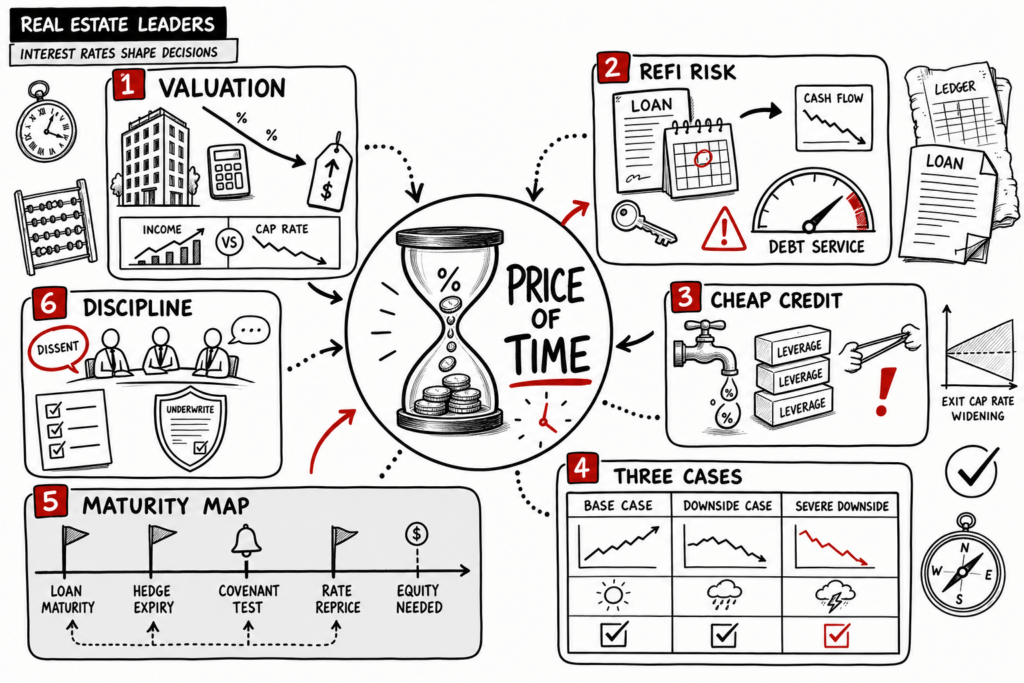
The Price of Time summary for real estate leaders: Edward Chancellor argues that interest is the price of time, and suppressing that price for long periods can distort asset values, leverage decisions, and capital allocation. Written for investors, executives, and policymakers, The Price of Time is an interest rate history book rather than a tactical property manual. Its strategic implication is clear: leaders should treat the cost of capital as a core valuation input, not a temporary inconvenience. In real estate, that means stress-testing acquisitions against refinancing rates, exit cap rates, debt-service coverage ratios, and slower liquidity. A practical benchmark is to model at least three cases—base, downside, and severe downside—rather than approving a deal from one rate forecast. Readers responsible for hurdle rates, acquisitions, development, or commercial real estate debt refinancing will find the book useful. Operators seeking near-term predictions or loan-structuring tactics will need a more current market resource alongside it.
Quick Orientation for Busy Investors
Edward Chancellor’s The Price of Time is a sweeping history of interest, credit, monetary policy, and the consequences of making money unusually cheap. Chancellor is a financial historian best known for examining speculation and market manias. His strength is pattern recognition across long periods, not short-term rate forecasting.
The book matters because many investment habits were built during an era of low policy rates, abundant liquidity, and forgiving refinancing markets. Higher borrowing costs expose the assumptions hidden inside those habits. For property executives, the question is not simply whether rates decline next quarter. It is whether an asset, capital stack, or business plan remains viable when money has a meaningful price.
Core Idea: Interest as the Price of Time
The core premise is simple: interest compensates a lender for giving up the present use of money, accepting risk, and waiting for repayment. In that sense, interest is the price of time. Like other prices, it helps coordinate decisions about saving, borrowing, investment, and consumption.
Chancellor traces the moral and economic arguments around interest from ancient restrictions on usury through the development of credit markets and modern central banking. A recurring pattern drives the narrative: when rates remain artificially or unusually low, investors can mistake inexpensive financing for durable economic value. Asset prices rise, weak projects receive funding, leverage expands, and expected returns fall. When funding costs normalize, those choices become harder to defend.
This is not an argument that low rates are always wrong or that every credit expansion ends identically. It is a warning that manipulating the price of time creates trade-offs. Those trade-offs often emerge later, in places that conventional indicators or annual budgets did not capture.
Best Takeaways from The Price of Time
1. Valuation is downstream of financing conditions
Cap rates, discount rates, terminal values, and required returns do not exist independently of the cost of money. When discount rates fall, distant cash flows appear more valuable. That can justify higher prices, longer-duration projects, and thinner initial yields—but only while the assumptions remain credible.
The practical lesson for real estate investing and interest rates is to separate property performance from capital-market assistance. Ask how much of a historical return came from net operating income growth and how much came from cap-rate compression, leverage, or falling debt costs.
2. Refinancing risk can matter more than headline value
An asset may report stable occupancy and still face serious pressure at loan maturity. A higher coupon can reduce cash flow, weaken debt-service coverage, require an equity contribution, or make refinancing unavailable at the desired proceeds. Floating-rate exposure and expiring hedges add another layer of risk.
For commercial real estate debt refinancing, the right KPI set includes debt yield, interest coverage, loan-to-value ratio, maturity date, hedge expiration, and the equity required under multiple lender proceeds scenarios. Appreciation alone is not protection.
3. Cheap credit changes behavior before it breaks models
Reach-for-yield behavior appears when investors accept lower returns, weaker covenants, more leverage, or longer duration because safer alternatives look unattractive. In property markets, it may show up in aggressive development starts, optimistic rent growth, narrow spreads, or dependence on a quick disposition.
The Price of Time key takeaways are strongest when used as behavioral warnings. Easy money does not merely change spreadsheet inputs. It can lower institutional resistance to risk.
4. Institutional memory is an operating advantage
Teams tend to treat the conditions they know as normal. Leaders who preserve lessons from prior cycles can challenge that recency bias. This is one of the clearest The Price of Time leadership lessons: maintain underwriting discipline when competitors relax theirs, and revisit the assumptions that became standard during favorable markets.
Major Themes Without Spoilers
The book repeatedly examines the tension among savers, borrowers, asset owners, and policymakers. Low rates can support borrowers and lift asset prices while penalizing savers or encouraging excessive risk-taking. Chancellor also explores financial repression, malinvestment, bubbles, and the difficult adjustment that follows when the price of time reasserts itself.
Another important theme is political. Interest rates influence wealth distribution and access to capital, so their effects are never purely technical. That broader lens helps executives understand why rate policy generates conflict—and why investment committees should avoid treating a central-bank forecast as a complete strategy.
Where It Falls Short
This The Price of Time review would be incomplete without a caution: Chancellor’s thesis is persuasive enough that readers may start using it as a universal explanation. Not every poor investment comes from easy money, and not every low-rate period produces the same outcome. Local supply, tenant demand, regulation, demographics, operating capability, and capital structure still matter.
The historical range is impressive, but breadth sometimes comes at the expense of practical specificity. The book will not tell a sponsor how to negotiate an extension, price an interest-rate cap, or choose between fixed and floating debt. Nor should it be treated as a timing model for policy rates, cap rates, or transaction volume.
Its best role is as a risk framework. Pair it with live market evidence from sources such as the Federal Reserve Bank of St. Louis FRED database, lender quotes, loan-performance data, and current cap-rate surveys.
Who Should Read It?
Yes—if you approve acquisitions, set hurdle rates, structure leverage, oversee development, manage dispositions, or allocate institutional capital. Board members and investment-committee leaders will also benefit because the book supplies historical context for questioning consensus assumptions.
It is less essential for operators who only need immediate debt-market tactics. Those readers should start with a current financing resource, then use Chancellor to understand the longer cycle behind today’s terms. A time-constrained executive can focus on the sections addressing suppressed rates, asset prices, financial repression, and modern monetary experiments.
How to Apply It
The strongest The Price of Time strategy lessons become useful only when translated into approval standards. Add these practices to investment-committee materials:
- Run three financing cases. Model the base case plus higher-for-longer and severe refinancing scenarios.
- Stress the exit separately. Test wider exit cap rates, lower buyer leverage, longer marketing periods, and reduced disposition proceeds.
- Build a maturity map. Show every loan maturity, extension option, hedge expiration, covenant trigger, and estimated equity need.
- Decompose returns. Separate income growth, operational improvement, leverage, and multiple or cap-rate movement.
- Challenge inherited hurdle rates. Required returns should reflect the current risk-free rate, liquidity, execution risk, and property-specific uncertainty.
- Record the dissenting case. Require one investment-committee member to explain how cheap credit may have shaped the deal’s price, product type, or exit assumptions.
The final verdict: The Price of Time is valuable not because it predicts the next rate move, but because it makes capital allocators less casual about the cost of money. Its best contribution is disciplined skepticism—especially when rising asset prices make leverage look safer than it is.
For the next step, explore a related RE Luxe Leaders leadership briefing on underwriting discipline, refinancing risk, and investment-committee decision quality across changing market cycles.