
The Serviceberry Summary and Review for Real Estate Leaders
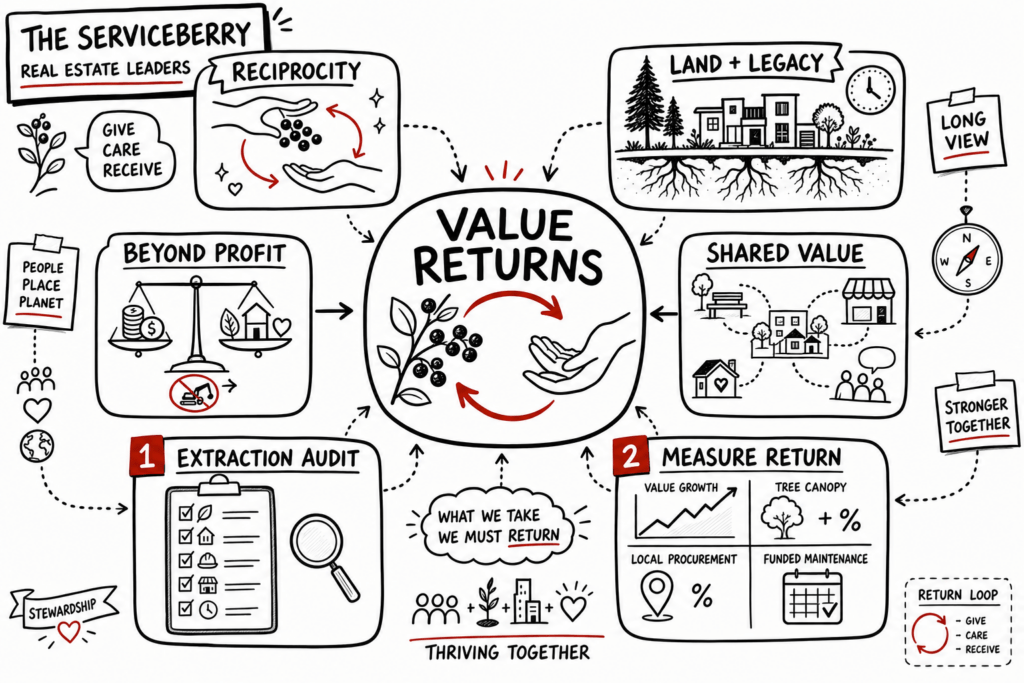
What The Serviceberry asks its reader to consider
Robin Wall Kimmerer’s The Serviceberry: Abundance and Reciprocity in the Natural World uses the sharing of fruit in a living community to explore gratitude, reciprocity and the gift economy. Her argument asks what receiving creates an obligation to return, and challenges an account of wealth centered on accumulation and self-sufficiency.
For people whose work concerns land, the question has practical force: which relationships make a place valuable, and what responsibilities follow from benefiting from them? Applying that question to real estate is our interpretation. The book’s purpose should not be reduced to a technique for improving a project’s price or reputation.
Who should read it
The book suits readers willing to think about land, enoughness and mutual dependence outside a conventional business framework. Developers, brokers and owners may find material for discussion about stewardship, while readers with no commercial interest can approach it on its own terms.
Kimmerer is a scientist and an enrolled member of the Citizen Potawatomi Nation. Her SUNY ESF faculty profile provides context for her work with plant ecology and Indigenous knowledge. The publisher’s page identifies John Burgoyne as illustrator and describes the book’s argument about reciprocity. It was published in November 2024.
A reader looking for a development model, entitlement advice or environmental reporting standard will need specialist sources. This is an invitation to examine values and relationships.
Core idea: receiving carries a responsibility
The serviceberry offers Kimmerer a way to discuss how abundance can circulate through a community. Giving, receiving and caring are connected. Her account draws on Indigenous knowledge and ecological observation; it is more demanding than adding charitable giving after the commercial decisions have already been made.
For a business reader, a useful distinction is between a gift offered for mutual flourishing and an inducement offered to secure a return. Describing a marketing expense as reciprocity does not resolve that distinction. Ask who determines what is useful, who receives the benefit and what expectations accompany it.
Questions for people working with land
The following applications belong to this review. They offer ways to discuss responsibilities without claiming that Kimmerer supplies a real estate operating system.
1. Consider what should be returned
Identify the sources of a project’s value: land, water, public infrastructure, labor, local knowledge and neighboring activity. Consider what the project asks of each and what it contributes in return. A contribution should respond to an actual need, with input from the people affected, rather than simply fit a convenient promotional story.
2. Distinguish enough from more
A larger amenity package does not answer whether a place is cared for. Discuss the durability, repairability and ongoing demands of the choices being made. A business can still examine cost and feasibility while asking whether additional consumption serves a useful purpose.
3. Treat land as a continuing relationship
A transaction date does not end the consequences of a land-use decision. Ask what is known about the site’s ecology and history, whose knowledge is missing, and who will remain responsible for maintenance. Seek the relevant local expertise before making claims about restoration, cultural significance or environmental benefit.
4. Examine who shares in the value
Be specific about access and benefit. An amenity reserved for owners has a different role from a public space. Local employment, purchasing or planting choices may matter, but the existence of a program alone does not demonstrate its effect. Listen to participants and neighbors, including when their assessment differs from the project team’s.
Where a business application can go wrong
The danger is borrowing an appealing vocabulary while leaving the underlying choices unchanged. A promise of stewardship needs an identified responsibility, suitable expertise and resources to continue the work. A claim about community benefit needs a clear account of who benefited and how that was established.
Measurement can help make some commitments visible, but it does not capture every relationship. Nor does meeting an internal target amount to another community’s agreement with a project. Keep the limits of any evidence alongside the result.
How to make the discussion practical
- Land: What is the starting condition, and who can assess the proposed effect on soil, water, habitat or tree canopy?
- People: Which residents, workers and neighbors are affected, and how can their concerns influence the work?
- Local economy: What do purchasing and employment records actually show about participation?
- Culture: Whose history is being described, and who should be involved before that account is published?
- Long-term care: Who funds and performs maintenance after the initial project team leaves?
Choose a commitment the responsible people can explain and sustain. Record the starting evidence, the agreed work and how its effects will be reviewed. Where useful, this may include measures such as canopy condition, local purchasing or funded maintenance; choose measures suited to the actual commitment instead of creating targets solely because they are easy to report.
The book’s question remains larger than a project checklist: how should people live within relationships from which they receive so much? Carry that question into the work without treating the answers as proof of a commercial outcome.