
The Thinking Machine Summary: Jensen Huang’s Long Bet
What is The Thinking Machine summary for business leaders?
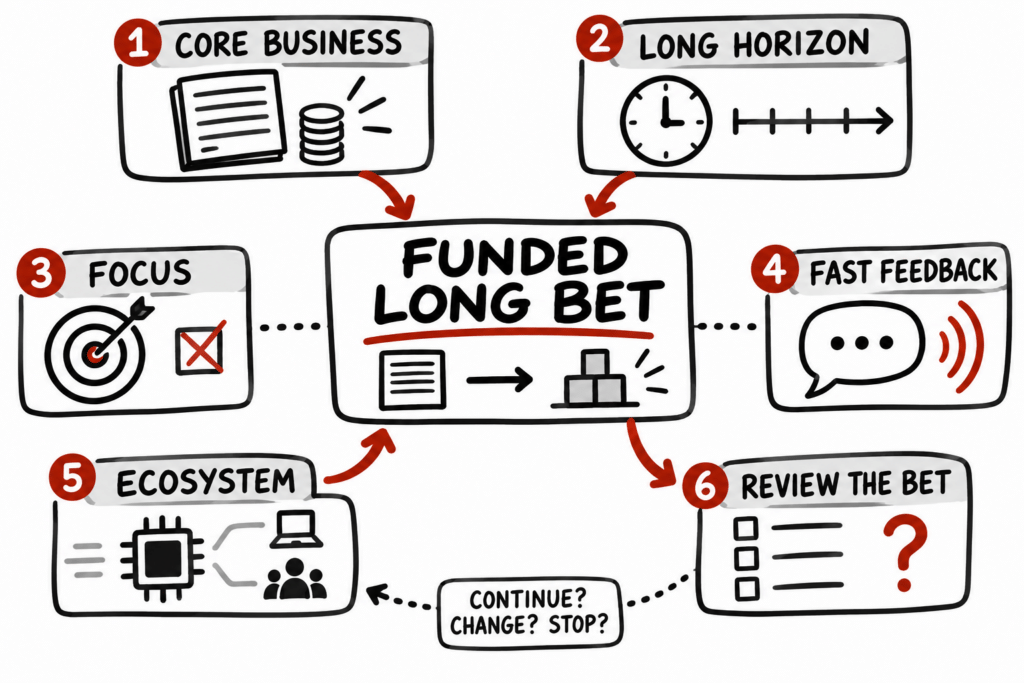
For established agents, team leaders, and brokerage owners, The Thinking Machine summary is a case for funding a long-term bet with a business that works today. Stephen Witt’s book follows Jensen Huang and Nvidia as graphics technology becomes central to modern artificial intelligence. The strategic implication is not that every leader should pursue AI; it is that conviction needs both a financial runway and the discipline to withstand years of uncertainty. Call this a funded long bet: an investment in a future capability, paid for by a productive core business. A brokerage, for example, might use current transaction income to build a more reliable referral system rather than expecting the experiment to pay for itself immediately. Read Witt for a reported account of judgment, timing, and the consequences of a consequential technology bet. Look elsewhere if you primarily want a management checklist or a technical guide to building GPUs.
The public arc, without the ending
Witt’s subject is Jensen Huang, the Taiwan-born engineer who co-founded Nvidia in 1993 with Chris Malachowsky and Curtis Priem. The company’s early years were precarious; its eventual position was not guaranteed by a neat founding vision.
The public history that matters for operators is the move from graphics toward broader computing. Nvidia built graphics processing units, or GPUs, to handle many calculations in parallel. Graphics remained a major business while the company invested in making GPUs useful for work beyond rendering images.
CUDA, introduced in 2006, is Nvidia’s platform for programming GPUs for broader computing tasks. That investment helped developers use the hardware for applications beyond graphics. As deep learning grew, the combination of hardware, software, and developer familiarity became strategically important.
That is the mechanism, not a spoiler: a business with a present market supported a capability whose largest future market was not yet obvious. The book offers more than this public arc, but you do not need its closing scenes to test the operating lesson.
Core Idea: The funded long bet
For this review, the useful name for the pattern is the funded long bet. It is not a quotation from Witt or a proprietary framework. It describes a practical relationship: the core business generates resources, and a deliberately chosen investment uses some of those resources to build a future advantage.
A long bet without a funding engine is a wish. A funding engine without a credible future bet can become a franchise waiting for its economics to change. The hard part is deciding how much the present business can responsibly carry while the future remains uncertain.
Being early is not the same as being right. Nvidia’s experience also reflects timing, technical execution, and a market that eventually rewarded capabilities it had developed. A leader should not use the outcome to justify every delayed investment. The better question is whether there is enough evidence to keep funding the work, and whether the business can survive if the anticipated market arrives later than expected.
Who Should Read It
Read this book if you want a substantial business story about conviction under uncertainty and are willing to examine the costs as well as the outcome. It is especially useful for a leader deciding whether to protect a promising investment from the pressure of this quarter’s easier opportunities.
Skim it if you want a step-by-step operating manual. It is also not a substitute for a neutral policy brief on the semiconductor industry or a technical history of GPU architecture. The Thinking Machine book review question is less “Can I copy Nvidia?” than “What does this case help me see about my own choices?”
The Thinking Machine vs The Nvidia Way
For readers choosing between the two, The Thinking Machine by Stephen Witt is the broader narrative choice: Jensen Huang, Nvidia, the technology, and the consequences of the company’s rise. Tae Kim’s The Nvidia Way puts more explicit emphasis on the company’s management approach and operating culture.
If you want a reported story to think through and debate, start with Witt. If your first question is how Nvidia’s management practices work, Kim is the more direct fit. Both concern the same company and leader, so the distinction is one of emphasis, not a promise that either book covers only one subject. You can get value from this review without reading both.
Best Takeaways: Strategy and culture
Focus is a funding decision
Nvidia’s case illustrates the value of building around a technical direction over time. For a brokerage owner, focus may mean choosing which lead sources, service lines, or capabilities deserve sustained investment—and declining attractive distractions that consume the same people and cash.
Do not confuse focus with dependence. One portal, one rainmaker, or one hero agent can become a serious concentration risk. In a relationship business, the more transferable advantage is consistent delivery, trusted referrals, and a team that can serve clients without one person rescuing every deal.
Make feedback fast, not frightening
Huang is widely associated with direct communication and an unusually broad span of control. Those traits are worth examining, not imitating by default. The portable lesson is to shorten the distance between a problem and the person who can act on it.
Ask for unpolished facts early. Make standards visible. Give people a way to disagree without having to manage the leader’s reaction first. Intensity, fear, and long hours are not a culture system; an extraordinary equity outcome does not make their human cost automatically acceptable.
Separate the ecosystem from the product
Nvidia’s position is not just one successful chip. Hardware, software, developers, and customers can reinforce one another. That combination also brings dependencies, including manufacturing concentration and exposure to export controls.
For a service firm, an ecosystem might be less glamorous: referral partners who trust the handoff, a repeatable client experience, and a team cadence that keeps commitments from slipping. Those elements compound only if clients and colleagues can rely on them.
Where It Falls Short
A narrative centered on an exceptional leader can make the eventual outcome feel more inevitable than it was. Readers should watch for survivorship bias: many leaders make long bets, but fewer become the subject of books because their bets worked.
The case also has limits outside semiconductors. Nvidia’s research demands, product economics, and global supply dependencies differ sharply from those of a local relationship business. Use the story to improve judgment, not to import chip-company economics or founder behavior into a brokerage.
Finally, a leadership-centered account cannot by itself settle the policy or competitive questions surrounding AI. Treat the book as a business case, not the last word on who benefits from the industry’s growth.
How to Apply It This Quarter
- Name one bet. Choose a capability that could matter over several years, such as a dependable referral handoff or a stronger client-service process. Define what would make it valuable to your business.
- Set the funding boundary. Decide what time and money the current operation can spare without compromising client delivery. For example, a firm might allocate four staff hours a week for a quarter to test a referral process; that is an illustrative limit, not a benchmark.
- Stop something. Identify the meeting, offer, or initiative that will give those resources back. If nothing stops, the bet is probably an addition to an already crowded list.
- Invite bad news. At the end of the quarter, ask what improved, what failed, and whether clients or referral partners noticed. Continue, change, or end the investment on that evidence—not on attachment to the original idea.
Is The Thinking Machine Worth Reading?
Yes, if you want a thoughtful case on conviction, timing, and culture—and can resist treating Nvidia’s outcome as a template. Skip or skim it if your immediate need is a how-to manual. The most useful result is a clearer decision about what your business can fund, what it must stop, and whether people can bring you bad news quickly.
If that decision deserves a conversation grounded in your business, we can help you work through it.