
The Status Game Summary & Review: Leadership Takeaways
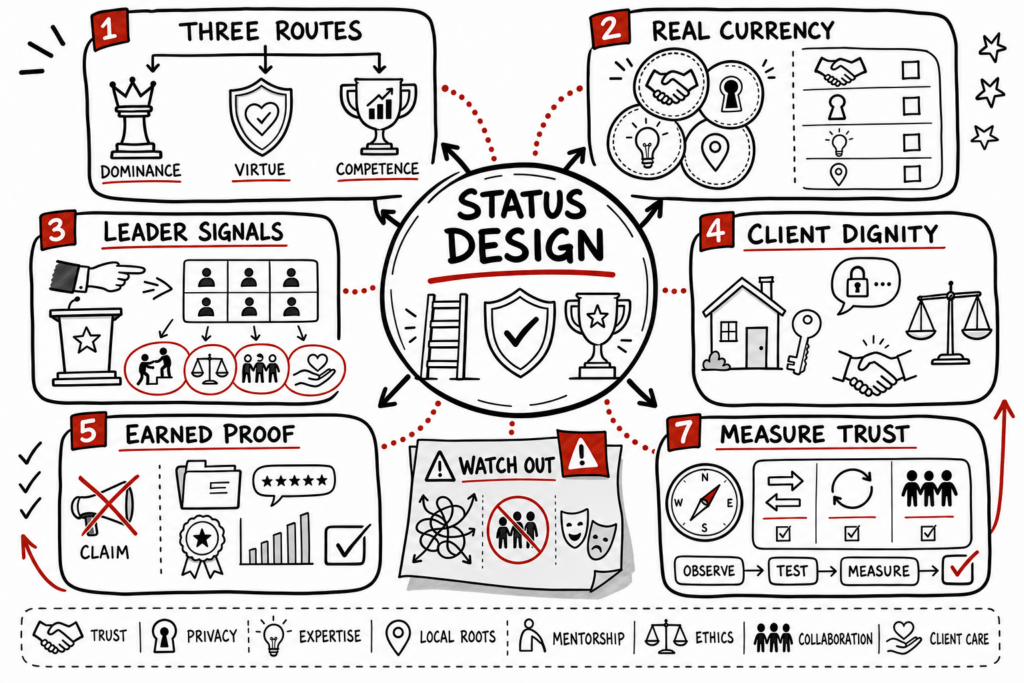
Will Storr’s The Status Game is useful to a luxury real-estate leader as a lens on reputation, recognition and the social rules that shape behavior. It is a diagnostic framework, not a manual for gaining rank at any cost.
What Is The Status Game Summary for Leaders and Luxury Advisors?
Storr argues that status is a social need and that groups create games through shared rules, stories and rewards. For a leader, the question is what the team actually recognizes: volume, judgment, service, ethical conduct, mentorship or visible performance.
Quick Book Snapshot
The Status Game is narrative nonfiction by journalist and author Will Storr. It draws together research, historical examples and cultural observation to explain why people seek standing within groups. The book is accessible and wide-ranging, but it is not a conventional sales or management manual. Learn more from Storr’s official site.
Who Should Read It
The book suits advisors whose work depends on trust, discretion, referrals and premium positioning; team leaders deciding what earns recognition; and founders building a public reputation. Readers who need scripts or a ready-made operating cadence may find it less immediate.
The Status Game Summary: Core Idea
Status is more than wealth or title. It is perceived standing within a group. Storr describes recurring routes including dominance, virtue and success or competence. These are lenses rather than fixed personality categories.
Britannica’s social-status overview offers neutral background. In a brokerage, the actual status game is visible in what produces attention, advancement and trust, not only in the values printed on a wall.
Best Takeaways
1. Leadership Means Designing the Local Status Game
People notice what leaders admire, promote, reward and tolerate. If recognition goes only to top-line production, collaboration and client care may become secondary. A healthier system makes sound judgment, ethical conduct, mentorship, learning and durable client outcomes visible as well.
2. Premium Clients Are Often Protecting Identity
Luxury decisions can involve privacy, family identity, dignity and a desired future self as well as price. The ethical response is better diagnosis: ask what the decision represents, who else is involved and what outcome allows the client to feel respected.
3. Personal Branding Is a Reputation System
Attention is not the same as durable trust. Demonstrated competence, relevant insight, discretion, consistency and credible third-party proof are stronger signals than generic declarations of excellence. Audit earned signals separately from claimed ones.
4. Every Group Has a Status Currency
One market may prize volume; another may value local roots, architectural knowledge, philanthropy, privacy or access. Influence improves when a leader understands the actual currency and checks whether the incentives support client trust.
The Status Game Review: Where It Falls Short
The book’s broad synthesis makes the framework memorable, but status cannot explain every act of generosity, disagreement or underperformance. Financial constraints, skill gaps, incentives and genuine principle still matter. Use the framework as a question, not a total theory of motivation.
How to Apply It
- Map what raises standing among clients, peers, referral partners and community leaders.
- Review your public claims and replace unsupported statements with evidence and useful perspective.
- Inspect awards, meetings, promotion, compensation and praise for the behaviors they actually reward.
- Protect client dignity with private decision paths and no public pressure.
- Track referral, repeat-client, retention, collaboration and complaint signals to see whether the change improves trust.
These measures are prompts for local review. They do not prove that status awareness caused a particular result.
Is The Status Game Worth Reading?
Yes, if you lead people, sell high-consideration services or build a reputation in a status-sensitive market. Read it as a way to notice hidden incentives and design healthier ones. If you want to examine the recognition system in your own operating model, request a complimentary one-hour conversation with a senior advisor who is an experienced operator. Talk through your next move. See what RE Luxe Leaders believes for the broader operating context.