
Feel-good Productivity Summary: Executive Review & Takeaways
What is the best Feel-Good Productivity summary for executives?
Feel-Good Productivity by Ali Abdaal presents positive emotion, motivation and recovery as part of how people approach difficult work. For an executive or real-estate operator, the useful question is how to design work that supports attention and momentum without pretending every constraint can be solved by a better routine.
The book is a practical lens. It is not clinical care, a team diagnosis or evidence that a particular habit will produce a particular business result.
Book Context and Author Background
Abdaal writes about productivity, learning and the relationship between energy and action. The book’s accessible strength is its invitation to examine how work feels and what makes starting easier. Readers who need research depth, treatment or an organizational redesign should add the appropriate expert or source.
For context on the author’s work, see Ali Abdaal’s official site. A related Harvard Business Review burnout collection offers a separate workplace context; neither link establishes an outcome for a particular reader.
Who Should Read It
The book may help a leader who is working hard while losing attention, recovery or a sense of progress. It is less useful as a complete operating model for a brokerage, a capital-intensive project or a team whose main problem is authority, staffing or incentives.
Core Idea
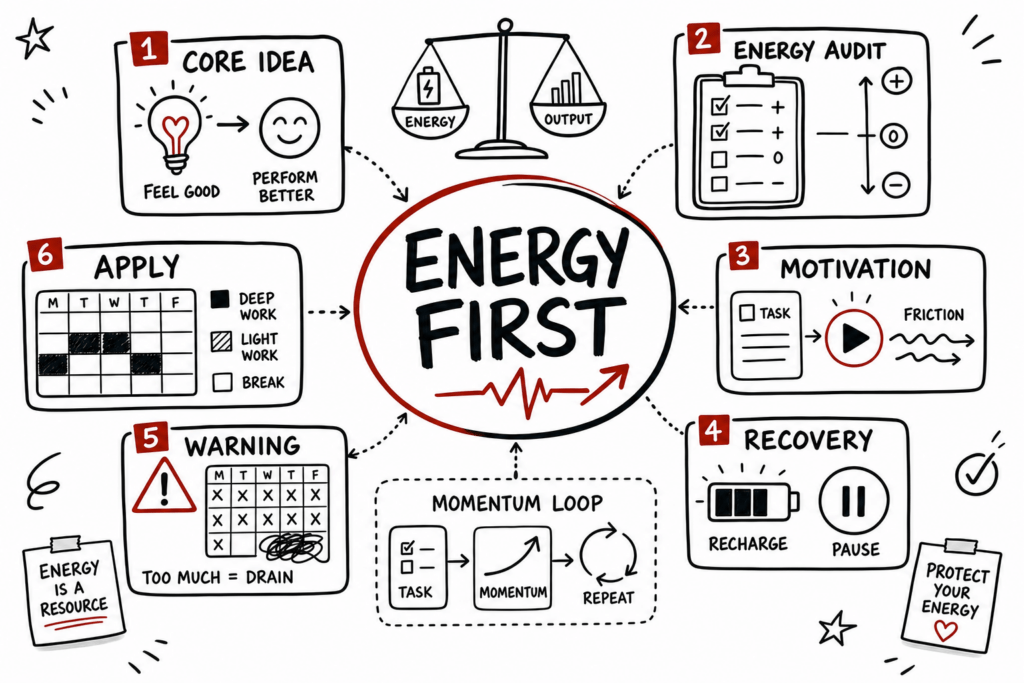
Make productive action easier to begin and easier to sustain by noticing emotion, reducing unnecessary friction and connecting work to a reason that matters. That can change a task’s design, sequence or support. It does not remove the need for judgment, accountability or hard conversations.
Best Takeaways
1. Energy is a management metric, not a mood
Notice which work gives useful momentum, which work drains attention and what conditions change the pattern. Use that observation to improve a meeting, handoff or work block rather than turning it into a universal score.
2. Motivation improves when work has emotional texture
Meaning, curiosity, progress and a sense of agency can make difficult work easier to enter. A leader can offer a clear purpose, a visible next step and a realistic choice about how the work will be done.
3. Recovery is part of the production cycle
Rest and recovery protect the capacity needed for good decisions. If a team is depleted, examine workload, role scope, decision rights and recurring meeting demands alongside personal habits.
Where It Falls Short
A personal framework can understate power, incentives, staffing, market pressure and organizational design. An exhausted leader may need a change in scope or authority, not another morning routine. The book also cannot decide what a particular person’s health or work situation requires.
Feel-Good Productivity Strategy Lessons
For a leadership team, ask where activity is being mistaken for value, which recurring work drains senior attention and whether the calendar protects decision quality. Use the answers to choose one operating change and one observation period.
How to Apply It
Run a two-week energy audit
For two weeks, note the task, the energy before and after, the condition that helped and the friction that slowed the work. Keep the notes private or permissioned. Review patterns without claiming that the result generalizes to everyone.
Redesign one high-friction task
Choose a recurring handoff, meeting or decision. Clarify its purpose, remove one unnecessary step, set a realistic owner and see whether the next cycle is easier to complete and easier to assess.
Protect decision-quality windows
Reserve a period for work that requires judgment, then move low-value interruptions away from it where the role allows. A protected window is an operating choice, not a guarantee of performance.
Use the framework with your team
Ask what makes an important task easier to start, what blocks progress and what support would help. Do not make emotional disclosure a condition of belonging or performance. Turn the discussion into a practical change the team can choose and review.
Final Verdict
Feel-Good Productivity is useful when a leader wants to examine the conditions that support sustained effort. Its best contribution is a prompt to redesign work with more awareness of energy, meaning and recovery, while keeping structural and professional support in view.
You can request a complimentary one-hour conversation with a senior advisor who is an experienced operator. Talk through your next move when your operating rhythm needs more energy for the decisions that matter.