
The Everything Token Summary: Review for Real Estate Leaders
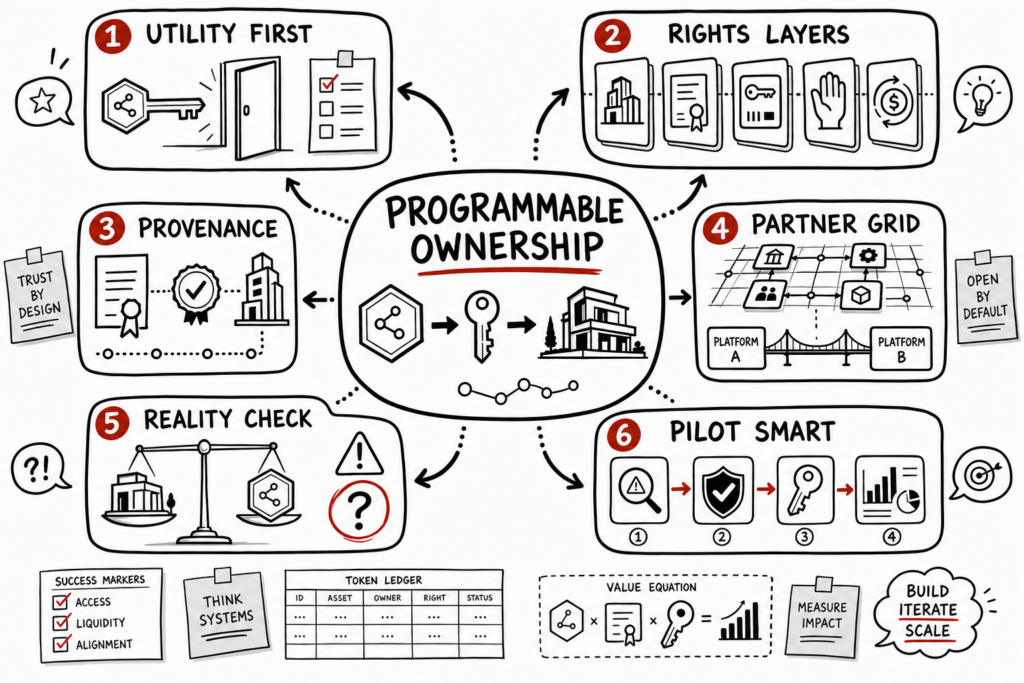
What Is The Everything Token Summary for Business Leaders?
Steve Kaczynski and Scott Duke Kominers’s The Everything Token examines NFTs as a way to organize digital ownership and relationships around products and brands. Its useful business question is what an owner can actually do with a token. For real estate, that requires separating the technology from the legal rights, services and responsibilities around it.
What The Everything Token Is About
The publisher’s record identifies the authors and the January 2024 release. Their case looks beyond collectible images toward commercial uses and community participation. Read that as an argument for examining the technology’s possibilities, not evidence that any proposed token will attract demand or appreciate.
The book’s business perspective is its appeal. It gives leaders a vocabulary for discussing ownership and participation before they approve a product. The practical tests below are RELL’s applications, not claims that the authors have validated a particular real-estate structure.
Core Idea: Ownership Can Become Programmable
An NFT is a distinct token recorded on a blockchain. Applications can use it to recognize a holder and enable an action, such as requesting access to a service. But recording or transferring the token does not automatically transfer a deed, copyright, investment interest, promised benefit or enforceable royalty.
For a hypothetical hospitality membership, ask who owes the booking benefit, how eligibility is checked, whether it follows a transfer and what happens when the service is unavailable. Software can execute a rule while leaving those commercial questions unresolved. Compare the idea with a conventional account or database that might solve the same problem with less work.
Best Takeaways from The Everything Token
Use the book to frame a discussion about the customer’s experience, then test each proposed benefit against delivery, cost and enforceability. Token scarcity and trading activity are insufficient evidence of a useful product.
1. Design utility before scarcity
Define a practical benefit, its limits and the party responsible for delivering it before discussing supply or resale. Measure use and service quality: for example, successful redemptions divided by eligible requests during a stated period, with failed and unresolved requests reported separately. A high token price cannot compensate for an unavailable benefit.
2. Incentives matter more than technology
Examine who pays, who controls the rules and who bears failure costs. A community requires continuing work, not just a list of holders. Ask whether people would still value the service without price appreciation, and whether transfers or issuer decisions can undermine the expectations on which they joined.
3. Provenance has commercial value
A recorded history can help an authorized process verify a sequence of events. It cannot make a false entry true or authenticate a physical object by itself. Identify who checks the link between the record and the asset, how mistakes are corrected and what evidence a later holder receives. Keep that responsibility visible rather than describing the ledger as trust by default.
4. Composability expands partnership options
Possible integration with other services raises questions about permission, compatibility and continuity. Do not assume that another platform must recognize a token or preserve a benefit. Test the actual supported transfer and access paths, including custody, recovery, customer support and failure of a partner service.
Technical openness does not require publishing personal or confidential records. Decide what information may be shared, who can read it and how correction, retention and privacy obligations will be met before placing data in a system that may be difficult to change.
How to Apply It to Real Estate and Funds
Begin with the right being proposed. Property title, an equity or debt interest, a contractual benefit, access permission and a community role are different arrangements. A token labelled “membership” does not settle its legal classification, and a token linked to a property does not necessarily give its holder an interest in that property.
The SEC staff’s January 28, 2026 statement on tokenized securities distinguishes structures and the rights they afford. It discusses, among other differences, third-party arrangements that may not give the holder the underlying issuer’s rights. It is staff guidance without legal force or effect, not approval of a proposed offering.
Before a pilot, obtain current, jurisdiction-specific review of the actual rights, offering, transfers, custody and tax treatment. An access-service concept also needs that review; do not call it exempt or non-investment merely because that is the intended use.
- Customer purpose: what problem does the proposed token solve better than an ordinary account?
- Rights and delivery: who owes what, under which agreement, and what can be changed?
- Records: how are holder, asset, right and status reconciled, with appropriate privacy?
- Recovery: what happens after a lost key, mistaken transfer or vendor failure?
- Exit: how are obligations honored and records preserved if the pilot ends?
Fractional tokens do not create a willing buyer. Assess actual eligible demand, transfer restrictions, time to transfer and completed trading volume. Where no market exists, a price spread or liquidity claim may have no meaningful basis.
Where It Falls Short
A strategic primer cannot complete the operating design. Wallet setup, key recovery, support, records, fees and dependable benefit delivery can determine whether a concept is usable. Neither technical feasibility nor a legal structure on paper proves a sustainable business.
Be especially careful with claims that ownership automatically produces alignment, access or liquidity. Those are outcomes to demonstrate. A rights register and measured pilot can reveal a gap; the existence of a token cannot fill it.
Who Should Read It?
The book is useful for leaders who need to question a digital-ownership proposal before hiring vendors or authorizing a launch. It is less useful as a stand-alone guide to securities, title, tax or technical implementation. Keep the discussion grounded in the customer, the responsible operator and the actual terms.
Final Verdict: Is The Everything Token Worth Reading?
It is worth considering as a business primer that expands the questions a team can ask. Use a contained, authorized test with a clear stopping rule and measures unrelated to speculative price gains. Expand only when delivery, demand, cost and the reviewed structure support the decision.
For a related perspective on dependence and control, read our review of Technofeudalism. The books approach digital ownership from different directions; neither removes the need to examine who can change the rules.