What Is The Hard Thing About Hard Things Summary for Leaders?
The Hard Thing About Hard Things summary for ambitious founders, brokerage owners, and luxury real estate executives is this: Ben Horowitz argues that leadership is defined less by elegant strategy than by the quality of decisions made when markets, cash, talent, and confidence are all under pressure. The strategic implication is practical: build a company that can make and execute uncomfortable calls before volatility forces rushed reactions. In this Ben Horowitz book summary, the useful definition is “wartime CEO”: a leader who narrows priorities, communicates with precision, and protects execution when uncertainty rises. For real estate leaders, a measurable application is a 90-day downside plan tied to cash runway, listing pipeline conversion, buyer lead quality, and retention of top producers. Read it if you want a crisis leadership book about founder decision-making, not a polished formula for easy growth in stable normal markets. Its value is highest when the next move is consequential and incomplete data is unavoidable.
Book Context and Author Background
Ben Horowitz is not writing as a theorist observing leadership from a safe distance. He built and ran technology companies, survived brutal operating cycles, and later became a venture investor through Andreessen Horowitz. That matters because The Hard Thing About Hard Things is not a tidy management manual. It is a field report from the part of leadership most business books avoid: when the numbers are deteriorating, the team is anxious, and every available option has a real cost.
This is why The Hard Thing About Hard Things review conversations tend to be more durable than trend-driven business book chatter. The book keeps showing up in founder circles because it is about decision-making under uncertainty. Not uncertainty as a slide-deck concept. Real uncertainty: incomplete data, conflicting advice, people depending on you, and no guarantee that the “right” answer exists.
For luxury real estate executives, the translation is clear. You may not be running a Silicon Valley software company, but you do operate in cycles where buyer confidence, interest rates, inventory quality, lending standards, and team morale can shift quickly. If your brokerage, development firm, or advisory practice serves high-net-worth clients, volatility is not just a market condition. It becomes a leadership test.
Who Should Read It
Read this book if you lead people through markets that do not behave. It is especially relevant for brokerage founders, managing brokers, development principals, team leaders, and senior operators who have to make decisions before the market gives them clean confirmation.
It is also useful for executives who are tired of leadership content that assumes a stable environment. Horowitz is focused on what happens when incentives get messy, people lose confidence, or the company must choose between two bad options. That makes it highly relevant as a business leadership book review for professionals navigating market volatility leadership.
It is not the best first book for someone looking for basic management structure, hiring templates, or culture-building checklists. It is better as a second-stage leadership book: the one you read after you already understand the basics and need help thinking through pressure, ambiguity, and consequences.
Core Idea
The core idea is blunt: the hard thing is not knowing the elegant principle. The hard thing is applying judgment when the principle collides with reality.
Most executives know they should communicate clearly, hire strong people, preserve culture, make strategic bets, and protect the business. The problem is that those goals often conflict. You may need to retain top talent while cutting costs. You may need to protect brand prestige while adjusting pricing strategy. You may need to reassure agents or investors without pretending conditions are better than they are.
This is where the book earns its place. Horowitz separates management theory from lived execution. He is not saying frameworks are useless. He is saying frameworks do not remove the emotional burden of leadership. A leader still has to decide, communicate, absorb criticism, and keep the company moving.
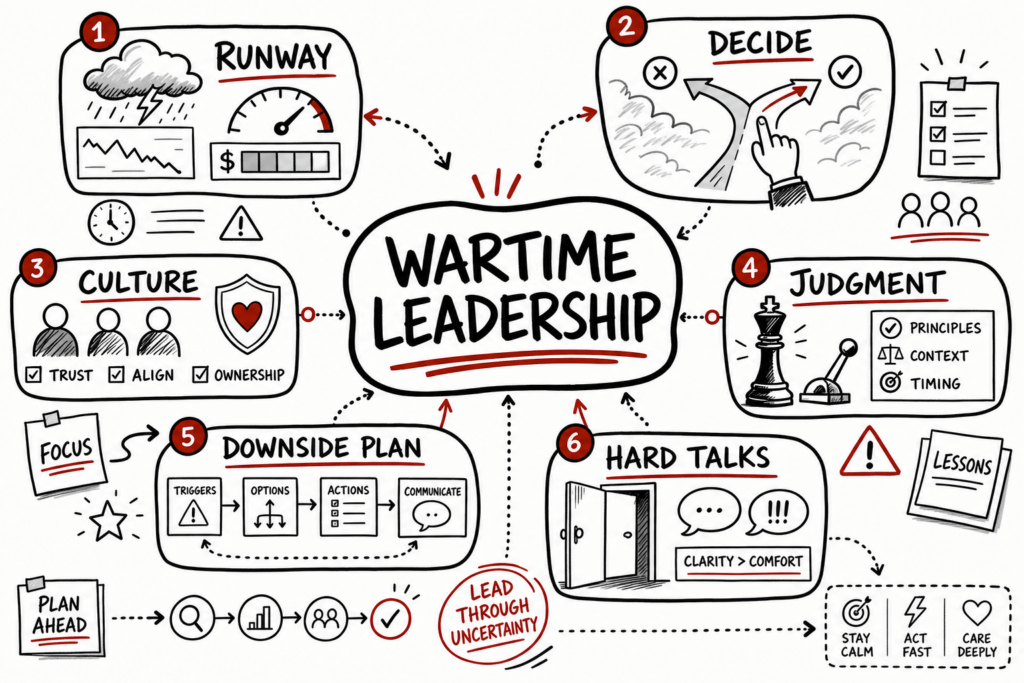
The most useful concept is the difference between peacetime and wartime leadership. In peacetime, leaders can optimize, delegate broadly, experiment, and let culture absorb complexity. In wartime, the leader often has to narrow the focus, make faster calls, and personally own the highest-risk decisions. For luxury real estate, wartime may look like a frozen luxury listing market, a sudden financing shock, a failed capital raise, a recruiting threat, or a brand-damaging client issue.
Best Takeaways
1. Hard conversations are a leadership system, not a personality trait.
One of The Hard Thing About Hard Things key takeaways is that avoiding hard conversations usually creates more damage than having them. This applies directly to real estate teams. If production is slipping, if a senior agent is poisoning the culture, or if a development timeline is no longer credible, silence becomes expensive.
The practical lesson: build a communication rhythm before the crisis. Weekly operating reviews, clear pipeline metrics, and direct one-on-one conversations make it easier to act when the pressure rises. A luxury firm should know its leading indicators: qualified buyer activity, showing-to-offer ratio, days-on-market movement in target segments, net agent retention, referral volume, and cash coverage.
2. Culture is proven under stress.
Horowitz is strong on the gap between stated values and actual behavior. Culture is not what appears on a website. Culture is what gets rewarded, tolerated, and repeated when conditions are difficult.
For real estate leaders, this is a serious point. In a hot market, almost any team can look aligned. In a slower market, the truth appears. Do agents collaborate or hoard information? Do managers coach or blame? Does the brand protect client trust or chase weak deals to preserve short-term volume?
3. There is no substitute for judgment.
This is the spine of the book and one of the strongest The Hard Thing About Hard Things leadership lessons. Horowitz does not offer a magic formula because his point is that leadership often requires choosing among imperfect paths.
That is why the book works for founder decision-making. A founder, CEO, or principal cannot outsource the final responsibility for existential decisions. Advisors can inform. Data can sharpen the view. But the leader still has to make the call.
4. Strategy must survive contact with reality.
The best The Hard Thing About Hard Things strategy lessons are not about clever positioning. They are about resilience. A strategy that only works in favorable conditions is not a strategy; it is a preference.
In luxury real estate, that means testing your business against specific downside scenarios. What happens if transaction volume drops 25 percent? What happens if your top two rainmakers leave? What happens if a flagship development misses its sales absorption target for two quarters? What happens if wealthy buyers pause because they do not trust pricing?
Where It Falls Short
The book is not perfect. Its startup context is both its strength and its limitation. Some examples come from a high-growth technology environment where venture capital, software scale, and founder control shape the decision set. A brokerage owner or development executive cannot copy the playbook directly.
There is also a risk that readers romanticize wartime leadership. Not every difficult quarter requires command-and-control behavior. Some leaders use “wartime” language to justify poor listening, rushed decisions, or unnecessary drama. That is not the lesson to take. The better lesson is situational leadership: match your management style to the level of threat, complexity, and time pressure.
Another caveat: the book is stronger on executive judgment than on operational templates. If you want step-by-step hiring systems, compensation models, or real estate-specific restructuring plans, you will need additional tools. For broader leadership research and related management thinking, Harvard Business Review’s leadership coverage is a useful companion source.
Finally, Horowitz’s voice is direct and sometimes intense. That will appeal to operators who want candor. It may feel less useful to readers looking for a softer, coaching-oriented leadership book. This is a pressure book, not a comfort book.
How to Apply It
Do not read this as a motivational story. Read it as a diagnostic tool. The value is in asking where your organization is fragile before the market exposes it.
Run a 90-day wartime audit.
Identify the three conditions that would most threaten your business over the next quarter. For a luxury brokerage, that might be falling qualified lead volume, longer listing timelines, and agent attrition. For a developer, it might be carrying costs, financing conditions, and absorption risk. Assign owners, thresholds, and response triggers. Example: if qualified buyer consultations fall below a defined weekly number for three consecutive weeks, marketing spend and outreach strategy are reviewed immediately.
Separate facts, fears, and decisions.
During volatility, leadership teams often mix data with anxiety. Create a simple meeting discipline: what do we know, what do we suspect, what must we decide, and what will we monitor? This makes decision-making under uncertainty cleaner without pretending certainty exists.
Protect your talent core.
Horowitz is clear that people issues become sharper in hard times. In luxury real estate, your top producers, client-facing advisors, project leaders, and operations talent carry disproportionate value. Know who is mission-critical. Know what they need. Know which cultural behaviors cannot be tolerated, even from high performers.
Communicate without theater.
Clients, agents, investors, and staff do not need forced optimism. They need credible leadership. Say what is true, what is being done, what standards remain unchanged, and when the next update will come. Calm specificity beats inspirational vagueness.
Use the book for leadership rehearsal.
The best way to use this book is to discuss it with your senior team. Choose one chapter or concept and ask: what is our version of this problem? Where are we avoiding a hard call? What would a more honest operating plan look like?
Final Verdict
This Ben Horowitz review is simple: The Hard Thing About Hard Things is worth reading if you lead through consequences. It is not a universal operating manual, and it should not be treated as a formula. Its value is that it tells the truth about leadership under strain.
For luxury real estate leaders, the book is most useful during interest-rate cycles, inventory shocks, buyer-confidence shifts, recruiting battles, and capital pressure. It helps you think less like a market commentator and more like an operator. That is the real advantage.
If you want more leadership lessons for real estate executives, read it slowly, mark the uncomfortable sections, and translate each idea into one operating behavior. Then keep going with more RE Luxe Leaders strategy briefings—or book a confidential strategy call when the next hard decision needs sharper thinking.