What Is The Status Game Summary for Leaders and Luxury Advisors?
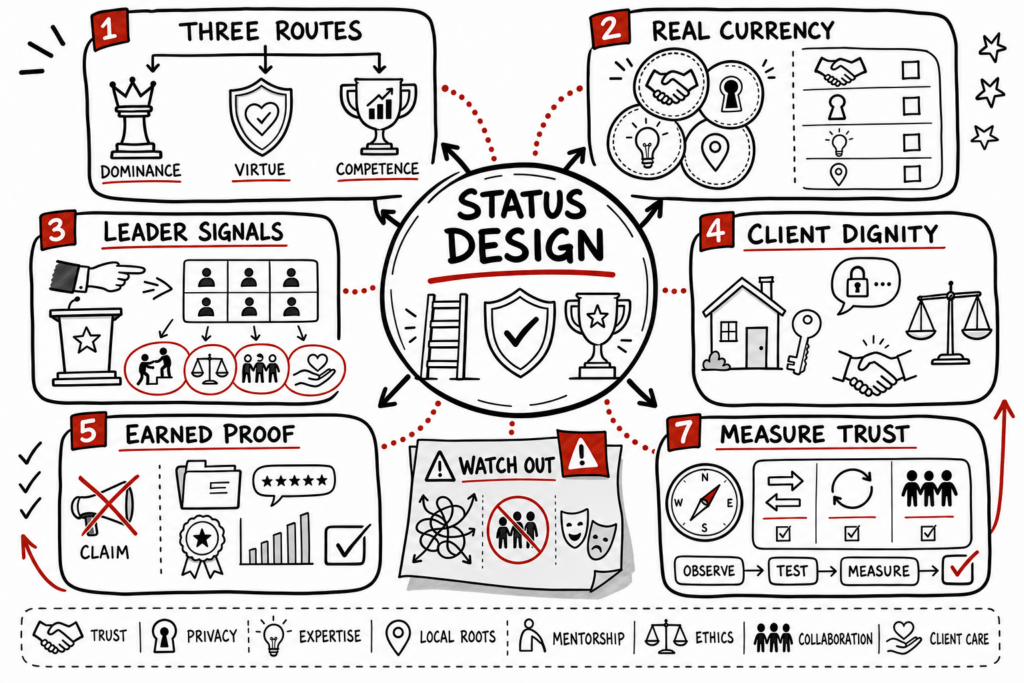
The Status Game summary for luxury real estate advisors, team leaders, and ambitious professionals is this: Will Storr argues that status is a basic social need, so reputation systems should be managed as deliberately as revenue or authority. In the book, status means a person’s perceived rank and value within a group, earned through three recurring routes: dominance, virtue, and success or competence. That framework explains why a client may care about discretion as much as price, why a team copies what its leader publicly rewards, and why visible proof often beats self-promotion. The practical reader-fit test is simple: if your work depends on trust, referrals, culture, or premium positioning, the book offers a useful diagnostic lens rather than a step-by-step sales manual. Track one concrete KPI—referral rate, repeat business, or regrettable team turnover—while auditing which behaviors receive recognition. That turns Storr’s broad behavioral argument into a measurable leadership practice without treating every interaction as cynical competition.
Quick Book Snapshot
The Status Game is a popular psychology and behavioral science book by long-form journalist and author Will Storr. His broader work examines identity, belief, storytelling, and the social self. Readers can learn more about his books and reporting on Will Storr’s official website.
This is narrative nonfiction, not a conventional management manual. Storr uses research, historical examples, cultural observation, and human stories to explain why people compete and cooperate within shared systems of rank. The result is accessible and memorable, although broader than a tactical leadership or sales book.
Who Should Read It
This book is best suited to people whose results depend on reputation and socially sensitive decisions:
- Luxury real estate advisors managing trust, discretion, and premium positioning.
- Team leaders deciding which behaviors receive recognition and advancement.
- Founders and executives building a visible professional reputation.
- Agents who depend on referrals, centers of influence, and community credibility.
- Reflective operators interested in status games in the workplace.
Checklist-only readers may find it less immediately useful. Storr provides a lens for interpreting behavior, not scripts for winning listings or running meetings. The value comes from applying the framework to situations where money, identity, belonging, and reputation overlap.
The Status Game Summary: Core Idea
The central argument is that status is not merely vanity or wealth. It is a powerful social need tied to belonging, self-worth, motivation, and perceived value within a group. For a neutral background definition, Britannica’s overview of social status describes status as the relative rank an individual holds within a social group.
Storr organizes status-seeking around three recurring lenses. Dominance relies on force, fear, or control. Virtue earns standing through perceived moral worth. Success earns it through competence, achievement, or mastery. These are not rigid personality categories. A single person or organization may move among all three depending on the setting.
Status games form wherever groups share rules, stories, symbols, and rewards. A brokerage may claim to value service while reserving nearly all public recognition for transaction volume. A luxury brand may speak about discretion while broadcasting every client interaction. In both cases, the real game is revealed by what produces attention and rank—not by the stated values.
This is the book’s most useful leadership insight: reputation mechanics often matter as much as formal title or compensation. Status can motivate excellence and prosocial behavior, but poorly designed games produce anxiety, exclusion, resentment, and performance theater.
Best Takeaways
1. Leadership Means Designing the Local Status Game
The strongest of The Status Game leadership lessons is that people notice what leaders admire, promote, reward, and tolerate. If internal prestige goes only to top-line producers, collaboration and client care become secondary regardless of the values printed on the wall.
A healthier system gives visible standing to sound judgment, ethical conduct, mentorship, learning, and durable client outcomes. This does not mean eliminating competition. It means ensuring that the route to recognition strengthens the culture instead of quietly degrading it.
2. Premium Clients Are Often Protecting Identity
Luxury real estate client psychology cannot be reduced to financial optimization. Buyers and sellers may also be protecting dignity, privacy, family identity, social belonging, or a desired future self. A negotiation that looks irrational on a spreadsheet may make sense when viewed as an attempt to preserve standing or avoid embarrassment.
The ethical response is not manipulation. It is better diagnosis. Ask what the decision represents, who else influences it, and what outcome allows the client to feel respected. Protecting dignity can be as important as presenting another comparable sale.
3. Personal Branding Is a Reputation System
The link between personal branding and status is obvious but frequently mishandled. Conspicuous displays can create attention while weakening trust. In premium markets, more durable signals include demonstrated competence, selective taste, consistency, discretion, thoughtful opinions, and credible third-party proof.
A useful brand audit separates earned signals from claimed ones. Case evidence, repeat clients, relevant expertise, and specific market insight show value. Generic declarations of excellence merely ask the audience to grant it.
4. Every Group Has a Status Currency
One of The Status Game key takeaways is that different groups reward different qualities. One market may prize transaction volume; another may value access, architectural knowledge, local roots, philanthropy, or privacy. Influence improves when you understand the actual currency rather than importing signals that worked elsewhere.
The Status Game Review: Where It Falls Short
The book’s strength is also its limitation. Storr builds an ambitious synthesis across evolutionary behavior, history, politics, culture, and personal identity. That range makes the framework memorable, but some readers may feel that status becomes an explanation for almost everything.
Not every act of generosity is disguised competition, and not every disagreement is a rank struggle. Financial constraints, personality, incentives, skill gaps, and genuine principle still matter. Leaders should use the framework as a diagnostic question, not a total theory of human motivation.
The book also requires translation. It does not provide a detailed operating system for team recognition, sales conversations, or brand measurement. Readers wanting immediate scripts may prefer a tactical influence or negotiation book. Readers willing to observe patterns and test changes will get more from it.
The reading experience is lively and story-led rather than academic. That makes the ideas accessible, although readers primarily interested in business may find some examples more expansive than necessary. This The Status Game review remains positive because the central framework travels well across leadership, branding, and client service.
How to Apply It
- Map your market’s status currency. List what raises standing among clients, peers, referral partners, and community leaders. Separate genuine trust signals from superficial visibility.
- Audit your brand evidence. Review your website, social channels, presentations, and client experience. Replace unsupported claims with case evidence, specialist knowledge, consistency, and useful perspective.
- Review recognition systems. Examine awards, meetings, promotions, compensation, and praise. Determine whether they reward client outcomes, collaboration, ethics, and learning—or only volume theater.
- Protect client dignity. Build private decision paths for sensitive conversations. Avoid public pressure, one-upmanship, and tactics that make clients defend their standing.
- Measure the result. Track referral rate, repeat-client rate, review quality, team retention, collaboration, and complaint patterns. Status awareness is valuable only if it improves trust and behavior.
Three reflection questions sharpen The Status Game strategy lessons: Which game am I currently playing? What does my market genuinely reward? Where do my incentives conflict with client trust or team health?
Is The Status Game Worth Reading?
Yes—if you lead people, sell high-consideration services, build a public reputation, or operate in a status-sensitive market. The core framework becomes clear quickly, but its deeper value comes from repeatedly applying it to client meetings, brand decisions, referral relationships, and team culture.
Do not read it as a manual for gaining rank at any cost. Read it as a way to recognize hidden incentives and design healthier ones. For the next step, explore the related RE Luxe Leaders leadership and culture briefing to turn these observations into practical team standards.