
The Technological Republic Summary & Review: Executive Takeaways
What the book argues
The Technological Republic, by Alexander C. Karp and Nicholas W. Zamiska, challenges the purposes to which the technology industry puts its talent. The authors argue for renewed cooperation between software companies and government, particularly around national security and the position of the United States and its allies. Their case links technical capability with a willingness to defend a shared political project.
For a real estate business, the useful starting question is narrower: what should technology make the firm better able to do? That is a management application of the argument. The book does not establish that a particular AI product will improve a brokerage, or that adopting the authors’ politics produces a better business.
Core idea: capability needs a purpose
The authors criticize a technology sector they see as too preoccupied with consumer engagement and too detached from public responsibilities. They also ask government to learn from engineering culture. The publisher’s description and publication details make that national and political ambition explicit. Crown Currency published the book in February 2025.
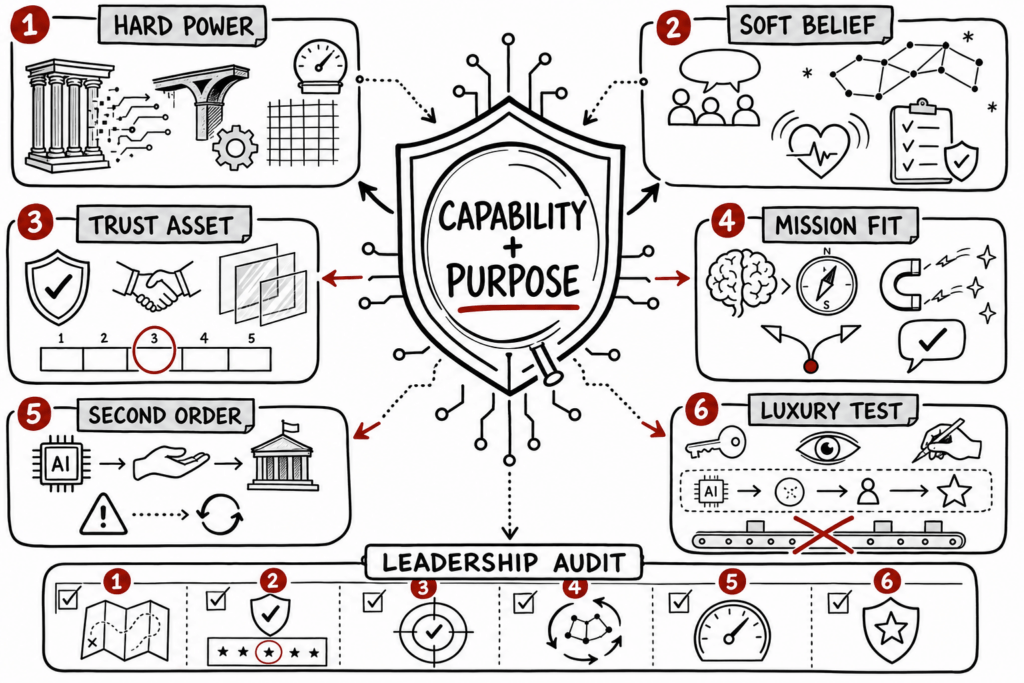
The distinction between hard power and soft belief gives a leadership team two subjects to examine: the capacity it can actually deliver, and the convictions governing its use. Agreement about a mission still leaves questions about evidence, oversight and whose interests a decision serves.
The authors’ perspective
Karp is a Palantir co-founder; Zamiska’s publisher biography identifies his corporate-affairs and legal role at the company. They write from inside the business whose approach they discuss. That experience is relevant, and it is also a reason to examine their assumptions and incentives. A company’s success does not independently settle its wider political argument.
Questions the argument raises for a business
The following takeaways are our applications to leadership decisions. They are discussion prompts, rather than a scoring system supplied or validated by the book.
1. Put the technology decision in context
Before introducing an automated step, describe the work, the people affected and the problem it should resolve. A tool that drafts a listing description needs different evidence and oversight from one that influences a consequential client decision. Ask who gains time, who has to correct mistakes and what information the tool requires.
2. Examine what trust depends on
Identify the promises that clients and colleagues rely on: accurate information, discretion, a reachable person and a reliable response. Then check whether the proposed system supports those promises. A favorable internal rating is weak evidence if staff cannot explain an output or a client cannot obtain a correction.
3. Make the mission concrete for the people doing the work
A hiring statement can describe meaningful work without proving that the job offers it. Compare that statement with the assignments, authority, support and incentives a person will receive. Ask employees what prevents them from doing work they consider worthwhile; leave room for answers that challenge the leadership team’s account.
4. Look beyond engagement measures
Clicks and usage can show that people interact with a service. They do not establish whether the service helps them. Add evidence appropriate to its purpose, such as whether information is correct, an unanswered question reaches the right person, or a task can be completed without repeated explanation.
5. Let operating choices support the brand
A claim of attentive service needs time, capable people and clear responsibility behind it. Review a recent decision where convenience or cost competed with that claim. The decision offers more useful material for discussion than another statement about excellence.
Who should read it
The book suits readers interested in the relationship among technology companies, government and political purpose. It can also give a leadership team material for examining its own assumptions about capability and responsibility. Readers seeking a politically neutral history, software procurement guide or step-by-step AI deployment manual will need other sources.
Where the argument needs scrutiny
The business application has limits. Defense work and consumer products cannot be sorted into valuable and trivial categories solely by their customers. A public-purpose claim needs scrutiny of the actual use, the authority behind it and the people bearing its consequences. Equally, disagreement with an organization’s purpose does not by itself establish that its technology fails.
The practical challenge is to examine both the proposed purpose and the means used to pursue it. A brokerage should not borrow national-security language to make an ordinary purchasing decision sound more consequential, or treat an ambitious mission as a substitute for testing.
How to use it in a leadership discussion
- Name the capability. Describe one useful thing the firm needs to do reliably.
- Identify the promise. State what clients or colleagues should be able to expect.
- Check mission and incentives. Compare the stated purpose with the work being funded and rewarded.
- Consider the effects beyond the task. Ask what knowledge, judgment or relationships could weaken if the firm becomes dependent on the system.
- Keep responsibility visible. Identify who reviews errors, hears concerns and decides whether to continue.
- Protect the service’s character. Test whether automation preserves the discretion, craft and human recognition clients value.
Record the evidence and unresolved questions. A simple discussion note is more useful than assigning an arbitrary pass mark to something the team has not yet tested.
Final assessment
The useful contribution is a demanding question about the ends of technical capability. Read the authors’ answer critically, and make any application to your own firm explicit. The leadership work begins with deciding which purposes deserve support and what evidence would show that the proposed work serves them.
For a different perspective on technology and human responsibility, see our review of The Worlds I See.