
The Worlds I See Summary & Review: AI Lessons for Real Estate
What the memoir offers real estate leaders
The Worlds I See: Curiosity, Exploration, and Discovery at the Dawn of AI is Fei-Fei Li’s account of her life in science and the development of artificial intelligence. It connects immigration, family responsibilities and scientific curiosity with work on computer vision. The human story gives business readers a way into a subject often presented only through products and performance claims.
Its relevance to real estate is a question about judgment: how should people evaluate and use a system whose output depends on the information and objectives it has been given? The operating suggestions below are our applications to that question, rather than a property-industry method prescribed by Li.
Book snapshot
Flatiron Books published the memoir in November 2023. The publisher’s account and excerpt introduce a scientist moving between research, public discussion and family life. That combination matters to the book’s purpose: technical progress is examined through the people pursuing it and those affected by it.
Expect a memoir and an account of scientific work. A reader selecting a property-management system, assessing a vendor’s security or designing a production integration will still need evidence specific to that task.
The author’s research context
Li’s Stanford profile describes her research and her role in human-centered AI. Her work includes ImageNet, a large visual-data resource associated with the development of computer-vision research. The ImageNet project is a useful primary reference for that research context.
Neither an author’s credentials nor a model’s success on a research benchmark verifies a product’s suitability for your files, clients or buildings. They help a reader understand the background; an adoption decision needs its own evaluation.
Core idea: keep people in the account of progress
Li’s story brings scientific ambition and human responsibility into the same discussion. Our practical interpretation is to make the people, evidence and consequences visible when discussing an AI system. A demonstration can be impressive while leaving those questions unanswered.
For example, a system that organizes property images might help someone find a file. Using an image to infer a defect, establish a property’s condition or support a consequential decision is a different task. Decide what the system is actually being asked to do before accepting a general claim about its ability.
Takeaways to discuss with your team
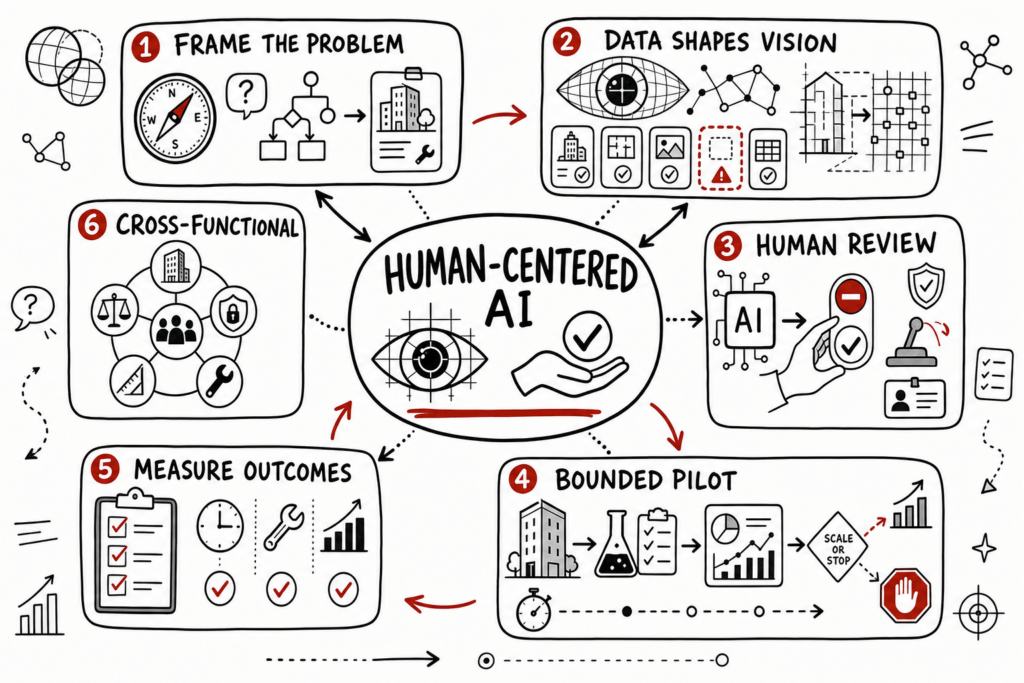
These four questions connect the book’s human and scientific concerns with ordinary operating decisions.
1. Start with a question worth answering
Choose a recurring task that people can describe clearly. Where does the difficulty occur, what information is available and what would useful assistance look like? Ask the people doing the work before turning a product demonstration into a requirement.
2. Examine the information behind the output
A property record can be incomplete, mislabeled or out of date. Check the source, coverage and permitted use of the information a proposed workflow would receive. Include ordinary mistakes and missing context in an evaluation, rather than testing only clean examples selected for a demonstration.
3. Give human review a real job
Specify what a reviewer must verify and how to resolve uncertainty. A person who can only click approve, without the original evidence or time to assess it, may provide little useful oversight. Keep a route for correction and a named person responsible for deciding when the process should stop.
4. Bring different kinds of knowledge to the review
Someone familiar with the software may see a different problem from a broker, an administrator or the person answering a client’s question. Involve the people relevant to the particular use, including privacy, security or legal specialists where needed. Their task is to test assumptions together, not to rubber-stamp a decision already made.
Where its usefulness has limits
A memoir can deepen understanding without answering a procurement question. It cannot tell you whether a specific service handles your information appropriately, how often its output will be wrong in your market or what it will cost to correct those errors. Those questions call for current product evidence and a test of the intended workflow.
The book also deserves attention beyond its possible commercial applications. Reducing the life of a scientist to a set of productivity tips would miss much of the reason to read it.
How to apply the questions
- Define the task. State what the system may draft, organize or flag, and what remains a person’s decision.
- Record the current process. Note the time, corrections and unanswered questions involved before introducing a change.
- Check the inputs. Review accuracy, coverage, access permissions and what should stay out of the system.
- Try a limited evaluation. Use examples appropriate to the proposed task and include difficult or incomplete cases.
- Compare the results. Account for review and correction time as well as speed, and describe what would justify expanding, changing or stopping the work.
For an early evaluation, a modest internal task with clear source material may make the results easier to inspect. That does not establish readiness for decisions involving a client’s eligibility, finances or safety.
Who should read it
Read it for the relationship between a scientist’s life, the history of computer vision and the human questions surrounding AI. It can give colleagues a shared subject for discussion even when their technical backgrounds differ. Pair that reading with task-specific evidence when the next decision is an actual purchase or deployment.
Questions for your leadership team
- Which problem have we observed, and which one are we assuming exists?
- Whose experience or information is missing from our test examples?
- Can a reviewer explain an error using the original evidence?
- Who can correct the output or stop the workflow?
- What would persuade us that continuing is useful, and what would persuade us to stop?
For another view of technology’s purpose, our review of The Technological Republic considers the authors’ argument about software, government and national ambition.