What is the best Co-Intelligence summary for leaders?
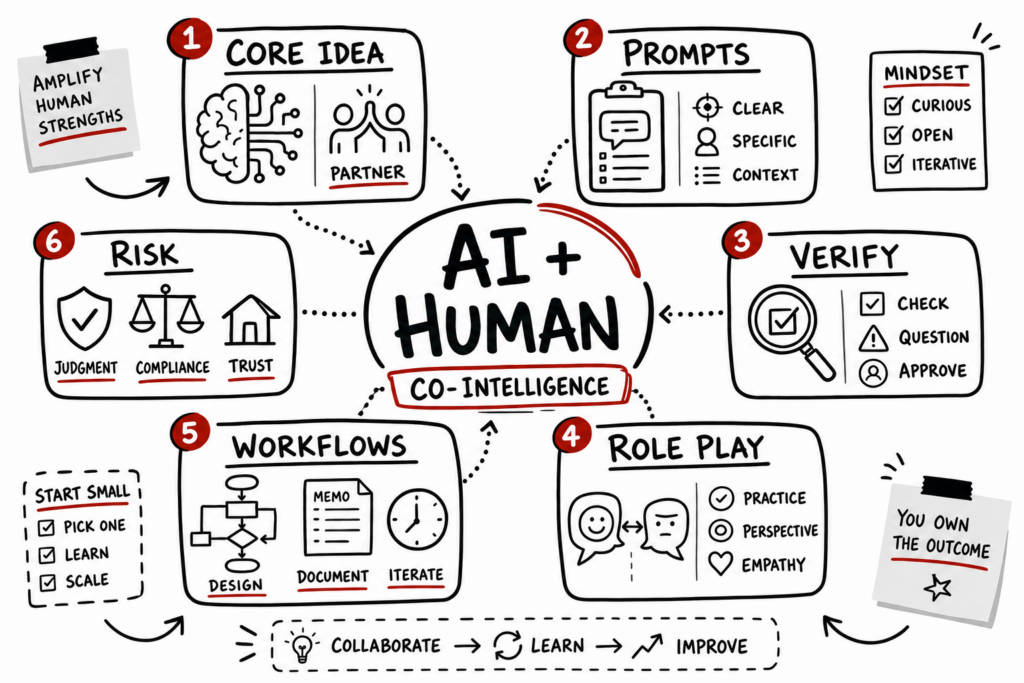
This Co-Intelligence summary is for real estate principals, executives, and ambitious operators who want to use Ethan Mollick’s Co-Intelligence without confusing AI adoption with automation theater. Mollick’s core idea is that generative AI works best as a collaborator, not a replacement: a thinking partner for drafting, research, analysis, simulation, and feedback, while humans retain accountability for judgment, ethics, client trust, and final decisions. A useful business definition of “co-intelligence” is a workflow where AI handles first-pass cognitive labor and humans set context, verify outputs, and make the call. For a brokerage leader, that might mean cutting a 90-minute market memo draft to 25 minutes while adding a mandatory human fact-check before it reaches clients. Reader fit is clear: this book is strongest for leaders ready to test AI in daily work, not those looking for either magic or permission to ignore it.
Book and Author Context
Co-Intelligence: Living and Working with AI arrived at the exact moment many executives moved from curiosity to pressure. By 2024, generative AI had become impossible to dismiss, but the advice around it was often either breathless or useless: “transform everything” on one side, “wait and see” on the other. Mollick offers a better middle lane.
Ethan Mollick is a professor at The Wharton School whose work sits at the intersection of entrepreneurship, innovation, and AI. His academic profile gives him credibility, but the book’s advantage is not academic density. It reads like someone who has spent serious time testing the tools, watching professionals struggle with them, and translating the findings into usable rules. Readers who want background can review his faculty and research profile, and the publisher’s page for Co-Intelligence gives the formal book details.
For luxury real estate leaders, the timing matters. Clients expect speed, polish, discretion, and market fluency. Teams are already experimenting with ChatGPT, Claude, Gemini, and AI-enabled CRMs whether leadership has set policy or not. That makes Co-Intelligence less of an “AI book summary” topic and more of an operating question: how do you raise leverage without lowering standards?
Who Should Read It
This is a strong fit for founders, managing brokers, team leaders, marketing directors, and operations executives who know AI is relevant but do not want to hand their brand voice, pricing judgment, or client relationships to a machine. If your organization is still debating whether generative AI matters, this book will probably move the conversation forward. If your team is already using AI casually, it will help you impose better structure.
The best reader is not the technologist. It is the responsible decision-maker who needs a practical framework for AI in business leadership. In a real estate context, that includes leaders thinking about listing presentations, client communications, recruiting, training, competitive research, neighborhood analysis, transaction coordination, internal SOPs, and investor-facing insights.
This may not be the right first read for someone seeking a technical manual, vendor comparison, or step-by-step software implementation plan. Mollick is not writing a CRM playbook. He is writing about how humans should work with AI when the technology is powerful, inconsistent, and improving quickly.
Core Idea
The central argument of this Co-Intelligence book review is simple: Mollick wants leaders to stop treating AI as a search engine and start treating it as a collaborator with limits. That distinction matters. A search engine retrieves. A collaborator drafts, challenges, role-plays, summarizes, synthesizes, and reframes. But a collaborator can also misunderstand, overstate, omit, or invent.
Mollick’s strongest contribution is his insistence on human oversight. The book does not ask leaders to surrender expertise. It asks them to use AI to expand the number of decent first drafts, alternative angles, simulated objections, and strategy options they can review. For high-stakes fields like luxury real estate, that is the right posture.
Think of co-intelligence as a three-part operating loop: assign, interrogate, decide. First, give the AI a clear role and context. Second, test the output with follow-up prompts, contrary evidence, and source checks. Third, make the final decision yourself. This is especially important in real estate AI strategy, where errors can affect compliance, fiduciary duty, pricing confidence, and reputation.
Best Takeaways
1. Use AI where the cost of a first draft is too high
Mollick is most useful when he pushes readers to experiment with ordinary knowledge work. Leaders often waste expensive human attention on blank-page work: drafting meeting agendas, rewriting listing copy, summarizing inspection themes, creating onboarding documents, preparing market talking points, or turning a long call transcript into next steps. Generative AI can reduce that friction without owning the final product.
A practical benchmark: if a task requires 30 to 90 minutes of drafting, synthesis, or formatting but still needs human judgment before delivery, it is a strong AI test candidate. If the task involves legal advice, confidential client strategy, pricing promises, fair housing risk, or sensitive negotiation language, AI may still assist, but only inside a stricter review process.
2. Treat prompting as management, not magic
One of the better Co-Intelligence key takeaways is that prompting is less about clever phrases and more about clear delegation. Good managers do not tell a junior team member, “Make this better.” They define the audience, constraints, tone, purpose, deadline, and success standard. AI needs the same structure.
For example, a real estate principal might ask AI to act as a chief of staff and produce a one-page prep brief for a seller meeting, using recent comparable sales, known objections, the client’s likely emotional concerns, and three pricing scenarios. The value is not that the AI “knows” the answer. The value is that it organizes the leader’s thinking faster.
3. AI can help leaders practice harder conversations
This is one of the book’s most underrated leadership applications. AI can role-play a skeptical seller, an anxious buyer, a frustrated agent, a luxury client concerned about privacy, or a recruit comparing teams. For executives, this turns AI into a low-cost rehearsal room.
In luxury real estate, words matter. The difference between sounding defensive and sounding calm can shape trust. AI can generate objections, critique your response, and offer cleaner language. Human emotional intelligence still matters most, but practice volume improves performance.
4. The winners will redesign workflows, not just buy tools
The strongest Co-Intelligence strategy lessons are not about which chatbot to use. They are about redesigning work around human-AI collaboration. If your team uses AI only to write social captions, you are underusing it. If you use it to build decision memos, compare strategic options, identify operational bottlenecks, and prepare better client conversations, you are closer to the book’s real value.
For generative AI for executives, the immediate advantage is leverage: more scenarios reviewed, more drafts considered, more objections anticipated, more internal knowledge captured. But the leader still has to decide what good looks like.
Where It Falls Short
Co-Intelligence is practical, but it is not a full governance manual. Leaders looking for detailed policy templates on data privacy, vendor approval, regulatory exposure, intellectual property, fair housing, or brokerage compliance will need additional resources. Mollick gives principles and posture more than enterprise controls.
The book can also feel more optimistic than some conservative operators will be comfortable with. That does not make it naive, but it does mean readers should bring their own risk lens. In a luxury brokerage, an AI-generated client email that is 95 percent right can still create a 100 percent reputational problem if the remaining 5 percent is inaccurate, insensitive, or off-brand.
Another limitation: the book’s examples are broad. That is useful for accessibility, but real estate leaders will need to translate the ideas into listing operations, agent enablement, transaction workflows, recruiting, market intelligence, and client experience. The book opens the door. It does not walk your brokerage through every room.
How to Apply It
Start with low-risk, high-frequency work
Do not begin with client-facing promises or pricing recommendations. Start with internal leverage. Use AI to summarize leadership meetings, draft SOPs, prepare recruiting interview questions, convert training calls into checklists, build weekly market briefing templates, and create first drafts of internal strategy memos.
A clean 30-day pilot could include three workflows: market research summaries, listing presentation prep, and agent coaching scripts. Track time saved, quality of first draft, revision time, error rate, and whether the final output improved decision-making. If you cannot measure it, you are just playing with software.
Set a human-review standard
Every AI workflow needs a review rule. For example: no AI-generated client communication leaves the firm without human review; no market statistic is used without source verification; no confidential client information is entered into unapproved tools; no legal, tax, lending, or compliance guidance is generated without qualified professional review.
This is the difference between smart adoption and reckless delegation. The right message to your team is not “don’t use AI.” It is “use it inside standards that protect clients and the brand.”
Build a prompt library around real business moments
Luxury real estate teams should create prompts for recurring situations: preparing for seller objections, summarizing neighborhood shifts, drafting post-showing follow-up, comparing marketing angles, building relocation guides, creating open house debriefs, and role-playing negotiation pressure. The best prompt library is not generic. It reflects your market, voice, compliance boundaries, and service model.
Use AI to improve leadership cadence
One smart application is the weekly executive briefing. Feed approved internal notes, market observations, recruiting updates, and operational issues into a secure workflow, then ask AI to produce: top risks, decisions needed, client experience issues, agent performance patterns, and follow-up items. The leader reviews, edits, and acts. That is co-intelligence in practice.
Final Verdict
Ethan Mollick Co-Intelligence is worth reading because it gives leaders a grounded way to think about AI without pretending the tools are either harmless assistants or inevitable replacements. The book’s best value is strategic posture: engage seriously, experiment deliberately, verify relentlessly, and keep humans responsible for judgment.
For Co-Intelligence leadership lessons, the main one is this: AI will not fix unclear thinking. It will amplify whatever leadership system it enters. If your team has weak standards, messy data, poor review habits, or inconsistent brand voice, AI can make those issues faster and louder. If your team has strong judgment and disciplined workflows, AI can create meaningful leverage.
The right Co-Intelligence reader fit is an ambitious professional who wants practical AI fluency now, not a theoretical debate later. For luxury real estate principals, this is a useful read before you approve tools, redesign workflows, or let informal AI habits harden across the team.
If you want more private-briefing style strategy reads for real estate leadership, keep reading RE Luxe Leaders’ book reviews and operating insights. If your firm is ready to turn AI curiosity into a controlled real estate AI strategy, book a confidential strategy call.