
The Coming Wave Summary: Ai, Power, and Real-estate Risk
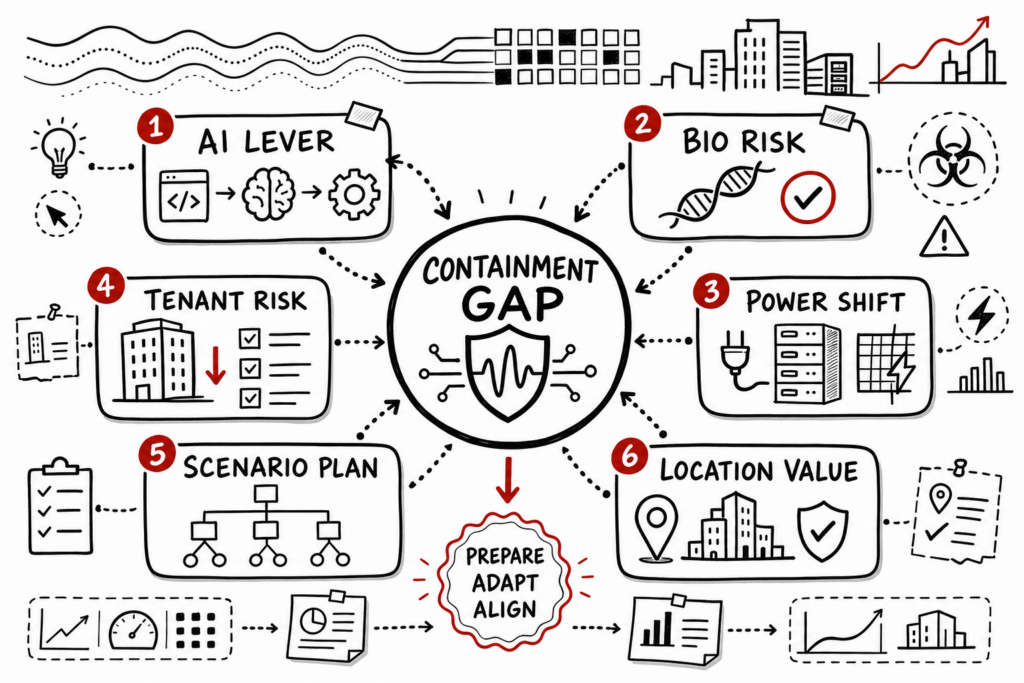
What is The Coming Wave summary for strategic real-estate leaders?
The Coming Wave is a book about the strategic consequences of powerful technologies, especially artificial intelligence and synthetic biology. For a real-estate leader, its useful question is narrower: which assumptions about work, infrastructure, governance and location would change if these capabilities spread faster than institutions can adapt? That question supports scenario planning. It does not produce a property forecast.
Book Overview
Mustafa Suleyman writes from experience in the development of advanced technology. The book’s argument is that new capabilities can lower the cost of intelligence, design, automation and biological experimentation while becoming harder to control as they spread. Its central concern is not whether innovation should stop. It is whether public and private institutions can set workable boundaries while preserving legitimate benefits.
For the publisher’s description and bibliographic context, see The Coming Wave. Suleyman’s background in AI development can also be considered alongside the official DeepMind site. Those sources provide context for the author and subject; they do not verify any real-estate conclusion in this article.
Core Idea
The book frames the challenge as containment: maintaining enough oversight, accountability and institutional control to reduce severe misuse while allowing useful innovation. The practical tension is a gap between fast capability growth and slower changes in policy, operating controls and public understanding.
That framing is valuable for property strategy because real estate follows changes in labor, infrastructure, capital and institutional trust. It does not mean every office, laboratory or industrial site will respond in the same way. It means a long-duration decision should identify which technology assumptions it relies on and which observations would cause the team to revisit them.
Who Should Read It
The Coming Wave is suited to principals, asset managers, development executives, family-office teams and policy-minded investors who make decisions over several years. It is especially useful when a portfolio depends on tenant labor, energy, logistics, research capacity or regional governance.
The book is less useful for a reader seeking a precise office-vacancy forecast, an AI investment recommendation or a technical explanation of model architecture. It offers a strategic lens, and the reader must do the local underwriting.
Best Takeaways
1. AI is not just software. It is leverage.
AI can change the cost and organization of cognitive work. That may affect headquarters, back-office space, professional services, logistics, security and research settings in different ways. A thoughtful real-estate review asks where work may become less space-intensive, where new infrastructure may be required and which uses still depend on collaboration, trust or physical access.
2. Synthetic biology deserves more attention from property strategists.
Biological tools raise questions about laboratory space, manufacturing, cold-chain logistics, university adjacency, permitting and safety controls. The relevant timing and location will vary by use case. Treat the topic as a scenario to investigate with specialists rather than as a universal demand forecast.
3. Power concentration is a market risk.
When compute, data, energy access or advanced manufacturing capacity concentrate among fewer institutions, location value may also become more concentrated. A location review can therefore include grid capacity, fiber, permitting, security, talent, university connections and resilience alongside prestige and access.
4. Containment is a leadership discipline.
The management lesson is to set decision rights, escalation paths and risk thresholds before a disruption is visible in quarterly performance. In a property business, that can mean vendor diligence, cyber resilience, tenant concentration review, insurance questions and a documented route for escalating unfamiliar technology exposure.
The Coming Wave Strategy Lessons for Real Estate
A useful application is a long-horizon scenario review. Ask where automation could reduce space intensity, where infrastructure demand could add pressure to power and permitting, and which locations offer the governance, skills and resilience a tenant may need.
For each scenario, separate the observation from the assumption. A team might track occupancy, renewal probability, tenant improvement needs, power constraints, operating cost and exit sensitivity, then record what evidence would change each view. The objective is a range of decisions that can be revisited, not a confident prediction dressed as certainty.
Where It Falls Short
The book is intentionally broad. It does not resolve the local facts needed to compare one office district with another, determine a laboratory conversion, or underwrite a data-intensive use. Readers must account for adoption speed, regulation, leases, financing, human behavior and the physical limits of each market.
It also moves across very different time horizons. A capability can be plausible without being commercially widespread, and widespread adoption can still take time to affect leases or construction. Keep those distinctions visible when translating the book into a portfolio discussion.
How to Apply It
Use this Mustafa Suleyman book summary as a structured prompt for a portfolio conversation.
Step 1: Add technology exposure to asset reviews.
For each asset, note whether the relevant technology could reduce tenant labor needs, increase infrastructure demand, change operating costs or affect location preferences. Avoid treating an industry label as a complete exposure measure; functions inside the same tenant can move in opposite directions.
Step 2: Stress-test the rent story.
Build a base case, an accelerated-adoption case and an infrastructure-led case. Test the assumptions that matter to the asset, such as occupancy, renewal, improvement cost, power and exit sensitivity. The exercise is useful because it makes a single-story underwriting model easier to see and challenge.
Step 3: Re-rank location value.
Consider grid capacity, fiber, permitting, talent, university proximity, climate resilience and institutional reliability alongside traditional access and prestige. The weighting should fit the tenant, asset and time horizon under review.
Step 4: Build a containment mindset into leadership.
Set internal controls before unfamiliar tools become embedded in operations. The practical version may include vendor review, cyber resilience, tenant concentration analysis, insurance questions and a board-level route for testing scenarios with qualified specialists.
Bottom Line
The Coming Wave is not a real-estate book. Its value for a property leader is the frame: AI and synthetic biology may influence economic power, institutional trust, labor demand, infrastructure and location value, but the path and timing require local evidence.
Read it when your decisions depend on how companies work, where they gather, what infrastructure they need and which institutions they trust. Use the book to improve the questions in your model, not to substitute for property-level research.
You can request a complimentary one-hour conversation with a senior advisor who is an experienced operator. Talk through your next move