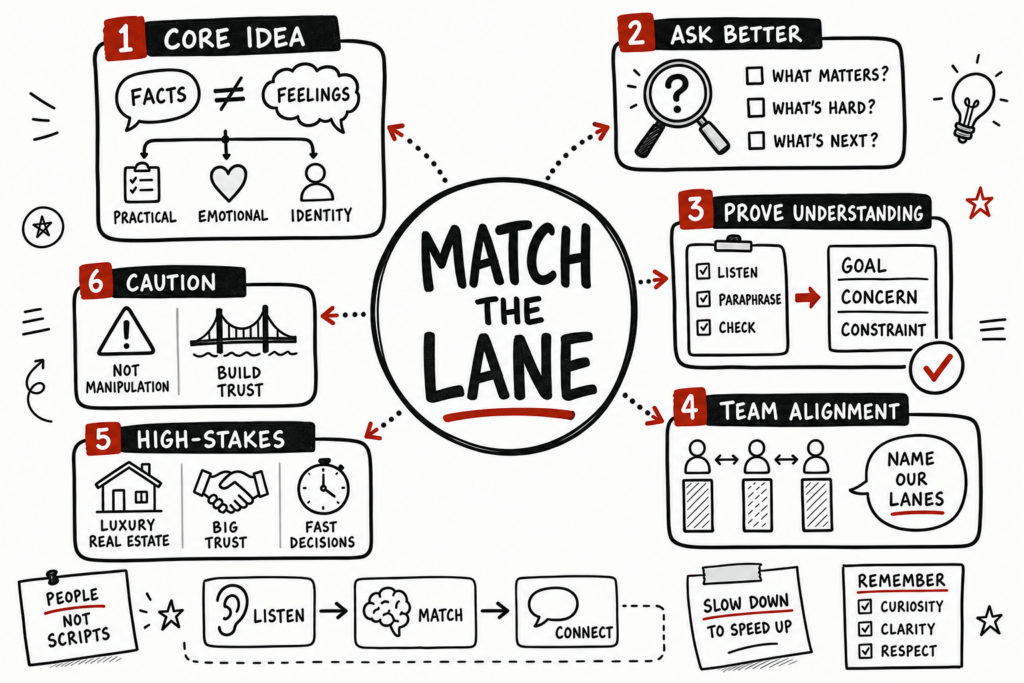
What Is the Supercommunicators Summary for Professionals?
This Supercommunicators summary explains Charles Duhigg’s Supercommunicators for ambitious professionals—especially luxury real estate leaders—and shows why conversation matching can improve trust, deal clarity, and team execution. Duhigg argues that strong communicators do not win by being polished; they identify what kind of conversation is happening and respond in the same lane. A practical definition: conversation matching means noticing whether someone needs a decision conversation, an emotional conversation, or a social-identity conversation, then aligning your questions, tone, and response accordingly. For a broker, that can mean separating a pricing objection from a fear-of-regret moment before proposing a counteroffer. The book is best for leaders, advisors, and sales teams who manage high-stakes relationships. It is less useful if you want scripts. Its strategic value is a repeatable diagnostic: before persuading, classify the conversation and prove understanding.
Book Overview
Supercommunicators by Charles Duhigg is a business and psychology book about why some people consistently create connection in difficult conversations. Duhigg, also known for The Power of Habit, stays in familiar territory: he turns social science into usable patterns without making the reader feel trapped in a research paper. You can view the publisher’s overview at Penguin Random House or the author’s work at Charles Duhigg’s official site.
The central argument is simple but commercially important: miscommunication often happens because two people are having different kinds of conversations at the same time. One person is trying to solve a practical problem. The other is signaling fear, status, loyalty, identity, or emotional risk. The conversation fails not because either person is unintelligent, but because they are mismatched.
That makes this Supercommunicators book review especially relevant for luxury real estate. High-net-worth clients rarely make decisions on information alone. They are weighing control, privacy, reputation, family dynamics, timing, and regret. A broker who treats every hesitation as a data gap will over-explain. A broker who can identify the real conversation has a better chance of becoming trusted counsel.
Who Should Read It
This book is worth reading if your work depends on influence without force. Team leaders, founders, managing brokers, sales directors, client advisors, recruiters, and negotiators will find immediate value. It is especially useful for professionals who are technically strong but occasionally frustrated that sound logic does not move people.
For the RE Luxe Leaders audience, the best fit is clear: luxury brokers and team leads managing expensive listings, delicate seller expectations, referral relationships, and internal performance conversations. If you are building luxury real estate communication strategies, this book gives you language for something elite operators already know instinctively: people need to feel understood before they will be led.
Skip it if you want a hard-nosed negotiation manual, a library of closing lines, or a tactical objection-handling script. This is not that book. It is more diagnostic than prescriptive.
Core Idea
The core idea in Charles Duhigg Supercommunicators is that great communication is less about charisma and more about alignment. Duhigg breaks conversations into different modes, including practical conversations about decisions, emotional conversations about feelings, and social conversations about identity and belonging.
The mistake most professionals make is answering the wrong conversation. A client says, I am not sure this is the right time to sell. A mediocre advisor launches into market absorption, rate forecasts, and comparable sales. A sharper advisor listens for the type of concern. Is the client asking for financial analysis? Are they afraid of making a visible mistake? Are they conflicted because the home represents family history or status? Same sentence. Very different conversation.
This is where the conversation matching framework becomes useful. Before you persuade, match. Before you solve, understand. Before you reframe, confirm what kind of conversation you are actually in.
Supercommunicators Key Takeaways
1. Match the conversation before you try to lead it
The most practical of the Supercommunicators communication techniques is matching. If someone brings emotion, do not respond only with facts. If someone needs a decision, do not stay vague and therapeutic. In business, mismatching burns time and trust.
Luxury application: when a seller resists a price adjustment, do not assume they need another CMA. Ask, Is your biggest concern the market data, the optics of reducing, or whether this still feels aligned with your original plan? That question separates logic, identity, and emotion in one move.
2. Ask questions that reveal stakes, not just preferences
Duhigg makes a strong case for deeper questions. In client work, weak questions collect surface answers. Strong questions uncover the decision architecture underneath the answer.
Instead of asking, Do you want to list now or wait?, ask, What would make waiting feel like the right decision six months from now? or What would make selling now feel irresponsible? These questions expose hidden risk thresholds, family pressures, and emotional trade-offs.
3. Prove understanding before making your recommendation
One of the strongest Supercommunicators leadership lessons is that people relax when they hear their own priorities reflected accurately. This is not performative empathy. It is strategic clarity.
A useful meeting standard: before presenting advice, summarize the client’s position in three parts—goal, concern, and constraint. For example: You want maximum exposure, you are concerned about privacy, and you do not want the process to disrupt your children’s schedule. If the client corrects you, you just discovered the real issue before it became resistance.
4. Team communication improves when leaders name the conversation
This is also a communication skills for leaders book. Team leads often mix coaching, accountability, and emotional reassurance into one messy conversation. The result is confusion.
A cleaner approach: announce the lane. This is a performance conversation, not a character judgment. Or, Before we solve the workflow issue, I want to understand why this has felt frustrating. That small framing move can prevent defensiveness and keep the meeting productive.
Where It Falls Short
The book’s strength is also its limitation. Duhigg gives readers a useful mental model, but some professionals may want more direct scripts, industry-specific examples, or a sharper operating system for sales teams. If you are expecting a luxury negotiation playbook, you will need to translate the ideas yourself.
At times, the stories can feel broader than necessary for a busy executive reader. The research is accessible and engaging, but the highest-ROI material could be condensed into a shorter field guide. That is why a Supercommunicators business book summary may be enough for readers who only want the professional application.
Another caveat: the framework should not become manipulation. Matching a conversation is not pretending to care so you can close faster. In high-trust markets, that will backfire. The real advantage comes from accurate listening, better diagnosis, and cleaner recommendations.
How to Apply It
For a practical supercommunicators review for professionals, use the book as a pre-meeting and post-meeting checklist. The goal is not to become more charming. The goal is to reduce preventable friction in conversations that matter.
Before a client meeting
- Identify the likely decision: price, timing, offer terms, exposure, privacy, or representation.
- Identify the likely emotional stake: regret, control, embarrassment, loss, urgency, or family pressure.
- Prepare one question for each conversation type instead of only preparing your talking points.
During the conversation
- Listen for whether the client is asking for facts, empathy, or identity validation.
- Use a clarifying question before giving advice: Are we solving the numbers, the timing, or the comfort level?
- Reflect the goal, concern, and constraint before recommending a next step.
After the conversation
- Send a recap organized by decision, emotion, and next action.
- Track one KPI: how often clients need fewer follow-up clarifications after your meetings.
- For teams, review one high-stakes conversation per week and ask: Were we in the same conversation as the client?
This turns Duhigg’s idea into an operating habit. Over time, better matching should improve meeting quality, reduce avoidable misunderstandings, and strengthen client confidence.
Reception and Business Relevance
Supercommunicators arrived at the right time. Leaders are dealing with distracted teams, cautious clients, remote communication habits, and higher emotional volatility around major financial decisions. In real estate, the 2024 market context made the topic even more relevant: buyers and sellers needed more interpretation, not just more information.
The book has gained traction in leadership and sales circles because it gives language to a problem executives recognize immediately. Most business breakdowns do not begin with incompetence. They begin with people thinking they agreed when they were actually speaking from different assumptions.
Final Verdict
Supercommunicators is not a magic formula, and it will not replace market expertise, negotiation skill, or disciplined follow-up. But it gives professionals a clean framework for understanding why smart conversations go sideways and how to bring them back.
For luxury real estate leaders, the payoff is practical: better discovery, calmer negotiations, stronger team accountability, and more client trust in moments when trust is the actual product. Read it if you want to become more precise in high-stakes conversations. Use it if you want your clients and team to feel not just heard, but accurately understood.
For more private-briefing style strategy reads, explore the latest RE Luxe Leaders book reviews and leadership notes—or book a confidential strategy call when you are ready to sharpen the communication system behind your brand.