What is the Inspired Marty Cagan summary for product leaders?
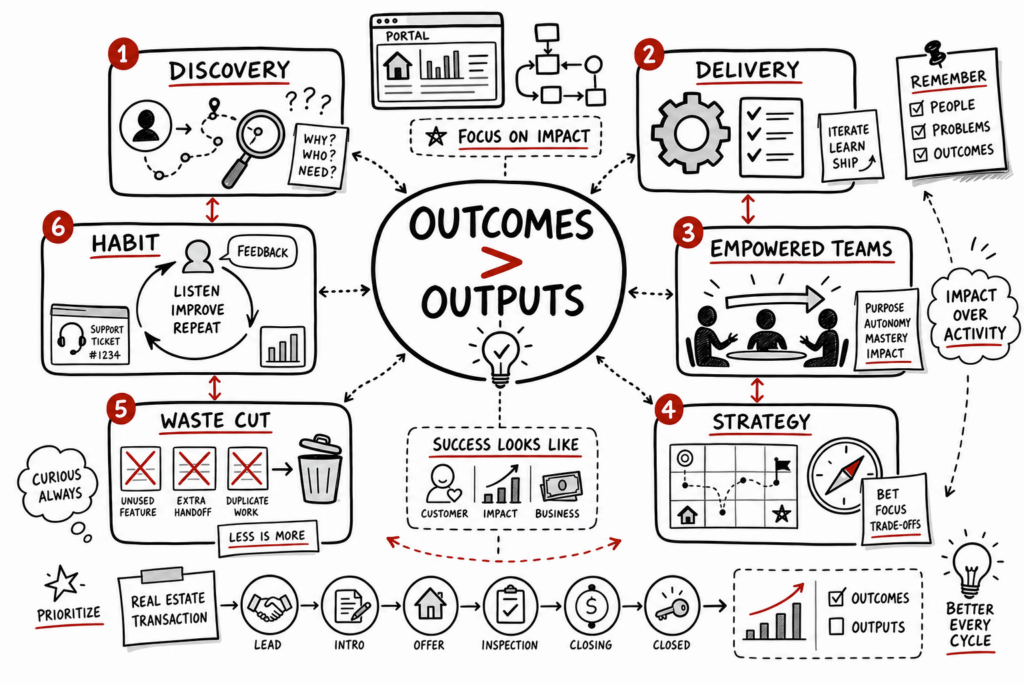
An Inspired Marty Cagan summary for product leaders, founders, and real-estate technology executives is this: Inspired argues that great products come from empowered teams using disciplined discovery, not executives handing down feature lists. Marty Cagan defines product discovery as the work of deciding what to build and proving it is valuable, usable, feasible, and viable before delivery begins. For leaders, the strategic implication is clear: stop measuring product teams only by output shipped and start measuring outcomes such as client adoption, time saved per transaction, lead-conversion lift, support-ticket reduction, or retention improvement. The book is most useful for organizations building client portals, internal workflow tools, AI-assisted operations, or data products where wasted development is expensive. If your team is trapped in product discovery vs delivery confusion, this is a strong operating manual; if you want a tactical UX research cookbook, it is less complete.
This Inspired Marty Cagan review is written for ambitious operators who do not need motivational product theater. You need to know whether the book helps you make better decisions, reduce waste, and build products people actually use. The short answer: yes, especially if your company is moving from founder-led intuition or stakeholder-driven roadmaps into a more mature product operating model.
Inspired: How to Create Tech Products Customers Love is one of the modern reference texts for product management. You can find the official book page at Silicon Valley Product Group, and the book listing is available on Amazon. The reason it still matters is not because every example maps perfectly to every business. It matters because Cagan names the organizational dysfunction many companies normalize: teams that ship features without proving demand, executives who confuse roadmaps with strategy, and product managers reduced to project coordinators.
Who Should Read It
Inspired is worth reading if you lead product, technology, operations, marketing, or client experience in a business where software now shapes the customer relationship. That includes real-estate services firms building portals, broker productivity tools, relocation platforms, owner dashboards, asset-management systems, AI intake workflows, or internal transaction-management software.
The book is especially useful for three groups. First, founders and executives who are tired of asking why expensive technology investments do not change behavior. Second, product leaders who need a cleaner language for explaining why discovery matters before engineering commits months of work. Third, real-estate operators who are not traditionally software companies but now compete on speed, transparency, data quality, and digital service experience.
If you are looking for a pure real-estate technology manual, this is not that. Cagan writes from a broader technology-product context. But the principles transfer well because the core problem is the same: clients, agents, investors, and internal teams do not reward you for features. They reward you for outcomes that make their lives easier.
Core Idea
The core idea of this Inspired book summary is simple and uncomfortable: most product failure is not engineering failure. It is decision failure. Companies build the wrong thing, for the wrong user, based on weak assumptions, and then ask delivery teams to rescue the result with speed.
Cagan separates product work into two connected but different modes: discovery and delivery. Discovery is about learning what should be built. Delivery is about building it reliably. The best teams do both well, but they do not pretend they are the same activity. Discovery should answer four hard questions: will customers use it, can they use it, can we build it, and will it work for the business?
This is where Marty Cagan product discovery becomes highly relevant for real-estate technology leaders. A brokerage may think it needs a new agent dashboard. A property-services firm may think it needs an AI leasing assistant. An investment platform may think it needs a reporting portal. Cagan would push the team to prove the underlying problem first. What decision is the user trying to make? What friction is expensive? What behavior would indicate success? What evidence do we have before we assign engineers?
Best Takeaways
1. Empowered teams beat feature factories
The strongest of the Inspired leadership lessons is Cagan’s case for empowered product teams. In weak product organizations, leaders decide what to build and teams execute tickets. In stronger organizations, leaders define strategic context, business outcomes, constraints, and priorities; teams figure out the best solution.
This matters because people closest to the customer, technology, and data usually see tradeoffs earlier than executives do. An empowered team can say, “The client does not need a bigger portal; they need fewer status-check calls.” That insight may lead to notifications, workflow automation, better document visibility, or no new feature at all.
2. Discovery reduces waste before delivery magnifies it
One of the clearest Inspired book key takeaways is that speed is dangerous when direction is wrong. AI tools now make it easier to prototype and ship quickly, but they also make it easier to scale bad assumptions. A team can generate screens, copy, workflows, and code faster than ever. That does not mean the product solves a real problem.
For client-experience initiatives, discovery might include interviewing ten top clients, mapping the last five failed onboarding journeys, running a concierge test, or measuring the current support burden before building automation. For internal tools, discovery might include shadowing transaction coordinators, calculating duplicate data entry time, or testing a spreadsheet-based workflow before committing to custom software.
3. Product strategy is not a list of features
Among the most useful Inspired strategy lessons is the distinction between strategy and roadmap. A roadmap says what might ship. Strategy explains which customer problems matter, why they matter now, and how solving them supports the business.
In real-estate services, this is the difference between saying “build a client app” and saying “reduce transaction-status uncertainty for high-value clients, measured by a 30% decrease in inbound status requests and a 15% improvement in repeat-client satisfaction.” The second statement gives a team room to think. The first simply assigns output.
4. Product managers need judgment, not just coordination skills
Cagan has a high bar for product managers. He does not frame the role as meeting scheduler, backlog owner, or stakeholder diplomat. The product manager is accountable for value and viability. That means understanding users, economics, market context, constraints, and the business model.
For service businesses, this is important. A product manager working on a property-management owner dashboard must understand owner anxiety, reporting cycles, accounting constraints, legal requirements, and operational capacity. Without that context, the team may build attractive software that creates more back-office burden than business value.
Where It Falls Short
The book is strong, but not flawless. First, it can understate how difficult empowerment is inside legacy, regulated, or relationship-driven businesses. Real-estate organizations often have powerful rainmakers, regional operating models, fragmented data, compliance concerns, and client-specific exceptions. You cannot simply declare teams empowered and expect the system to change.
Second, some readers may want more step-by-step operating detail. Cagan explains what excellent product organizations do, but leaders still need to translate those ideas into rituals: discovery cadence, decision rights, intake rules, experiment templates, KPI reviews, and executive communication norms. This is why some teams pair Inspired with more tactical resources on product operations, research, analytics, or continuous discovery.
Third, the book’s technology-company orientation may feel distant to executives in brokerage, title, mortgage, relocation, property management, or advisory businesses. The translation is worth doing, but it is still translation. The strongest readers will ask, “What is the equivalent in our operating model?” rather than copying Silicon Valley language into a service business without adaptation.
How to Apply It
Start with one high-friction customer journey
Do not begin by reorganizing the entire company. Pick one journey where friction is visible and measurable: lead-to-appointment conversion, client onboarding, offer preparation, closing coordination, maintenance intake, investor reporting, or agent recruiting. Define the business problem in outcome terms. For example: reduce average onboarding time from 14 days to 7, cut duplicate data entry by 40%, or reduce client status-call volume by 25%.
Separate discovery commitments from delivery commitments
A practical way to address product discovery vs delivery is to create two decision gates. Discovery commitments are small: interviews, prototypes, workflow mapping, data analysis, and assumption testing. Delivery commitments are larger: engineering capacity, vendor spend, launch planning, training, and support. Do not treat a stakeholder request as delivery-ready until discovery has exposed the real user problem and success metric.
Use discovery to improve build-versus-buy decisions
Real-estate firms often debate whether to buy a platform, customize an existing system, or build something proprietary. Cagan’s logic helps make this cleaner. If the capability is not strategically differentiating, buy it. If it directly shapes the client experience, data advantage, operating margin, or advisor productivity, discovery should determine whether a custom or hybrid approach is justified.
For example, a generic CRM may be enough for contact storage. But a proprietary client-intelligence layer that predicts next-best action for luxury buyers, sellers, or investors may be strategically valuable if it improves conversion, retention, or referral behavior. The point is not to build more. The point is to build only where learning proves strategic advantage.
Create a weekly customer evidence habit
The most practical application is also the least glamorous: keep teams close to customers. Require product managers, designers, and relevant engineers to review customer calls, conduct interviews, inspect support tickets, observe internal users, and compare assumptions against data every week. In an AI-driven market, this habit becomes more important, not less. AI can accelerate execution, but customer evidence should steer it.
Reframe executive leadership
The executive job is not to approve every feature. It is to set context: target customer, business outcome, strategic constraints, risk appetite, and decision principles. Then leaders must let teams solve. This requires discipline because feature control feels safer than outcome leadership. But feature control often produces exactly what executives say they do not want: bloated roadmaps, slow delivery, low adoption, and unclear ROI.
Is Inspired Worth Reading?
Yes, is Inspired worth reading for product leaders and real-estate technology executives? It is, if you are serious about moving from output management to outcome management. The book will not hand you a ready-made operating model for every real-estate services environment. But it will sharpen how you think about customer value, team accountability, discovery discipline, and the leadership behaviors that make strong products possible.
The private-briefing version is this: Inspired is less about product management as a department and more about product judgment as a company capability. In markets where AI, data, client expectations, and margin pressure are all moving at once, that capability is no longer optional.
For more RE Luxe Leaders strategy briefings on books, product thinking, client experience, and growth decisions, keep reading the latest reviews. If you are making a sensitive platform, AI, or client-experience decision, you can also book a confidential strategy call.