
The Coming Storm Summary: Power, Conflict, and Leadership Signals
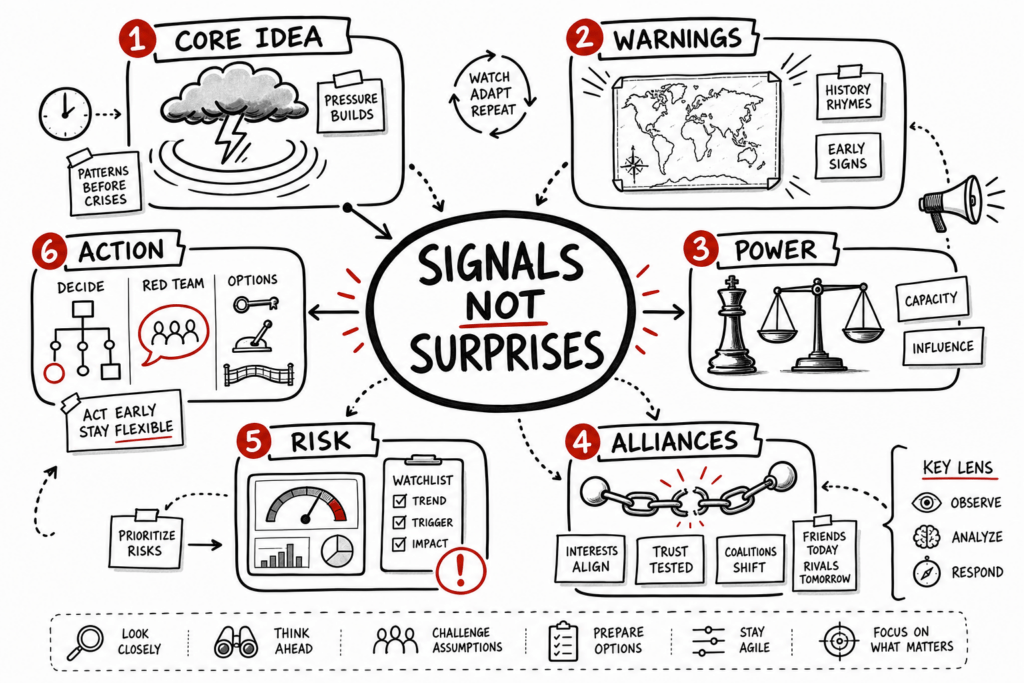
Short answer: This The Coming Storm summary is for leaders who want geopolitical pattern recognition without getting buried in historical sprawl. Odd Arne Westad argues that power struggles rarely arrive out of nowhere. They build through ambition, fear, misread incentives, alliance stress, and leaders who mistake temporary advantage for durable control. The book is most useful as a strategic foresight tool, not as a prediction machine.
This The Coming Storm book review looks at what ambitious professionals can actually use: how to read conflict signals earlier, pressure-test assumptions, and think more clearly about risk in a world where markets, security, technology, and politics increasingly move together. If you run capital, lead a company, advise clients, or make long-horizon decisions, the value here is not trivia. It is judgment.
The Coming Storm summary: the executive read
Odd Arne Westad, one of the more serious historians of global power, uses history to examine how nations drift, maneuver, and sometimes stumble toward confrontation. The book’s central warning is simple but uncomfortable: major conflict is often less about one dramatic event than about accumulating miscalculations. Leaders overestimate their leverage. Rivals misread each other’s limits. Alliances look solid until stress exposes their fragility. Domestic pressures push governments toward external aggression or symbolic escalation.
For readers seeking a history of power and conflict summary, this is not a neat checklist of wars and outcomes. It is a disciplined look at patterns. Rising powers want recognition. Established powers want stability on their own terms. Smaller states navigate pressure from both. Economic interdependence can restrain conflict, but it can also transmit fear and vulnerability. That is the book’s practical edge: it helps leaders see the strategic weather before the storm becomes obvious.
Who Should Read It
The strongest reader fit for executives and founders is someone making decisions across time, capital, markets, and reputation. If your business has supply-chain exposure, international clients, currency risk, energy sensitivity, defense-adjacent technology, luxury buyers, or regulatory vulnerability, this book gives you a better mental map for uncertainty.
It is also useful for investors, family office leaders, real estate principals, board members, and senior operators who need to interpret geopolitical risk without becoming full-time foreign policy analysts. If you already read macro notes from firms such as J.P. Morgan or follow current market signals through outlets like CNBC, Westad adds something those formats often cannot: historical depth. He slows the room down.
If you want a fast, dramatic narrative, this may feel restrained. If you want books on strategic foresight and geopolitics that improve your decision quality, it earns its place.
Core Idea
The core idea is that history does not repeat mechanically, but it does rhyme through incentives. Power transitions create anxiety. Anxiety distorts perception. Distorted perception drives bad choices. Westad is not saying today’s world is destined to repeat any specific historical crisis. He is saying leaders should stop treating geopolitical shocks as surprises when many of their ingredients were visible in advance.
That is the leadership lesson. Weak signals matter. Public rhetoric matters. Military posture matters. Trade dependencies matter. Domestic legitimacy problems matter. So do personal leadership styles. Some leaders contain pressure by leaving room for compromise. Others raise the cost of backing down until escalation becomes politically easier than restraint.
For a great power competition book review, the most important point is that great powers often talk in the language of principle while acting through fear, status, and strategic necessity. That does not make their behavior irrational. It makes it dangerous when interpreted too simplistically. Executives should take the same warning into business strategy: do not assume a competitor, regulator, lender, buyer, or foreign government sees the board the way you do.
Best Takeaways
1. Watch incentives, not just headlines
One of The Coming Storm key takeaways is that leaders should track structural pressure more than daily noise. Headlines tell you what happened. Incentives tell you what may become likely. Is a government boxed in domestically? Is a rising competitor seeking recognition? Is a supply chain becoming a political weapon? Is an alliance dependent on a leader who may not survive the next election? These are early-warning indicators.
2. Alliances are assets, but not guarantees
Westad’s historical framing shows how alliances can deter conflict, but also create false confidence. In business terms, this is a warning against assuming your partners, lenders, vendors, political allies, or client base will behave predictably under stress. Resilience requires redundancy, not sentiment.
3. Miscalculation is a leadership failure
The book is especially strong on the danger of misreading resolve. Leaders often assume the other side will absorb pressure, accept humiliation, or prioritize economics over status. Sometimes that assumption is right. When it is wrong, the consequences are severe. This is one of the most practical The Coming Storm leadership lessons: build decision processes that challenge the executive ego before reality does.
4. Interdependence is not immunity
A comfortable modern assumption is that commerce prevents major conflict because everyone has too much to lose. History is less reassuring. Economic ties can moderate behavior, but they can also create leverage, resentment, and panic. For founders and investors, this means exposure mapping matters. Revenue concentration, vendor dependency, capital flows, data infrastructure, shipping lanes, and regulatory chokepoints are not back-office details. They are strategic risk.
5. Strategic foresight is a habit, not a forecast
The best The Coming Storm strategy lessons are not about predicting the next crisis. They are about preparing for plausible ranges of disruption. Westad’s work nudges leaders toward scenario thinking: what happens if a region destabilizes, a trade route tightens, sanctions expand, capital gets more expensive, or buyer sentiment shifts? You do not need certainty to make better decisions. You need disciplined imagination.
Where It Falls Short
The book’s restraint is both its strength and its limitation. Readers looking for a highly tactical executive playbook may wish Westad translated more of the historical material into explicit frameworks. He trusts the reader to draw connections. Sophisticated readers will appreciate that. Busy operators may want sharper summaries at the end of each chapter.
There is also a risk with any historical warnings for leaders: the more persuasive the parallels, the easier it becomes to over-apply them. A past crisis can illuminate the present, but it cannot replace current intelligence. The point is not to say, “This is just like that.” The point is to ask, “What pressures are similar, what is different, and where could we be fooling ourselves?”
As an Odd Arne Westad book review, the fair verdict is that his authority is real, but the reader must bring a practical lens. The book will not hand you a boardroom template. It will make your boardroom questions better.
How to Apply It
Start by turning the book into a quarterly risk conversation. Do not ask, “What do we think will happen?” Ask, “What assumptions are we making that would hurt us if they failed?” Then separate those assumptions into categories: geopolitical, regulatory, financial, operational, reputational, and human.
Second, build an early-warning dashboard. Keep it simple. Track five to seven signals that matter to your business: policy shifts, capital conditions, insurance costs, logistics friction, election calendars, sanctions exposure, energy prices, or client confidence in key markets. The goal is not surveillance for its own sake. The goal is to notice when the operating environment is changing before everyone else prices it in.
Third, stress-test alliances. Which relationships are mission-critical? Which partners would still show up under pressure? Which contracts look strong legally but fragile commercially? This is where history becomes immediately useful. Conflict often exposes dependence that was invisible during growth.
Fourth, appoint someone to argue the other side. In major decisions, require a red-team view: how could a rival interpret our move? How could a regulator respond? What would a nervous client think? What if our confidence is being mistaken for clarity? This is one of the most valuable answers to what leaders can learn from history: bad outcomes often begin as unchallenged certainty.
Finally, preserve optionality. In unstable periods, the premium belongs to leaders who can move without panic. That may mean more liquidity, diversified suppliers, flexible deal structures, stronger local intelligence, or slower commitments in overheated markets. Optionality can feel inefficient in calm periods. It becomes priceless when conditions change.
Final Verdict
The Coming Storm is not alarmist, and that is why it lands. Westad does not need to shout. The historical record is sobering enough. For executives, founders, and strategic investors, the book’s real value is disciplined humility: power shifts are complex, leadership choices matter, and danger often announces itself quietly before it becomes undeniable.
Read it if you want a calmer, sharper way to think about geopolitical risk, great power competition, and long-range positioning. Skip it if you only want a quick formula. For serious leaders, this is a useful strategic literacy upgrade.
For more private-briefing style reviews and strategy notes, read the latest RE Luxe Leaders briefings or book a confidential strategy call when you want to translate these ideas into decisions for your market, portfolio, or leadership team.