What is the Nexus Harari summary for leaders?
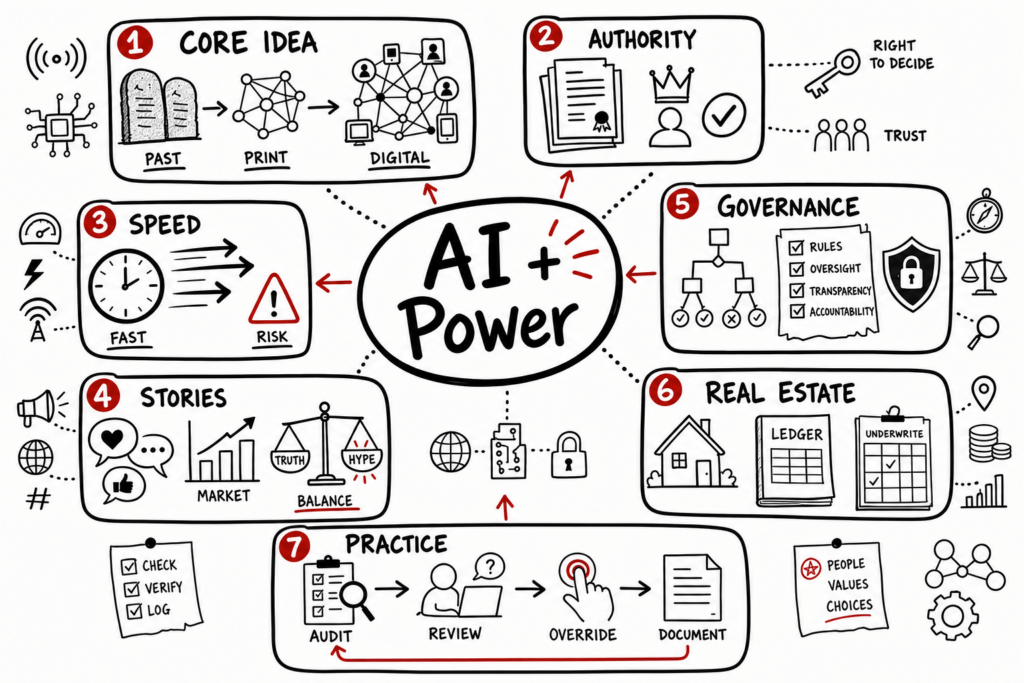
The Nexus Harari summary for ambitious real estate leaders is this: in Nexus, Yuval Noah Harari argues that every major power shift begins with information networks, and AI now changes who can see, decide, persuade, and govern at scale. The strategic implication is practical: executives should treat AI not as software alone but as an operating layer that shapes capital allocation, client trust, underwriting discipline, and regulatory exposure. A useful definition: an information network is the system of people, institutions, stories, records, and technologies that determines what counts as knowledge and who can act on it. For a brokerage, fund, or development firm, the KPI is not only model accuracy; it is decision traceability: can leadership explain why a recommendation was made, what data informed it, and who had override authority? This Nexus by Yuval Noah Harari review is best for leaders seeking judgment, not technical setup instructions.
Book Context and Author Background
Nexus is Yuval Noah Harari’s attempt to explain how information networks have shaped civilization and why artificial intelligence is not just another tool in that long story. Harari is already known for Sapiens, Homo Deus, and 21 Lessons for the 21st Century, so he is not writing as a narrow AI technician. He is writing as a historian of systems: power, myth, bureaucracy, religion, science, media, and governance.
That matters because the timing is not theoretical. AI is already moving into deal sourcing, valuation support, tenant analysis, risk scoring, marketing automation, investor reporting, and customer communication. Real estate leaders do not need another breathless promise that AI will change everything. They need a sharper map of what changes when machines participate in the flow of information.
The official book page describes Nexus as a history of information networks from the Stone Age to AI, and that framing is accurate enough to set expectations: this is not a software manual. It is a strategy lens. You can review the publisher’s description at Yuval Noah Harari’s official Nexus page and the listing from Penguin Random House.
Who Should Read It
This Nexus book summary is most relevant if you lead a firm where information quality affects money, reputation, and speed. That includes brokerage founders, real estate private equity leaders, developers, asset managers, proptech executives, family office principals, and senior operators responsible for AI adoption.
You should read Nexus if you are asking questions like: Who owns our client data? What happens when junior team members rely on AI-generated market analysis? How do we keep speed from becoming sloppiness? Which decisions should remain human-led? What governance do we need before automation becomes embedded in daily operations?
You may not need it if you want a tactical guide to prompt engineering, AI vendor selection, or implementation roadmaps. Harari’s strength is altitude. He helps you see the machinery around the tool. He is less useful on Monday-morning operating detail.
Core Idea
The core idea of Nexus is that societies are built and controlled through information networks. Harari is not simply saying that information is powerful. He is saying that the structure of information flow determines what groups can coordinate, what institutions can enforce, what stories become trusted, and what decisions appear legitimate.
That is the leadership relevance. In business, especially in real estate, power often belongs to the party with the best information advantage: better off-market intelligence, cleaner underwriting data, stronger lender relationships, earlier regulatory visibility, deeper local context, or superior client trust. AI can multiply those advantages. It can also pollute them.
The book’s strongest contribution is its insistence that information does not automatically equal truth. More data can create better decisions, but it can also create confidence without judgment. A model can accelerate analysis while hiding weak assumptions. A dashboard can make a bad metric look authoritative. A CRM can scale intimacy or scale manipulation. Harari wants leaders to notice the difference.
Best Takeaways
1. Information networks create authority
The first useful takeaway is that authority is not only about hierarchy. It is about who gets believed. In a real estate company, that may be the investment committee, the top producer, the research team, the data platform, the managing broker, or increasingly, the AI system that summarizes the market before anyone enters the room.
The leadership lesson: map where decisions actually originate. If your team says the AI recommended a pricing strategy, who validated the comps? If your acquisition model flags a market as attractive, who challenged the inputs? If a client-facing email is drafted by automation, who owns the tone and compliance risk?
2. Speed without accountability is not strategy
Harari’s historical lens makes one point especially relevant for executives: networks that move faster than their correction mechanisms become dangerous. In business terms, the issue is not whether AI can produce more analysis. It is whether your organization can audit, question, and improve that analysis before it affects clients, capital, or compliance.
A practical threshold: if an AI-assisted recommendation can influence pricing, lending, hiring, investor communication, or regulatory positioning, it needs a named human owner and an audit trail. That is basic Nexus AI governance, not bureaucracy.
3. Stories still organize markets
One of Harari’s recurring strengths is explaining how shared narratives organize human cooperation. Real estate is full of these narratives: emerging corridor, flight to quality, urban comeback, distress cycle, institutional-grade asset, luxury resilience, affordable housing shortage. Some are true. Some are partial. Some become self-fulfilling until capital discovers the gap.
The strategic lesson is to separate narrative from evidence. A market story should be tested against rent growth, absorption, replacement cost, policy risk, household formation, financing availability, and buyer depth. AI can help gather signals. It cannot relieve leadership of judgment.
4. Governance becomes a competitive advantage
Many firms will adopt AI for efficiency. Fewer will build governance well. That gap creates advantage. Clients, investors, lenders, regulators, and partners will increasingly care whether a firm can explain how it uses data and automation.
For real estate leaders, the winning posture is not anti-AI. It is disciplined adoption. Use AI to improve speed, pattern recognition, scenario planning, and communication. But define decision rights clearly. Decide what the machine can suggest, what managers can approve, and what must escalate to leadership.
Where It Falls Short
The main limitation of Nexus is that Harari operates at a sweeping scale. That is part of the appeal, but it can also flatten nuance. Readers looking for industry-specific playbooks will need to translate the argument themselves. There is no chapter that says how a luxury brokerage should govern AI-generated listing copy, or how a fund manager should audit machine-assisted underwriting assumptions.
At times, the tone can also feel more warning-heavy than operator-friendly. Harari is right to worry about concentrated information power, manipulation, surveillance, and institutional fragility. But business leaders also need a balanced view: AI can reduce friction, improve access to information, detect patterns earlier, and help smaller teams compete. The book is more alert to systemic danger than to everyday commercial usefulness.
That does not make it overhyped. It means the reader has to bring discipline. Treat Nexus as a strategic provocation, not an implementation guide. Its value is in the questions it forces, not in a ready-made operating system.
Nexus Key Takeaways for Strategy-Focused Real Estate Leaders
The strongest Yuval Noah Harari Nexus analysis for this audience is simple: AI changes the cost, speed, and scale of information. That affects brokerage, investment, development, lending, property management, and client relationships.
Here are the practical Nexus strategy lessons worth carrying into your next leadership meeting:
- Audit the information chain. Identify where data enters, who cleans it, who interprets it, and who acts on it.
- Separate signal from authority. A confident AI output is not the same as a sound decision.
- Define human override rules. Decide which recommendations require senior review before action.
- Protect client trust. If AI touches client communications, disclosures, valuations, or advice, quality control must be explicit.
- Measure explainability. Track the percentage of AI-assisted decisions with documented rationale, data source, and accountable owner.
These are not abstract ethics exercises. They are operational safeguards. In a market where reputation compounds slowly and can unwind quickly, governance is part of brand equity.
How to Apply It
Start with a 30-day information network review. Do not begin with tools. Begin with flows. Where does your firm get market intelligence? How does it verify it? Which reports shape investment or client advice? Where are people already using AI quietly? Which decisions are being accelerated without new controls?
Second, create a decision-rights matrix for AI use. Use four categories: low-risk drafting, research support, decision recommendation, and client- or capital-impacting action. The first two can move fast with light oversight. The last two require documentation, review, and clear accountability.
Third, appoint an AI governance owner. This does not need to be a large committee. In a mid-sized real estate firm, one senior operator can own standards, vendor review, usage policies, and escalation rules. The point is not to slow the business down. The point is to prevent invisible risk from becoming institutional habit.
Fourth, train leaders to ask better questions. Instead of asking, Did the AI say this asset is attractive?, ask: What data did it use? What data did it miss? What assumptions are hidden? What would make this recommendation wrong? Who benefits if we believe this output?
Finally, connect governance to growth. Better information networks help firms move faster with more confidence. They improve investor communication, client advisory quality, acquisition discipline, and internal alignment. That is the real business case.
Nexus Reader Fit: Final Verdict
Nexus is worth reading if you are responsible for strategy in an AI-mediated market and want a broader lens on information networks and power. It will not tell you which AI tool to buy. It will make you more careful about the systems you are building around those tools.
For real estate executives, the book’s best use is as a boardroom conversation starter: where does our information advantage come from, how could AI strengthen it, and where could it quietly distort our judgment? That is a high-value question.
If you want more RE Luxe Leaders briefings like this, read the next strategy review or book a confidential strategy call to pressure-test how AI, positioning, and information flow are shaping your firm’s next stage of growth.