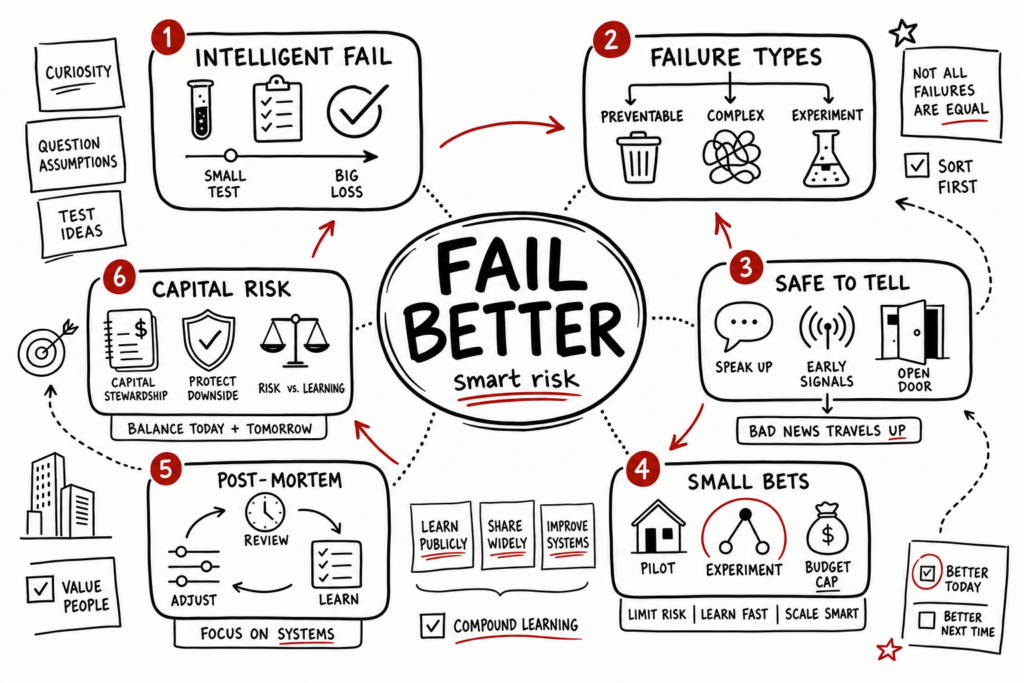
What is the Right Kind of Wrong summary for leaders?
This Right Kind of Wrong summary is for real-estate founders, executives, and growth leaders evaluating Amy C. Edmondson’s argument that failure is not one thing, and treating it that way creates bad strategy. In Right Kind of Wrong, Edmondson defines intelligent failure as a failure that occurs in new territory, in pursuit of a valuable goal, with a hypothesis, and at the smallest practical scale. The strategic implication is simple: do not celebrate failure broadly; build failure literacy so your team can separate preventable errors from useful experiments. For capital-intensive businesses, that distinction matters. A bad acquisition process, a sloppy underwriting assumption, and a controlled prop-tech pilot should not be discussed with the same language, budget tolerance, or leadership response.
Amy C. Edmondson, the Harvard Business School professor best known for psychological safety, has written a business book review readers will find more operational than inspirational. The official publisher page for Right Kind of Wrong positions the book around learning from failure, but its sharper value is managerial: it gives leaders a vocabulary for diagnosing failure before culture turns defensive or reckless. For real-estate leaders, that vocabulary is timely. The 2024–2025 operating environment has pushed firms into new markets, AI-enabled workflows, portfolio pivots, capital-stack experimentation, and service-model redesign. The risk is not experimentation. The risk is confusing experimentation with discipline.
Who Should Read It
Read this if you are running growth bets where uncertainty is real and capital exposure is meaningful: entering a new submarket, testing a differentiated brokerage model, launching a prop-tech pilot, redesigning asset management processes, or moving into a new client segment. This is also a strong fit for CEOs, operating partners, team leaders, and investors who sense that their organization says it values learning but punishes inconvenient information.
If you are looking for a tactical real-estate playbook, this is not that. It will not tell you whether to buy, sell, hire, expand, or pause. Its value is upstream. It helps you ask better questions before you scale a decision. That makes it especially useful for leadership teams that already have ambition, capital, and initiative, but inconsistent post-mortems.
Readers familiar with Edmondson’s earlier work on psychological safety will recognize the foundation. Her Harvard Business School faculty profile reflects the long arc of her research: teams perform better when people can speak honestly about risk, uncertainty, and mistakes. In this book, that idea becomes more precise. Psychological safety leadership is not about being nice. It is about making truth-telling operationally safe enough that expensive errors surface while they are still small.
Core Idea
The core idea is that failure comes in different types, and competent leaders must respond differently to each type. Edmondson’s framework separates failures that arise from carelessness or process breakdown from failures that occur in complex systems and failures that emerge from disciplined exploration. That distinction is the spine of the book.
For a real-estate executive, this matters because the word failure is often too blunt. A missed compliance step is not the same as a leasing strategy that underperforms in a market nobody fully understood. A poorly documented capital call process is not the same as a limited pilot of AI-assisted client follow-up. The first demands process correction and accountability. The second may demand learning, iteration, and clearer hypotheses.
This is where failure literacy becomes a leadership asset. The book does not argue that failure is good. It argues that undifferentiated reactions to failure are costly. If every error is punished, people hide the truth. If every failure is celebrated, standards decay. The useful middle is disciplined classification: what happened, why did it happen, what type of failure was it, what should change, and should we repeat the experiment differently?
Best Takeaways
1. Intelligent failure needs boundaries
The most useful concept in the book is intelligent failure. For ambitious leaders, the phrase can be tempting to overuse. Edmondson’s definition prevents that. A failure is intelligent only when it happens in new territory, serves a credible purpose, is informed by what is already known, and is kept small enough to generate learning without creating unnecessary damage.
In real estate, that could mean testing a new listing presentation with 20 high-intent prospects before retraining an entire sales organization. It could mean piloting a resident-retention service in one asset class before rolling it across the portfolio. It could mean setting a loss limit on a new marketing channel before the team declares the channel either brilliant or useless.
2. The language leaders use sets the risk culture
One of the stronger leadership lessons from Right Kind of Wrong is that teams listen closely to how leaders react after bad news. If the first response is blame, the second wave of information disappears. If the first response is vague reassurance, no one learns much. The better response is calm classification: Was this preventable? Was this complexity? Was this intelligent experimentation? What evidence do we have?
That may sound simple, but in high-performance cultures it is rare. Senior teams often move too quickly from disappointment to solution. Edmondson pushes leaders to pause long enough to locate the failure before prescribing the fix.
3. Psychological safety is not softness
This is the book’s most important correction for skeptical executives. Psychological safety is sometimes misread as comfort culture. Edmondson’s work argues the opposite: teams need candor precisely because the stakes are high. A development firm, luxury brokerage, investment team, or prop-tech-enabled operator does not benefit from people protecting each other’s egos. It benefits from early warnings, clean data, and fast escalation.
The best practical test is this: how long does it take for frontline evidence to reach the room where capital decisions are made? If leasing feedback, buyer objections, tech-adoption friction, or underwriting concerns are filtered until they sound safe, the organization is learning too slowly.
4. Post-mortems should happen before the corpse is cold
The book reinforces a habit many elite operators still underuse: build review rituals into the work while memory is fresh. A simple after-action review can ask five questions: What did we expect? What happened? What surprised us? What did we learn? What will we change before the next test?
For executives, the KPI is not how many failures you had. Better indicators include cycle time from issue detection to leadership visibility, percentage of experiments with written hypotheses, pilot budget variance, learning captured before scale, and number of stopped initiatives that prevented larger losses. Those metrics show whether failures are moving the organization forward or merely accumulating as expensive stories.
Where It Falls Short
This Right Kind of Wrong review would be incomplete without the caveats. First, the book is conceptually strong but not always industry-specific. Readers in real estate, private equity, brokerage, development, or asset management will need to translate the framework into their own decision architecture. Edmondson provides the lens; you supply the operating cadence.
Second, leaders who have already read deeply in innovation, lean startup methods, and psychological safety may find some of the territory familiar. The distinction between smart experiments and sloppy execution is not new. What Edmondson does well is consolidate the distinction in a way that is credible, memorable, and executive-friendly.
Third, the book can make failure classification sound cleaner than it feels in real time. In capital-intensive environments, the facts are often incomplete, incentives are tangled, and reputational pressure is high. A failed market entry may include preventable assumptions, external volatility, and intelligent learning all at once. The framework still helps, but leaders should not expect it to remove judgment. It improves judgment; it does not replace it.
How to Apply It
The best strategy lessons from Right Kind of Wrong start before the failure occurs. Do not wait for a painful outcome to decide what kind of learning your organization values. Build the distinctions into planning, governance, and debriefs.
Define the bet before funding it
For every new market, technology, partnership, or service model, require a one-page experiment brief. Include the hypothesis, the upside, the known risks, the smallest viable test, the budget cap, the decision date, and the evidence required to continue. This turns ambition into testable strategy.
Separate accountability from blame
When something goes wrong, ask whether the team followed a sound process. If not, fix the process and address the behavior. If yes, evaluate what the market taught you. This protects standards without punishing smart exploration.
Create a failure taxonomy for leadership meetings
Use three categories: preventable failure, complexity-driven failure, and intelligent failure. Require leaders to classify material misses before discussing remedies. The category determines the response. Preventable failures need controls. Complexity failures need sensing and adaptation. Intelligent failures need learning capture and possible iteration.
Reward early signal, not heroic recovery
Many organizations quietly reward the person who rescues a project late while ignoring the person who flagged the issue early. Flip that. Recognize fast escalation, clean evidence, and disciplined stopping. In real estate, not doing a bad deal can be as valuable as finding a good one.
Install a learning threshold
Before scaling any pilot, require evidence from a defined sample. For example: at least 30 qualified customer interactions, 90 days of operating data, or a pre-set adoption threshold such as 60 percent active usage by the target team. The exact threshold depends on the initiative, but the principle is consistent: no scale without learning.
Right Kind of Wrong Key Takeaways for Real-Estate Leaders
The strongest Right Kind of Wrong key takeaways are practical: name the type of failure, keep experiments small, make bad news safe to report, and treat learning as a management system rather than a motivational slogan. The book is not a permission slip to lose money. It is a warning against losing money without extracting intelligence.
So, should I read Right Kind of Wrong? Yes, if your firm is experimenting and you want a cleaner operating language for risk, learning, and accountability. Maybe not, if you want a real-estate-specific tactics manual or a radically new innovation theory. As an Amy C. Edmondson book summary for executives, the verdict is clear: the framework is worth your time if you implement it in meetings, metrics, and decision gates, not just in leadership off-sites.
For RE Luxe Leaders readers, the application is straightforward. In a market where capital is expensive, clients are more selective, and technology is changing the work, the winners will not be the firms that avoid being wrong. They will be the firms that know which wrongs are unacceptable, which are inevitable, and which are intelligent enough to fund carefully.
If you want more sharp strategy briefings for ambitious real-estate leaders, read the latest RE Luxe Leaders reviews and market notes, or book a confidential strategy call to pressure-test your next growth move.